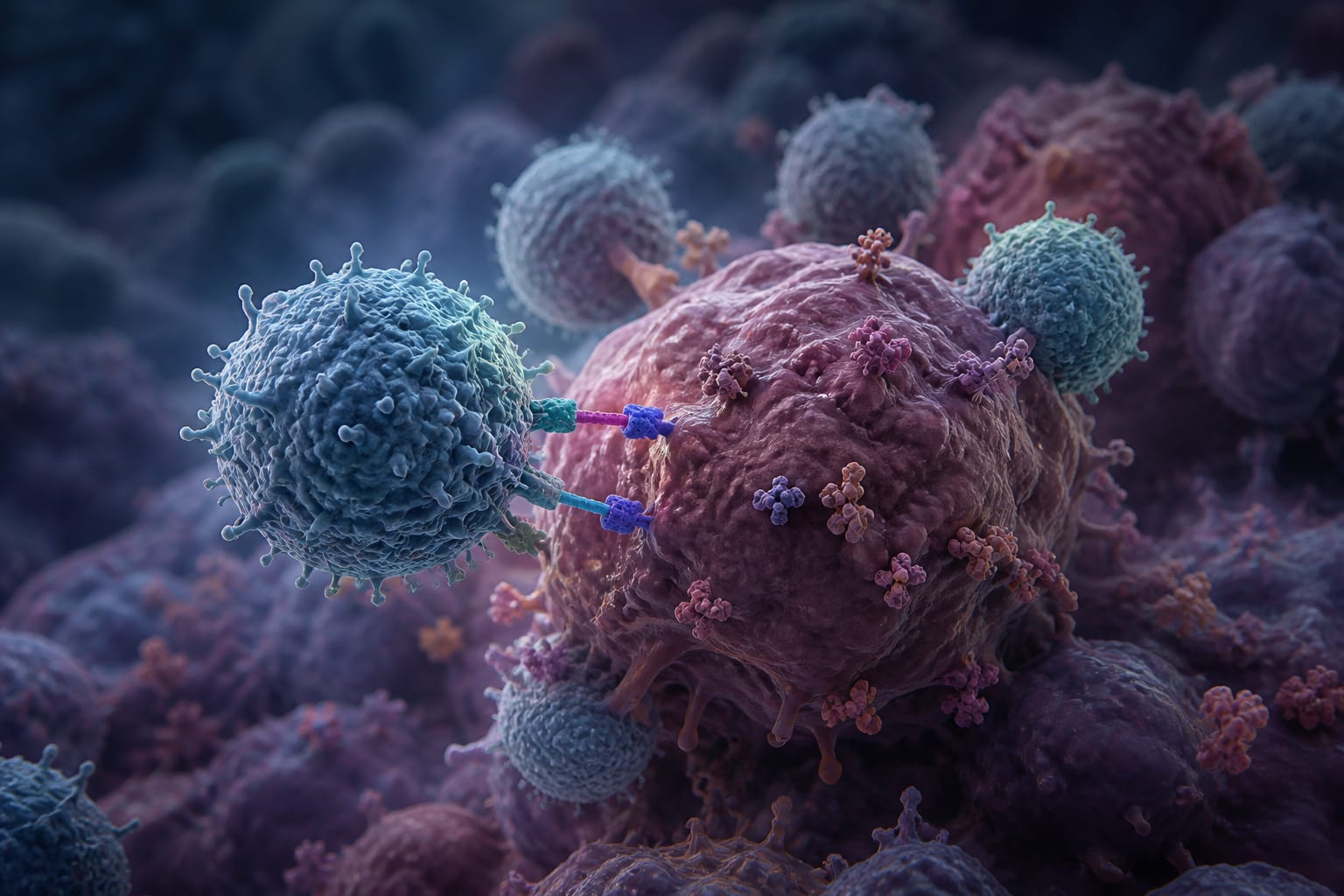
To develop and evaluate a CAR T-cell platform that senses the central nervous system (CNS) before activating tumor-targeting activity against diffuse midline glioma (DMG).
Approach:
B-SYNC design: Engineered T cells use synthetic Notch receptors to recognize brain-associated brevican (BCAN), triggering CAR expression against either EphA2 or IL-13Rα2.
Preclinical testing: Researchers assessed tumor killing in laboratory experiments and tested the cells in mouse models using intravenous or ventricular administration.
Key Findings:
In laboratory experiments, B-SYNC cells killed DMG cells only after exposure to BCAN; conventional CAR T cells killed cells without BCAN exposure.
After intravenous treatment, tumors regressed completely in 7 of 14 mice in one model and 4 of 11 in another; survival was significantly extended compared with conventional CAR T cells.
Ventricular administration eliminated tumors in all 19 treated mice across two models. Surviving animals resisted tumor rechallenge.
B-SYNC cells showed reduced exhaustion, improved persistence, and greater enrichment of naïve and stem cell memory-like populations.
An alternative B7-H3/IL-13Rα2 circuit caused fatal neurotoxicity after ventricular delivery, attributed to B7-H3 expression in healthy brain tissue. A modified B7-H3-targeting circuit cleared tumors without detectable neurotoxicity in immunocompetent mice.
Interpretation:
The researchers report that combining a CNS-associated molecular switch with tumor-targeting receptors produced antitumor activity in preclinical DMG models. They state that further investigation is needed to determine optimal dosing, administration routes, and safety controls.
Limitations:
The findings are preclinical and were reported in mouse models and laboratory experiments.
Optimal dosing, administration routes, and safety controls remain to be investigated.
Conclusion:
The study describes a brain-sensing CAR T-cell platform designed to restrict tumor-targeting activity to the CNS.