A multi-task deep learning framework for simultaneous prediction of microsatellite instability and tumor mutational burden in gastric cancer from histopathological images - Summary - MDSpire
Advertisement
A multi-task deep learning framework for simultaneous prediction of microsatellite instability and tumor mutational burden in gastric cancer from histopathological images
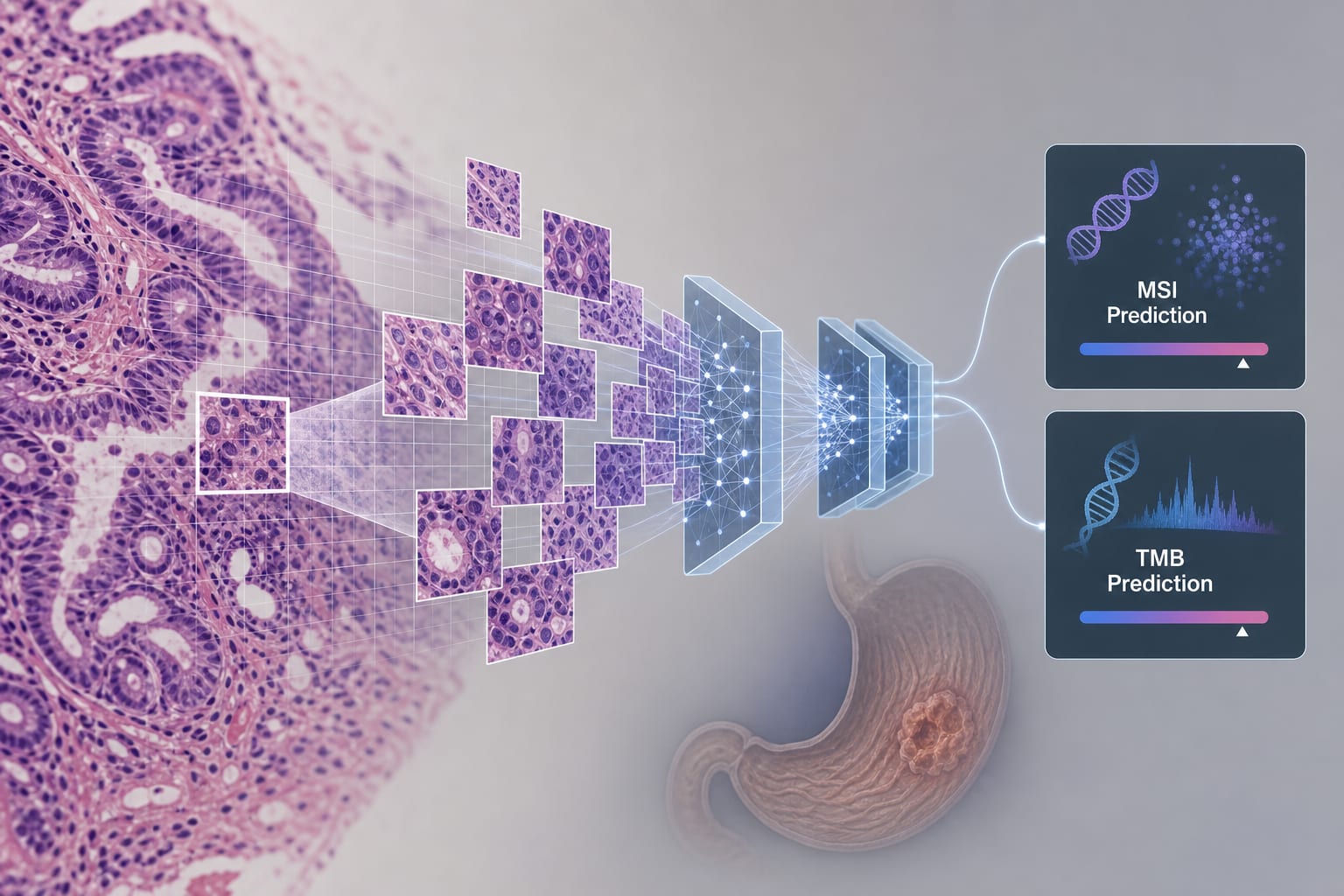
To develop a multi-task deep learning framework that simultaneously predicts microsatellite instability (MSI) and tumor mutation burden (TMB) using routine histopathological images and clinical data, thereby enhancing patient selection for immunotherapy.
Key Findings:
The model achieved AUC values of 0.828 for MSI and 0.836 for TMB on the internal TCGA test set, indicating strong predictive performance.
Performance on the external validation set yielded AUCs of 0.78 for MSI and 0.74 for TMB, indicating a moderate decrease due to domain shifts, which may affect clinical applicability.
Attention heatmaps provided insights into the spatial concordance of predictive regions for MSI and TMB, suggesting areas for further biological investigation.
Interpretation:
The study demonstrates the feasibility and accuracy of a unified, multi-task deep learning framework for predicting key immunotherapy biomarkers in gastric cancer using routine histopathological images.
Limitations:
External validation highlighted challenges in generalizability across different scanners, which may limit the model's application in diverse clinical settings.
Performance decreased on the external validation set compared to the internal test set, raising concerns about the model's robustness in real-world scenarios.
Conclusion:
The framework represents a significant innovation with potential to lower barriers to precision oncology in clinical practice, serving as a cost-effective preliminary screening tool for MSI and TMB in gastric cancer, and warrants further research to enhance its generalizability.