TGMS-UNet: A dual-branch segmentation network for ultrasound endometrium based on sequence guidance and multi-scale feature correction - Summary - MDSpire
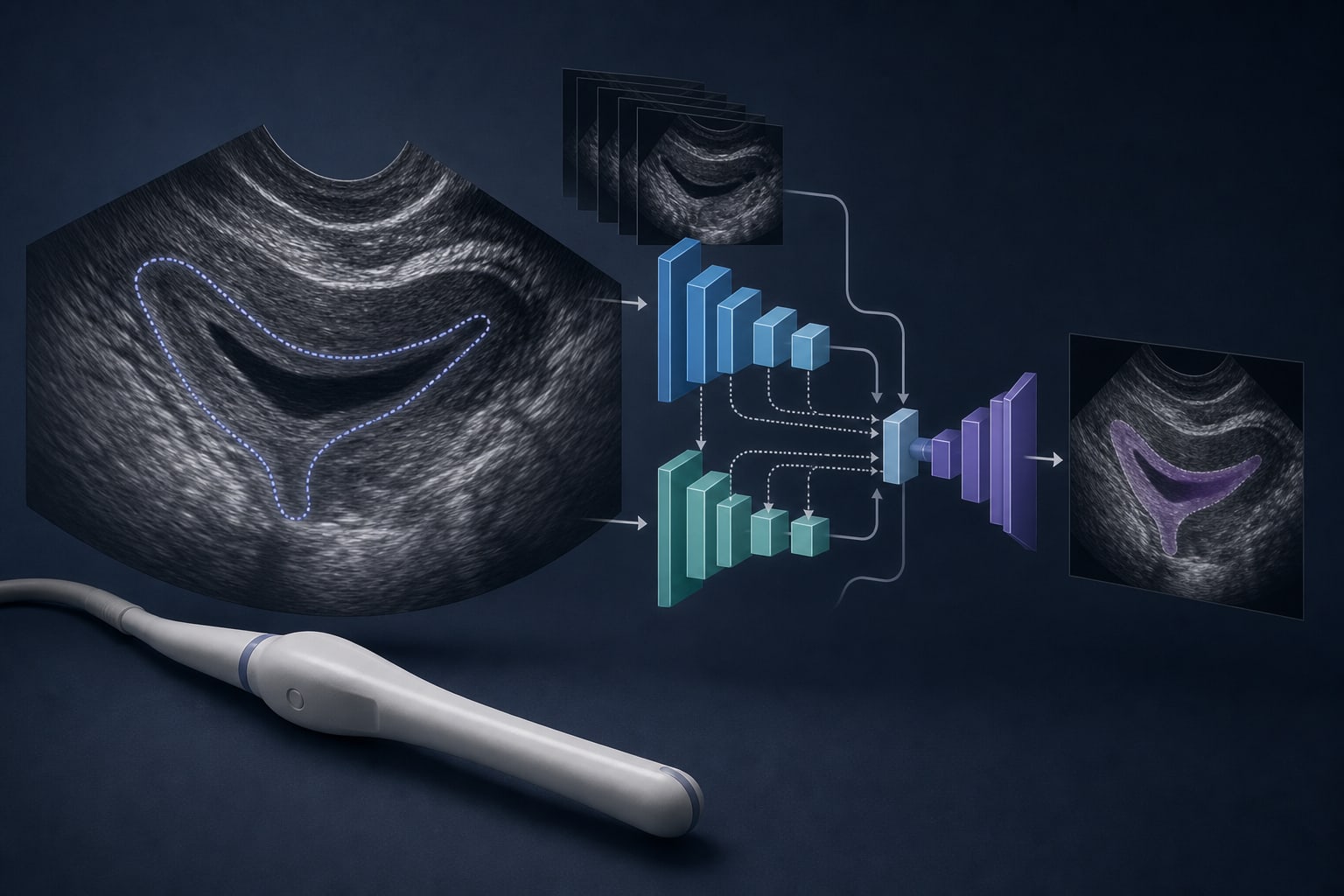
To propose a novel sequence-guided dual-branch segmentation network (TGMS-UNet) for accurate endometrial segmentation in ultrasound images, specifically addressing challenges such as noise interference and boundary ambiguity.
Approach:
Sequence-Guided Framework: TGMS-UNet encodes endometrial contours into distance-angle-based sequences, which help to resolve ambiguities in ultrasound images by incorporating clinical reasoning.
Feature Correction and Adaptive Fusion: A feature correction and adaptive fusion module is designed to mitigate multi-scale feature misalignment, allowing for dynamic adjustment of fusion ratios based on the input data.
Key Findings:
TGMS-UNet outperforms state-of-the-art segmentation methods across multiple metrics.
The model effectively incorporates clinical prior knowledge to enhance segmentation accuracy.
Interpretation:
TGMS-UNet demonstrates improved segmentation performance by integrating geometric contour information and addressing feature misalignment, as evidenced by the results.
Limitations:
The study may be limited by the specific datasets used for training and validation, which may not represent the full diversity of clinical scenarios.
Further validation on a wider range of clinical datasets is necessary to generalize the findings.
Conclusion:
TGMS-UNet offers a solution for endometrial segmentation in ultrasound imaging, aiming to enhance diagnostic objectivity.
A target trial emulation found small excess risks following fertility treatment, although the observed associations may largely reflect underlying infertility and increased medical surveillance.