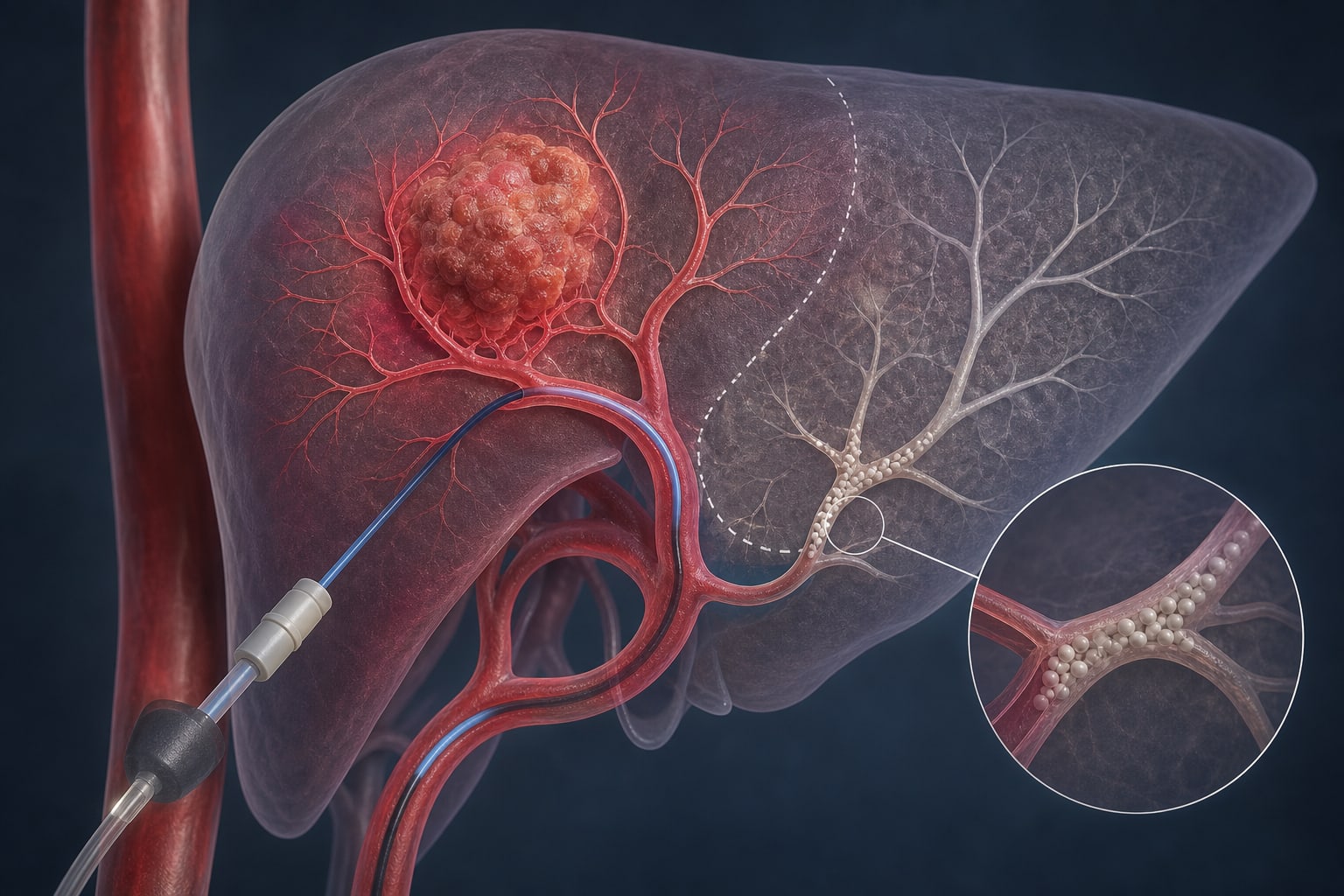
To investigate whether rapidly resorbable gelatin microspheres (RGMs) can protect non-tumorous liver (NTL) by temporarily modulating arterial flow during Y-90 radioembolization.
Approach:
Study design: SEGWAY (NCT06229080) was a prospective, single-arm phase II trial planned for 20 adults with liver cancer.
Eligibility: Participants had Child–Pugh class A status and NTL volume of at least 50% of the Y-90 perfused liver volume; patients with vascular invasion or biliary–enteric anastomosis were excluded.
Intervention and planning: Operators used RGMs to protect selected NTL territories during Y-90 delivery. Treatment planning used the partition model and MAA SPECT/CT; operators selected microsphere type, activity, and prescribed tumor dose.
Key Findings:
The supplied context describes the trial rationale and methods but does not report clinical outcomes or quantitative dosimetric results.
Interpretation:
The study was designed to assess temporary RGM-mediated flow modulation and NTL protection during Y-90 radioembolization; efficacy cannot be determined from the provided context.
Limitations:
The trial was single-arm and planned to enroll 20 patients.
The provided context does not include results.
Prescribed tumor dose and microsphere type were determined by operators, and no fixed tumor or NTL dose target was specified.
“Caribou’s story has taken a heartbreaking turn,” says CEO Rachel Haurwitz, with the CRISPR-focused biotech set to discontinue vispa-cel and CB-011, and reduce its workforce