An innovative 2D optical navigation workflow for percutaneous pedicle screw fixation in thoracolumbar fractures: comparison with O-arm 3D navigation - Summary - MDSpire
Advertisement
An innovative 2D optical navigation workflow for percutaneous pedicle screw fixation in thoracolumbar fractures: comparison with O-arm 3D navigation
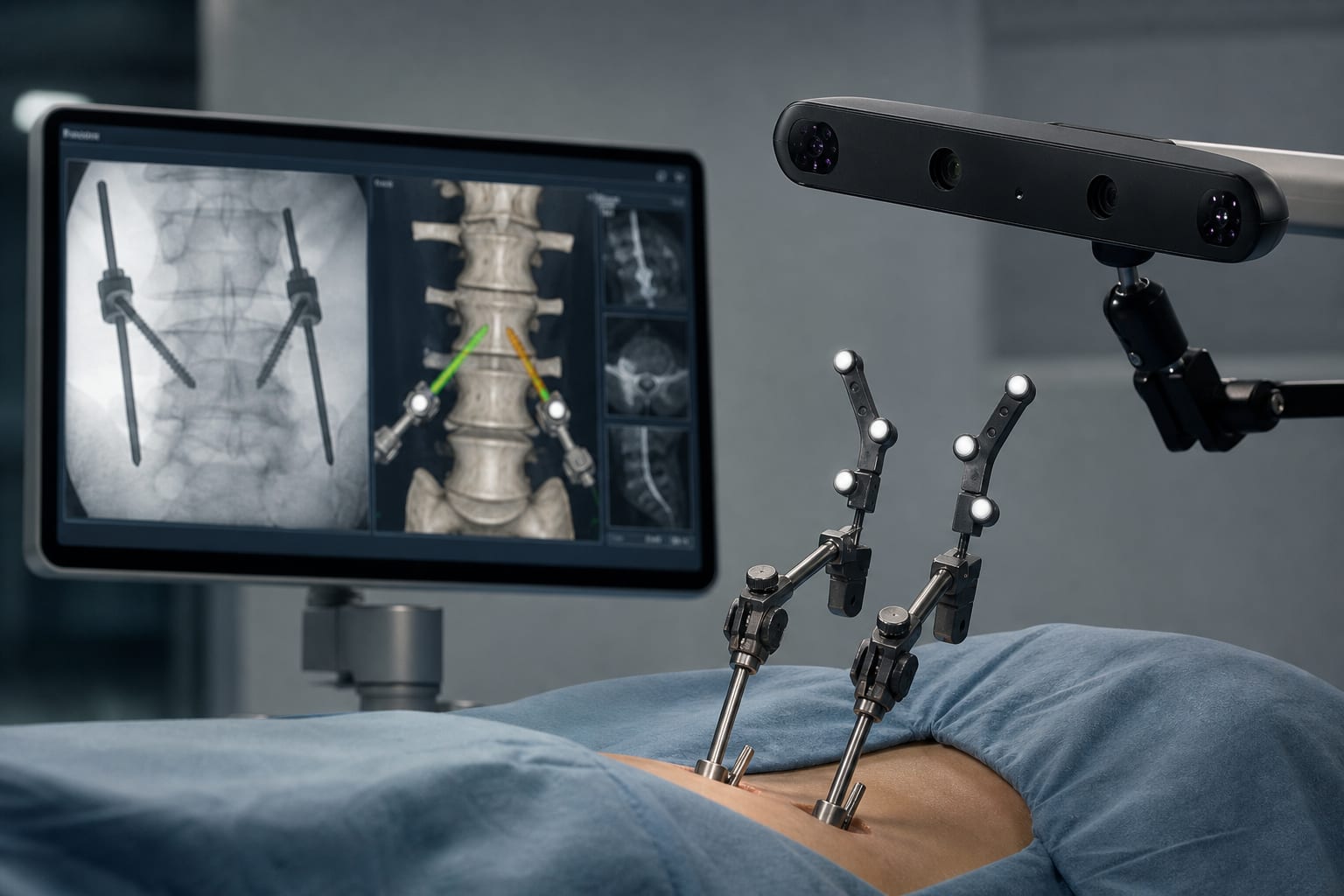
To compare clinical outcomes of 2D optical navigation and 3D navigation systems for percutaneous pedicle screw fixation in thoracolumbar fractures, focusing on operative time, radiation dose, screw placement accuracy, clinical recovery, complications, and learning curves.
Approach:
Study Design: Retrospective analysis of 105 patients with TLFs who underwent PPSF from January 2020 to February 2024, divided into 2D-navigation and 3D-navigation groups.
Outcome Measures: Intraoperative and postoperative outcomes including operative time, radiation dose, screw accuracy, and clinical recovery assessed by VAS and ODI were compared.
Learning Curve Analysis: Evaluated using cumulative sum (CUSUM) analysis.
Key Findings:
The 2D-navigation group had significantly shorter operative times (94.71 ± 14.38 min) compared to the 3D-navigation group (105.40 ± 11.22 min, P < 0.05).
Radiation doses were lower in the 2D-navigation group (81.0 ± 16.9 µGy·m2) than in the 3D-navigation group (137.2 ± 43.0 µGy·m2, P < 0.05).
Screw placement accuracy was comparable between groups (2D: 99.2% vs. 3D: 98.1%, P > 0.05).
Both groups showed significant postoperative improvements in VAS and ODI scores with no significant differences (P > 0.05).
Proficiency was achieved earlier with 2D navigation (15 cases) than with 3D navigation (29 cases).
Interpretation:
2D optical navigation reduced operative time and radiation exposure while maintaining comparable screw placement accuracy and clinical outcomes.
Limitations:
The retrospective design may introduce selection bias.
The single-center study limits generalizability.
Conclusion:
2D navigation-assisted PPSF may improve procedural efficiency and represents an alternative for minimally invasive treatment of thoracolumbar fractures.