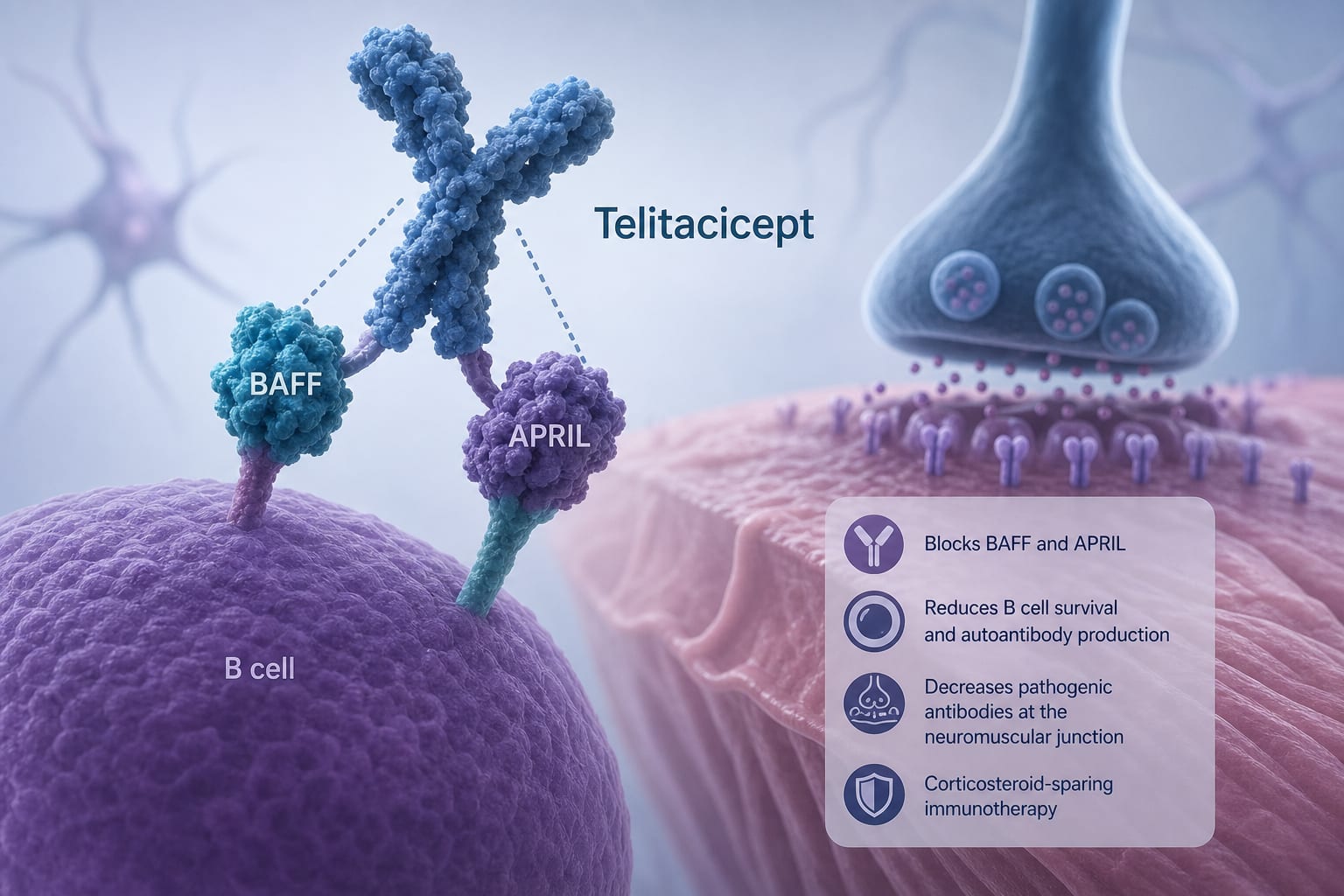
To evaluate the clinical response, tolerability, and potential corticosteroid-sparing benefit of telitacicept in juvenile refractory gMG.
Key Findings:
In the index case, telitacicept reduced the MG-ADL score from 3 to 0 and the QMG score from 10 to 3 by week 12.
By week 32, the MG-ADL score remained at 0, and the QMG score decreased to 2, with a 41.6% reduction in corticosteroid dose.
Three out of four patients achieved marked improvement (≥3-point reduction in MG-ADL score) at 3 months, and all showed sustained improvement by 5–6 months.
No severe adverse events were reported; mild injection-site reactions and a mild upper respiratory infection were noted.
Interpretation:
The findings suggest that telitacicept may be an effective treatment option for juvenile patients with refractory generalized myasthenia gravis, demonstrating significant improvements in both MG-ADL and QMG scores. The sustained reduction in corticosteroid dosage indicates a potential corticosteroid-sparing effect, which is crucial for minimizing long-term side effects associated with corticosteroid therapy. The absence of severe adverse events further supports the safety profile of telitacicept in this population, although mild adverse effects were observed.
Limitations:
The study is based on a small number of cases, limiting the generalizability of the findings.
Further large-scale prospective studies are needed to confirm these observations.
Conclusion:
Telitacicept shows promise as a treatment for juvenile refractory generalized myasthenia gravis, with notable clinical improvements and a favorable safety profile. However, due to the limited number of cases, further research is essential to validate these results and establish long-term efficacy and safety in a broader patient population.
In a multicenter registry study, genetic diagnoses were associated with substantially lower cognitive, language, and motor scores; while birth weight, surgical timing, hospitalization burden, and caregiver education were also associated with outcomes.