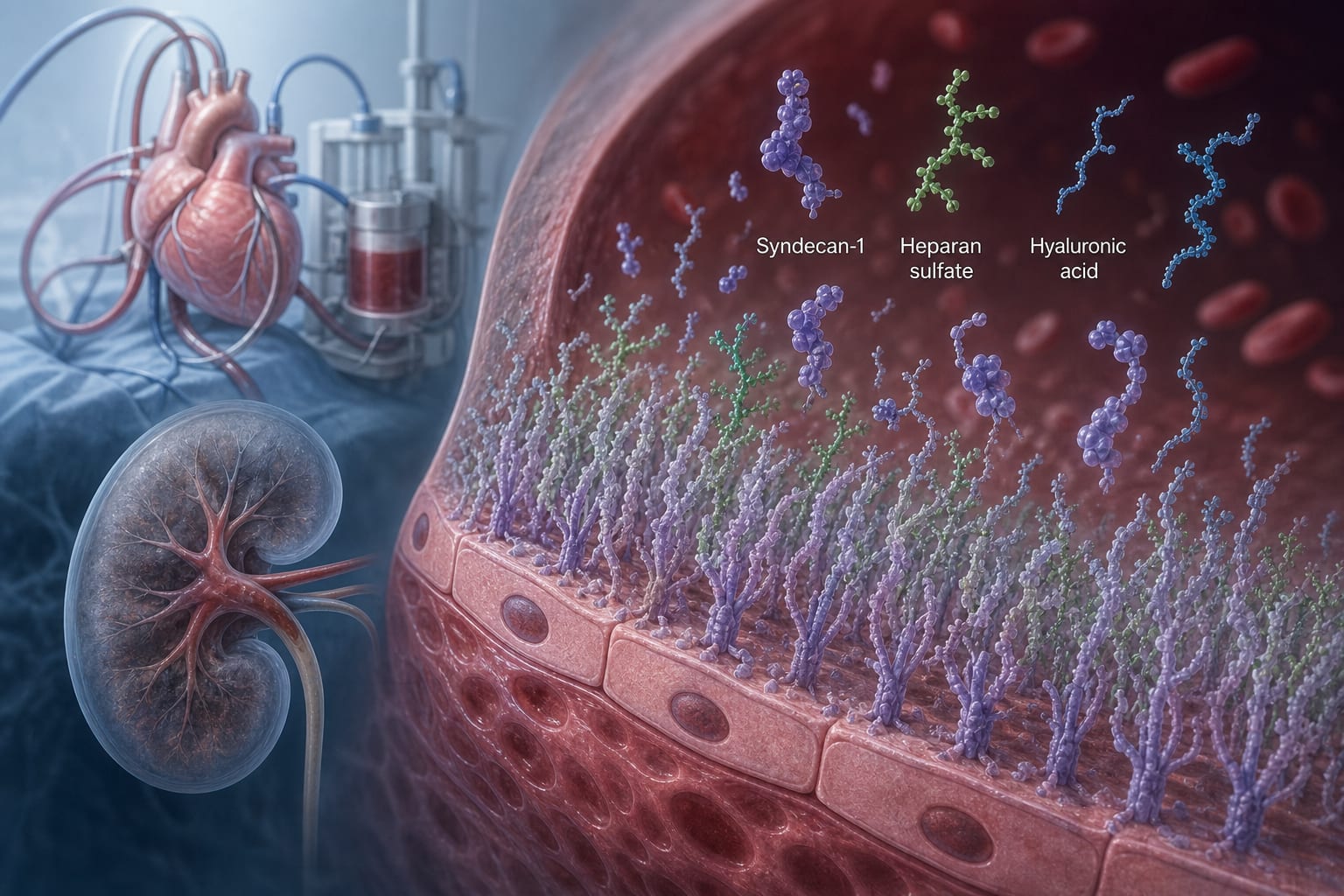
Association between circulating biomarkers of endothelial glycocalyx degradation and postoperative acute kidney injury in patients undergoing cardiac surgery with cardiopulmonary bypass - Summary - MDSpire
Advertisement
Association between circulating biomarkers of endothelial glycocalyx degradation and postoperative acute kidney injury in patients undergoing cardiac surgery with cardiopulmonary bypass
To investigate the association between circulating biomarkers of endothelial glycocalyx degradation and postoperative acute kidney injury in patients undergoing cardiac surgery with cardiopulmonary bypass.
Approach:
Study Design: Single-center retrospective observational study including 152 patients who underwent cardiac surgery with cardiopulmonary bypass.
Biomarker Measurement: Syndecan-1, hyaluronic acid, and heparan sulfate were measured before and at the end of cardiopulmonary bypass.
AKI Definition: Postoperative acute kidney injury was defined according to the Kidney Disease: Improving Global Outcomes criteria.
Statistical Analysis: Between-group comparisons, paired analyses, logistic regression, and receiver operating characteristic analysis were performed.
Key Findings:
Postoperative acute kidney injury occurred in 43 of 152 patients, with an incidence of 28.3%.
Patients with acute kidney injury were older and had worse baseline renal function.
Syndecan-1 and heparan sulfate levels were higher in the acute kidney injury group at the end of cardiopulmonary bypass, whereas hyaluronic acid did not differ significantly between groups.
Syndecan-1 showed the best discriminatory performance among the biomarkers, with an area under the curve of 0.743.
Interpretation:
Limitations:
Single-center study may limit generalizability.
Retrospective design may introduce bias.
Conclusion:
Syndecan-1 measured at the end of cardiopulmonary bypass is associated with postoperative acute kidney injury and shows the best discriminatory performance among the biomarkers evaluated.
In an observational US target trial emulation, glucagon-like peptide-1 receptor agonist initiation was associated with about 3 to 4 more ischemic optic neuropathy cases per 10,000 patients over 18 months than two comparator drug classes.