Association of serum 25-hydroxyvitamin D levels with indicators of target organ damage in patients with diabetes: a cross-sectional study - Summary - MDSpire
Advertisement
Association of serum 25-hydroxyvitamin D levels with indicators of target organ damage in patients with diabetes: a cross-sectional study
To assess serum 25-hydroxyvitamin D [25(OH)D] in relation to indicators of target organ damage in patients with diabetes.
Approach:
Study Design: Cross-sectional analysis of 372 adults with diabetes who underwent serum 25(OH)D testing.
Data Collection: Collected demographic characteristics, medical history, laboratory parameters, carotid ultrasonography, and electrophysiological examinations.
Statistical Analysis: Performed multivariable regression models and sensitivity analyses to examine associations.
Key Findings:
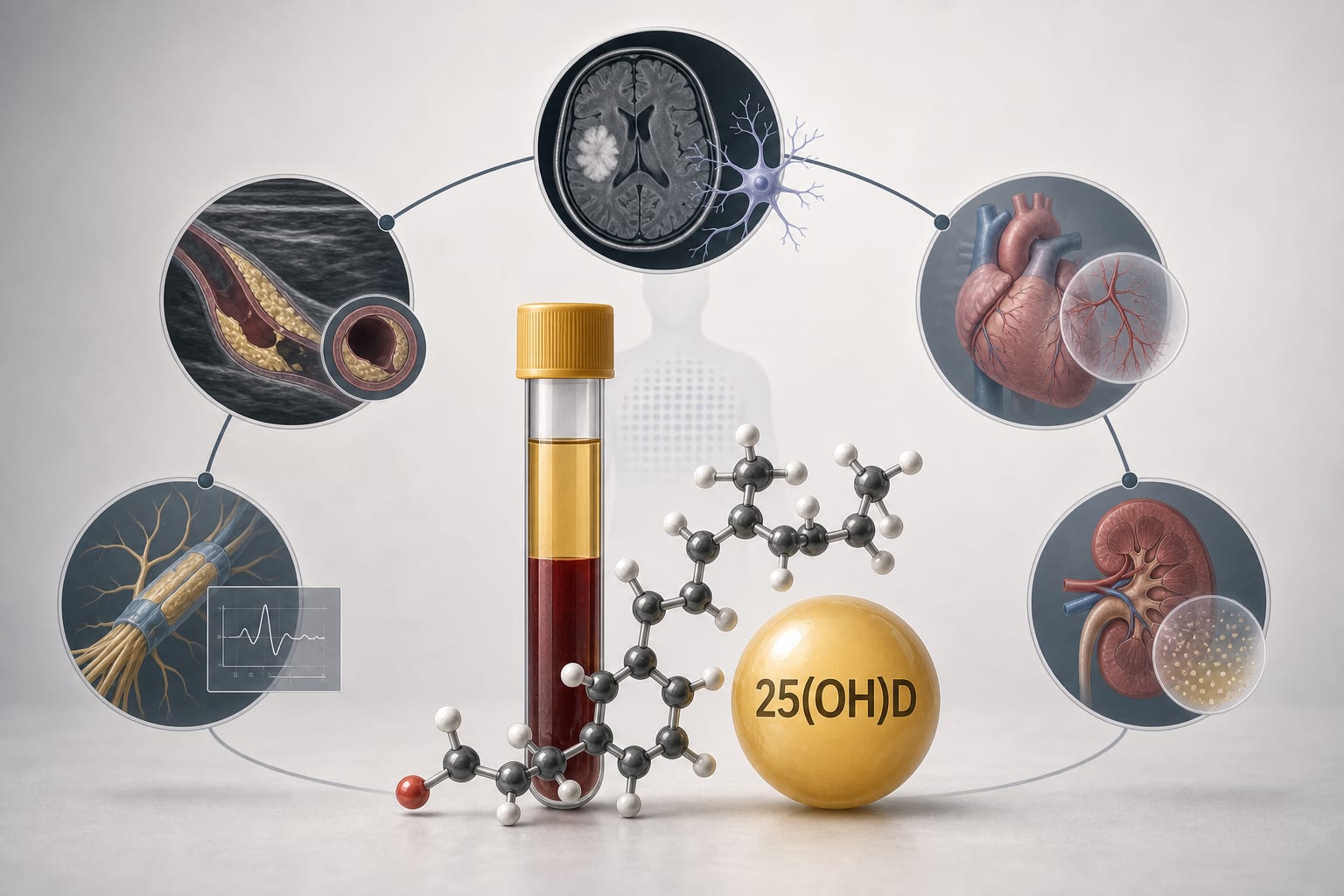
Serum 25(OH)D was inversely associated with peripheral nerve damage (OR = 0.941, 95% CI, 0.905–0.976; P = 0.001) and carotid plaque (OR = 0.942, 95% CI, 0.906–0.977; P = 0.002).
Higher serum 25(OH)D levels were associated with lower odds of urinary microalbumin (β = -0.035, 95% CI, -0.057 to -0.013; P = 0.002).
In continuous-variable models, higher serum 25(OH)D was linked to lower odds of cerebral infarction (OR = 0.896, 95% CI, 0.816–0.971; P = 0.013) and coronary heart disease (OR = 0.902, 95% CI, 0.835–0.966; P = 0.006).
Interpretation:
Lower serum 25(OH)D levels were associated with indicators of diabetes-related target organ damage.
Limitations:
Cross-sectional design limits causal inference.
Study population restricted to hospitalized patients may not represent the general diabetic population.
Conclusion:
Findings indicate an association between serum 25(OH)D and diabetes-related target organ damage.