To develop a robust and interpretable machine learning framework for arthritis risk prediction and to identify important risk factors associated with the disease.
Approach:
Datasets Used: Four datasets were utilized: BRFSS 2019, BRFSS 2021, NHIS 2020, and NHIS 2022.
Machine Learning Techniques: Evaluated 11 machine learning and deep learning architectures, including a custom stacked ensemble, with five resampling techniques and 9 imputation methods.
Performance Evaluation: Model performance was evaluated using AUROC, sensitivity, specificity, and balanced accuracy with fivefold cross-validation.
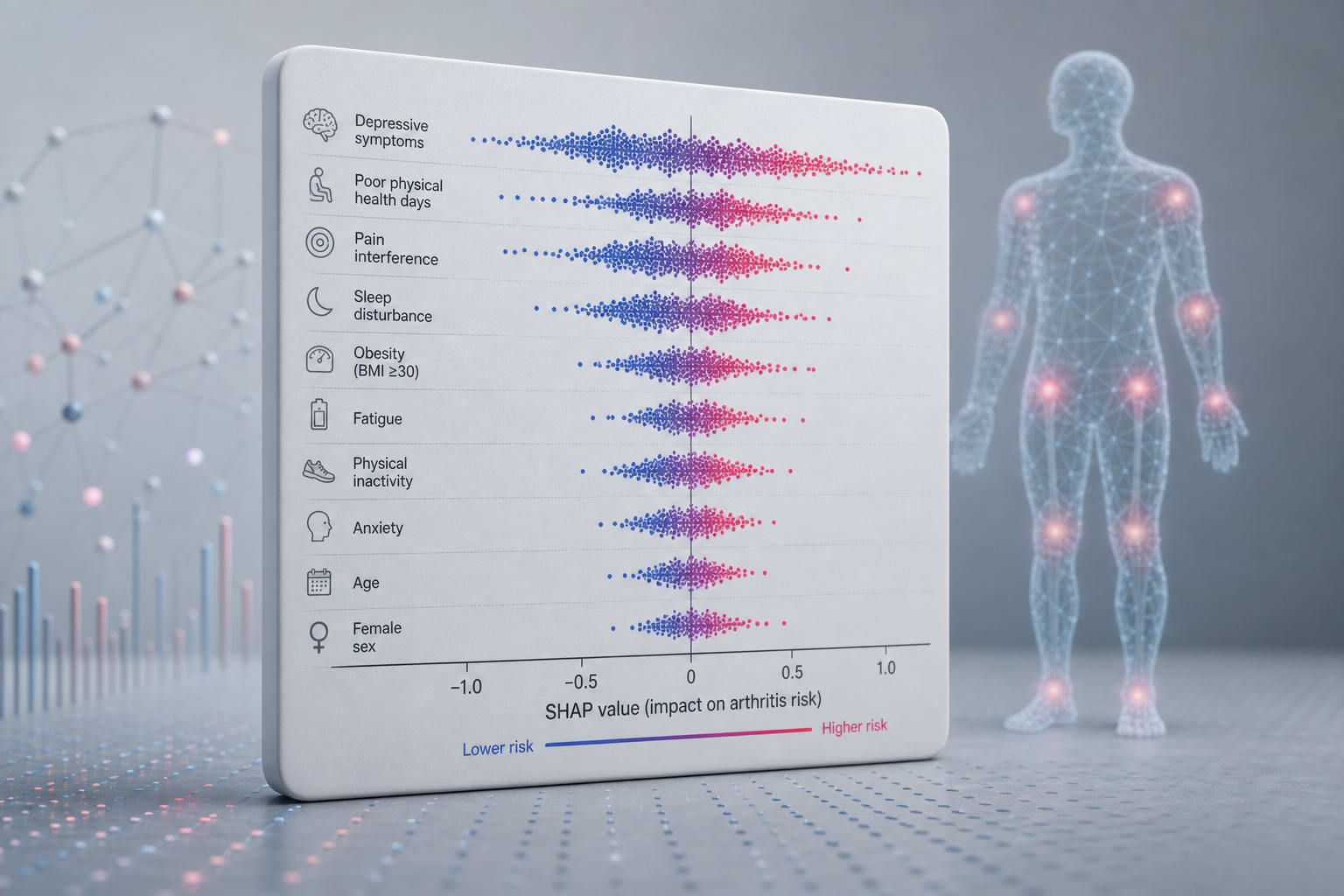
Feature Interpretability: SHapley Additive exPlanations (SHAP) was used for feature interpretability in predictions.
Key Findings:
The stacked ensemble with GAN imputation and random undersampling achieved the best performance with an AUROC of 0.8007 in the test set of BRFSS 2019.
The model maintained high performance across genders with AUROC of 0.808 for males and 0.800 for females in the test set of BRFSS 2021.
Higher age, walking difficulty, and high body mass index (BMI) were identified as top physical risk factors.
Parental separation was highlighted as a significant psychosocial factor influencing arthritis risk.
Interpretation:
The risk of arthritis is influenced by health, lifestyle, and childhood experiences, with SHAP analysis revealing key predictors such as age, walking difficulty, and BMI.
Limitations:
The study may be limited by the datasets used and the generalizability of the findings.
Potential biases in self-reported data from surveys.
Conclusion:
These results confirm important predictors of arthritis risk and provide an interpretable framework for understanding these influences.