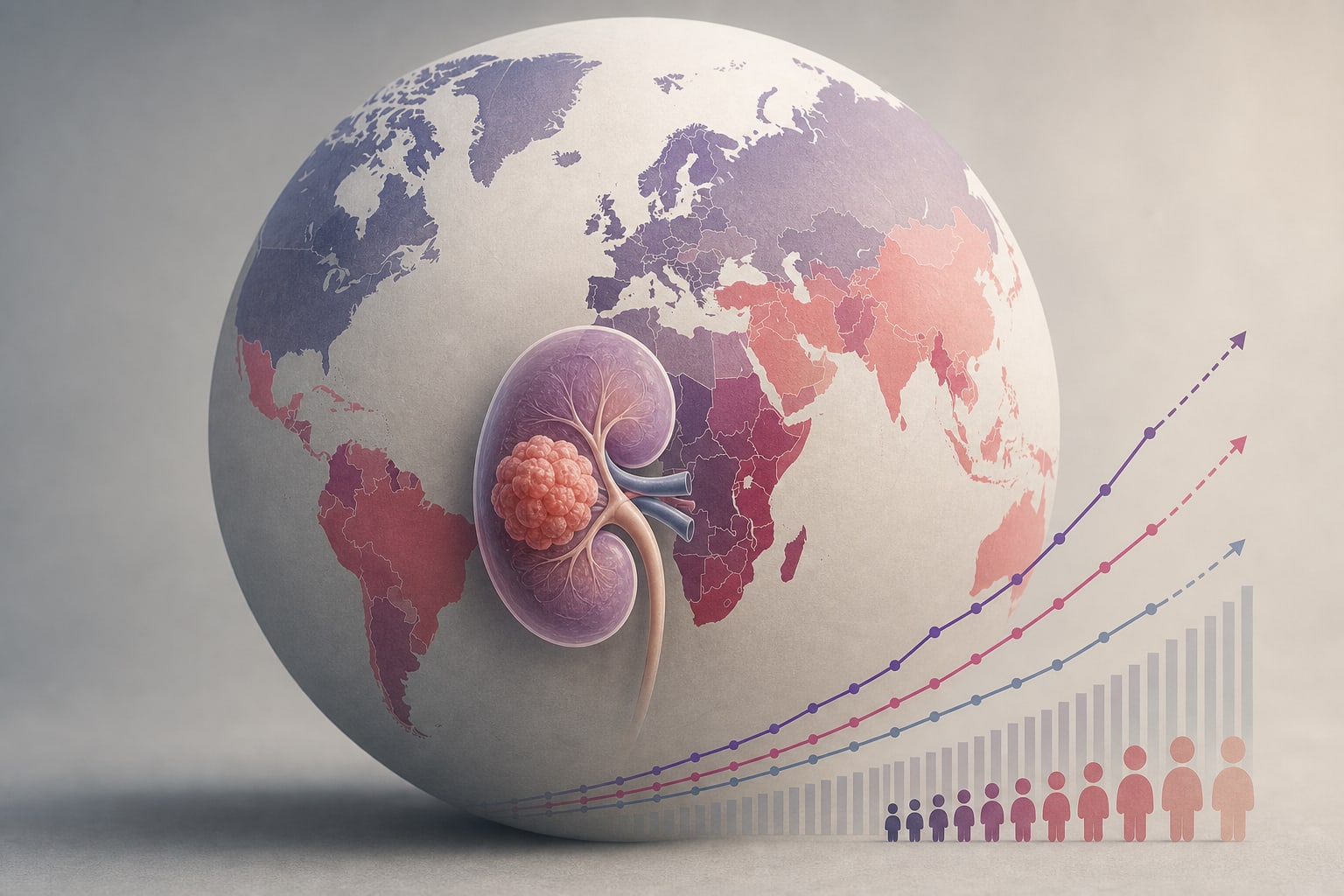
To analyze global trends, inequalities, and future burden of childhood kidney cancer (KC) from 1990 to 2021.
Approach:
Data Collection: Data on incidence, mortality, and disability-adjusted life years (DALYs) of KC among children aged 0–14 years were obtained from the Global Burden of Disease study 2021.
Analysis Methods: Incorporated estimated annual percentage change, joinpoint regression, slope index of inequality, concentration index for inequality assessment, and Bayesian age-period-cohort forecasting.
Key Findings:
In 2021, there were 9,576 incident cases, 3,063 deaths, and 268,049 DALYs globally due to childhood KC, with corresponding age-standardized incidence rate (ASIR), mortality rate (ASMR), and disability-adjusted life years rate (ASDR) of 0.48, 0.15, and 13.32, respectively.
The global burden of childhood KC declined overall from 1990 to 2021, with a steeper decline observed from 2018 to 2021.
The age-standardized incidence rate (ASIR) decreased by 4.87% per year from 2018 to 2021.
Mortality and DALY rates also showed significant declines, with ASMR and ASDR decreasing by 5.12% and 5.23% per year, respectively, from 2019 to 2021.
The burden of childhood KC was concentrated among children aged 0–4 years, with higher rates compared to older age groups.
Inequality metrics indicated that childhood KC mortality and DALYs were disproportionately concentrated in lower-SDI countries.
Interpretation:
Limitations:
The study primarily reflects the overall burden of childhood KC rather than specific subtypes like Wilms tumor.
Findings may not be generalizable to all pediatric cancers due to differences in epidemiological characteristics.
Conclusion:
While the burden of childhood KC has significantly reduced over the past three decades, further attention is needed to address health inequities.