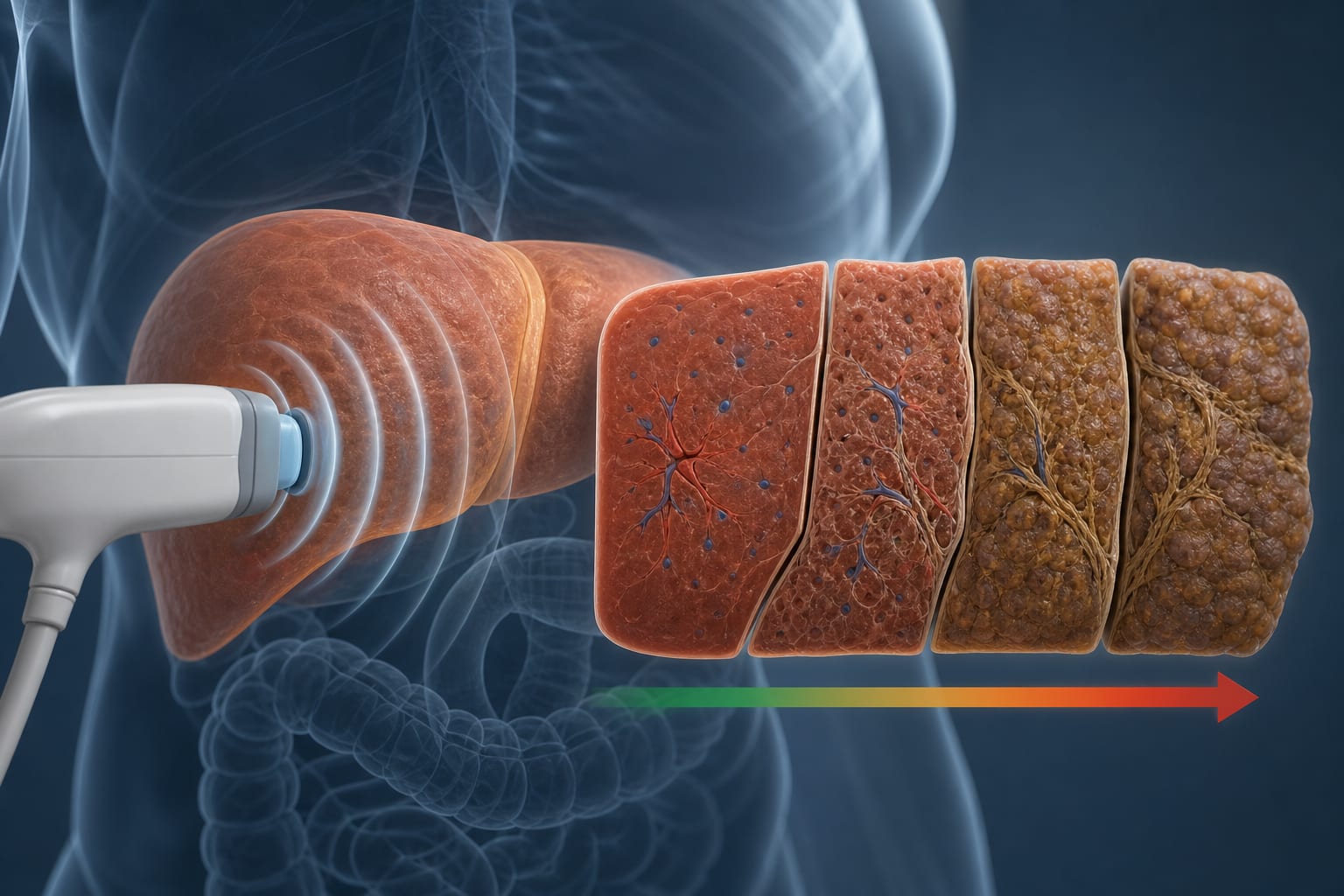
To investigate the correction value of inflammatory activity stratification on the diagnostic performance of liver stiffness measurement (LSM) for hepatic fibrosis in patients with autoimmune hepatitis (AIH), emphasizing the importance of accurate fibrosis assessment.
Key Findings:
A total of 86 AIH patients were enrolled, with a mean age of 54.1 years and a predominance of females (91.9%).
The area under the ROC curve (AUC) for diagnosing S≥2 fibrosis was 0.73 overall (95% CI: 0.62–0.83), with optimal cutoff at 8.2 kPa.
After inflammation stratification, the AUC increased to 0.85 (95% CI: 0.76–0.94) in the G1–G2 group and decreased to 0.69 (95% CI: 0.54–0.84) in the G3–G4 group.
A correction formula for the G3–G4 group improved AUC to 0.85 (95% CI: 0.76–0.93), sensitivity to 86.7%, and specificity to 69.2%.
Interpretation:
The diagnostic performance of LSM for fibrosis in AIH patients is significantly influenced by inflammatory activity, with severe inflammation causing pseudo-elevation of LSM, which has important implications for clinical practice.
Limitations:
The study is retrospective and may have inherent biases.
Further validation of the correction model is required before clinical implementation.
The potential impact of sample size on the findings should be acknowledged.
Conclusion:
The inflammation-stratified correction model significantly improves diagnostic accuracy for fibrosis staging in AIH patients.