Multifocal Noninvasive Deep Brain Stimulation to Enhance Cognition in Mild Cognitive Impairment: A Crossover - Summary - MDSpire

Multifocal Noninvasive Deep Brain Stimulation to Enhance Cognition in Mild Cognitive Impairment: A Crossover

  • By

  • Umberto Nencha

  • Monika Pupíková

  • Margaux di Natale

  • Pablo Maceira-Elvira

  • Martin Gajdoš

  • Elena Beanato

  • Stavriani Skarvelaki

  • Rebecca Jones

  • Isabel Ericson

  • Martin Lamoš

  • Andrea Nuti

  • Fabienne Windel

  • David Ondráček

  • Adam Šimo

  • Ela Vojtková

  • Klára Špunarová

  • Vincent Alvarez

  • Oana Simionescu

  • Giovanni B. Frisoni

  • Estelle Raffin

  • Irena Rektorová

  • Friedhelm C. Hummel

  • July 6, 2026

  • 0 min

Share

Objective:

To investigate whether dual-target, noninvasive neuromodulation of the striatum and cerebellum can improve working memory (WM) in individuals with mild cognitive impairment (MCI), particularly those with early nigro-striatal degeneration.

Approach:
  • Study Design: A quadruple-blind, randomized, placebo-controlled, crossover trial was conducted with patients diagnosed with amnestic MCI and mild cognitive impairment with Lewy bodies (MCI-LB), alongside age-matched healthy controls.
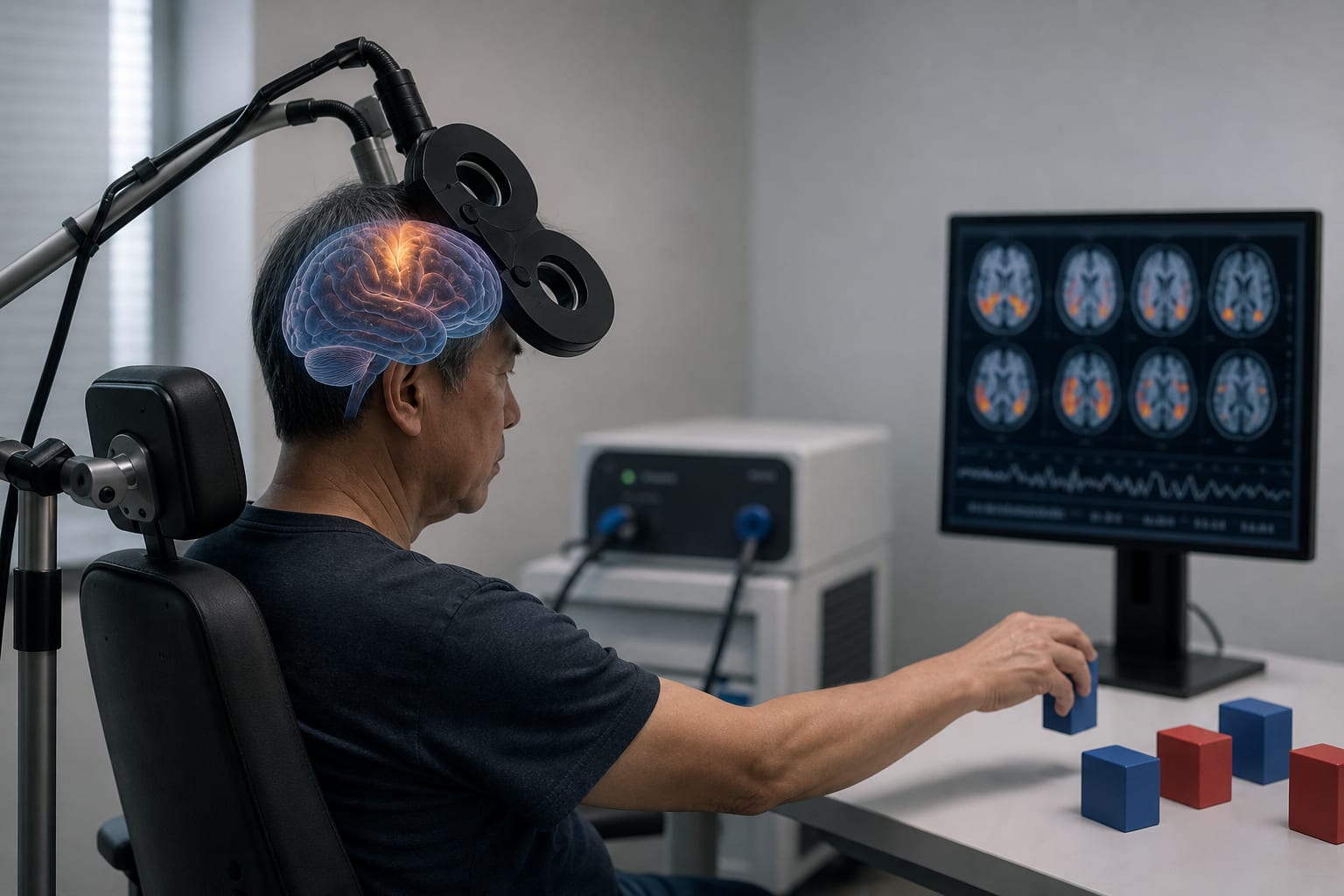
  • Stimulation Method: Transcranial magnetic stimulation (TMS) was applied to the left inferior cerebellar hemisphere, followed by striatal transcranial temporal interference stimulation (tTIS), utilizing two plasticity-inducing protocols.
Key Findings:
  • Patients with amnestic MCI showed greater impairment in cognitive functions compared to healthy controls and those with MCI-LB.
  • MCI-LB patients exhibited selective impairments in executive functions and visual memory.
  • The study assessed the impact of dual-target stimulation on WM performance during tasks manipulating distractor inhibition and memory load.
Interpretation:

The findings suggest that targeting both the striatum and cerebellum may provide a novel approach to enhance cognitive function in MCI patients, particularly in those with Lewy body pathology.

Limitations:
  • The study's sample size and duration may limit the generalizability of the findings.
  • Potential variability in individual responses to stimulation based on resting-state functional connectivity and gray matter volume was not fully explored.
Conclusion:

The dual-target stimulation approach may represent a promising strategy for cognitive rehabilitation in MCI, warranting further investigation.

Sources:

Original Source(s)

Related Content