Evaluation of Extravascular Lung Water Index in ARDS Patients Undergoing Veno-Venous ECMO: A Comparison of Transpulmonary Thermodilution and AI-Based Chest CT Analysis - Summary - MDSpire
Advertisement
Evaluation of Extravascular Lung Water Index in ARDS Patients Undergoing Veno-Venous ECMO: A Comparison of Transpulmonary Thermodilution and AI-Based Chest CT Analysis
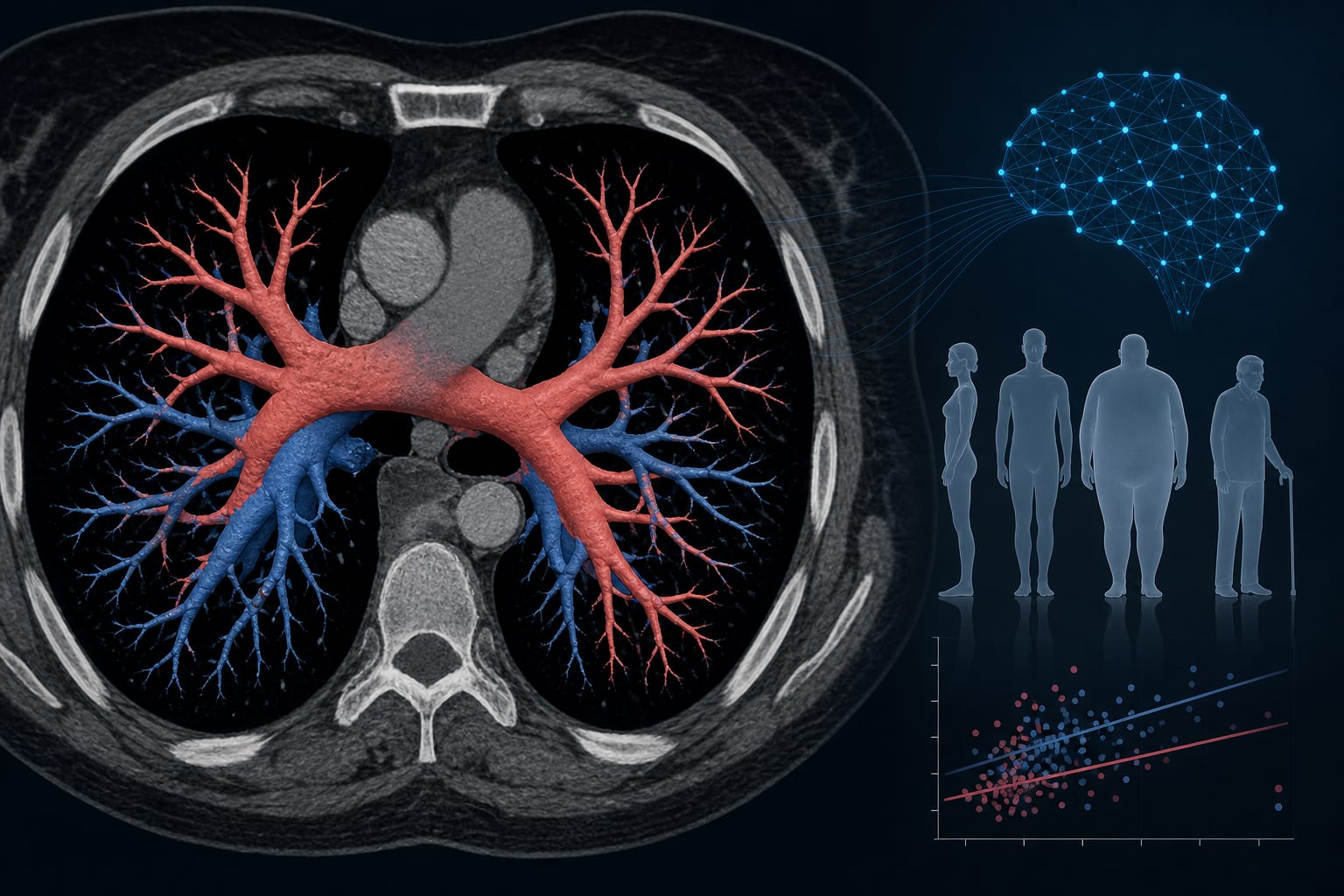
To compare EVLWI values obtained from AI-based automated CT segmentation with those derived from transpulmonary thermodilution and to derive a correction factor for TPTD in VV ECMO patients, enhancing clinical accuracy.
Key Findings:
AI-based CT segmentation provides a reliable assessment of EVLWI independent of ECMO-related hemodynamic interference, potentially transforming clinical assessment.
TPTD-derived EVLWI may be overestimated due to the confounding effect of extracorporeal blood flow, necessitating careful interpretation in clinical settings.
A correction factor for TPTD-derived EVLWI was developed to enhance its accuracy in VV ECMO patients, improving fluid management strategies.
Interpretation:
AI-based CT analysis may offer a more accurate and practical method for assessing pulmonary edema in ARDS patients on VV ECMO compared to TPTD.
Limitations:
Single-center study may limit generalizability of findings; further multicenter studies are needed.
Retrospective design may introduce selection bias, affecting the reliability of the results.
Potential inaccuracies in manual segmentation used for comparison could impact the validity of the findings.
Conclusion:
AI-based automated CT segmentation is a promising tool for assessing EVLWI in ARDS patients on VV ECMO, potentially improving fluid management strategies and patient outcomes.
by Matthias Otto, David Mohr, Julia Zimmermann, Nils Rathmann, Christoph Boesing, Manfred Thiel, Joerg Krebs, Thomas Luecke, Patricia R.M. Rocco, Alice Marguerite Conrad