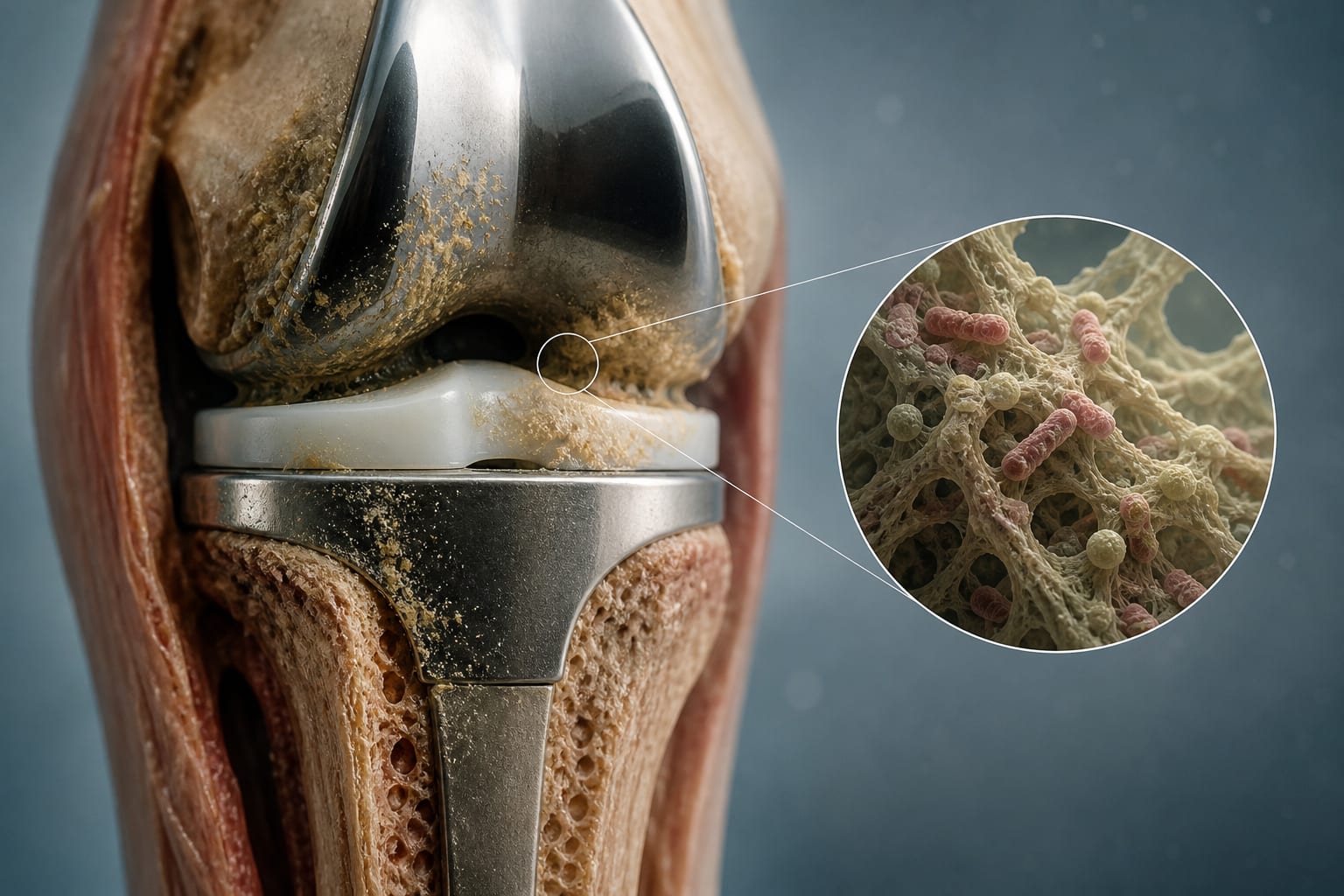
The boundary between microbial detection and implant-related infection: a structured narrative review of analytical credibility, biological persistence, host response, and clinical causality - Summary - MDSpire
Conexiant’s news site is now MDSpire News. Learn more
Advertisement
Distinguishing Microbial Detection from Implant-Related Infection: A Structured Narrative Review of Analytical Validity, Biological Persistence, Host Response, and Clinical Causality
To examine how microbial or molecular signals from orthopaedic implants should be distinguished from confirmed implant-related infection, focusing on analytical credibility, biological persistence, and clinical causality.
Approach:
Design: Structured narrative review, prepared with consideration of SANRA; no meta-analysis was conducted.
Search: PubMed, Embase, and Web of Science were searched through 27 June 2026, with reference-list screening.
Evidence framework: Evidence was organized by implant and sampling context, including routine fracture-device removal, arthroplasty and spinal revision, and mechanistic investigations.
Key Findings:
Positive culture, sonication, PCR, sequencing, or other microbial signals may occur without evidence sufficient to confirm implant-related infection.
An indeterminate signal may reflect contamination, non-viable microbial material, viable persistence without clinical manifestations, or infection missed by an incomplete workup or attenuated host response.
The causal significance of a finding varies by context; organisms detected during revision for implant failure may have contributed to that failure.
Molecular and animal studies can support mechanistic plausibility but cannot independently establish clinical causality.
Diagnostic frameworks for arthroplasty and fracture-related infection distinguish confirmatory from suggestive findings and require interpretation alongside clinical, histological, and other evidence.
Interpretation:
The review frames microbial detection and infection diagnosis as distinct inferences. It treats “stable coexistence” as a longitudinal phenotype or hypothesis, not as a microbiological state directly proven by the evidence described.
Limitations:
This is a narrative review, not a systematic evaluation of diagnostic accuracy or intervention effects.
The evidence spans heterogeneous populations, sampling protocols, infection definitions, methods, treatment exposures, and outcomes; meta-analysis was not undertaken.
The supplied context ends during the diagnostic-definitions section and does not provide the review’s full results or conclusions.