Impact of residual clonal plasma cell proliferation rate after autologous stem cell transplant on outcomes in multiple myeloma - Summary - MDSpire
Coming Soon: Introducing MDSpire News. Learn more
Conexiant’s news site is now MDSpire News. Learn more

Prognostic Impact of Residual Clonal Plasma Cell Proliferation After Autologous Stem Cell Transplantation in Multiple Myeloma

  • By

  • Tamer Hellou

  • Daniel G. Packard

  • Maximilian J. Steinhardt

  • Shaji K. Kumar

  • Angela Dispenzieri

  • Saurabh Zanwar

  • Shinichiro Suzuki

  • Estefania Gauto Mariotti

  • Dragan Jevremovic

  • Horatiu Olteanu

  • Pedro Horna

  • Gregory Otteson

  • Francis K. Buadi

  • David Dingli

  • Suzanne R. Hayman

  • Prashant Kapoor

  • Nelson Leung

  • Joselle Cook

  • Nadine Abdallah

  • Moritz Binder

  • Rahma Warsame

  • Taxiarchis V. Kourelis

  • Ronald S. Go

  • Yi Lin

  • Eli Muchtar

  • S. Vincent Rajkumar

  • Wilson I. Gonsalves

  • Morie A. Gertz

  • November 13, 2026

Share

Objective:

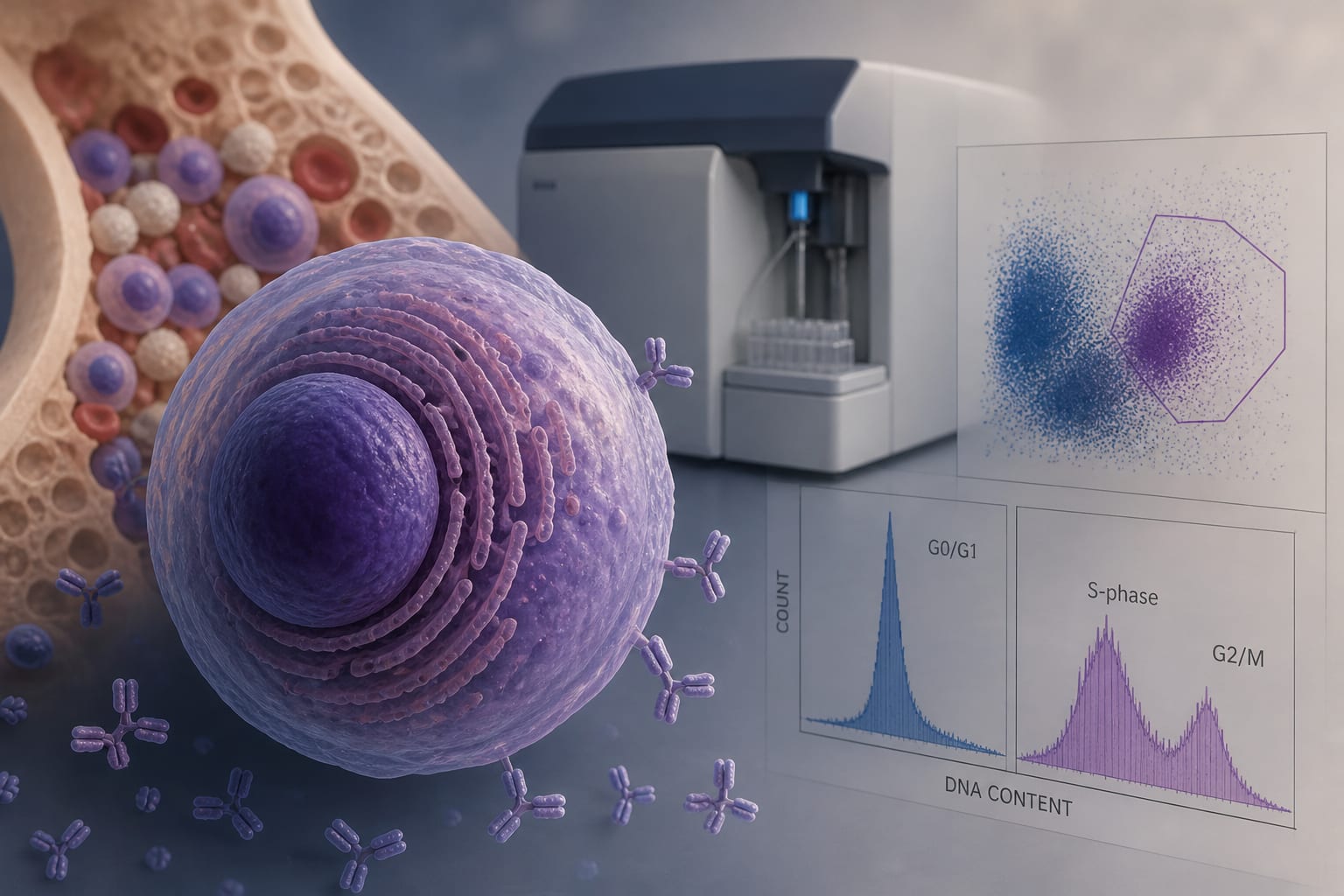
To assess whether post-ASCT clonal plasma cell S-phase and changes in S-phase from transplantation to post-transplant assessment are associated with outcomes in multiple myeloma.

Approach:
  • Study design and cohort: Retrospective Mayo Clinic study of 1,055 patients who underwent ASCT within one year of diagnosis between January 2013 and August 2024.
  • Measurement: Flow cytometry measured clonal plasma cell S-phase in post-ASCT marrow samples collected around day +60 or +100. S-phase was categorized as <2% or ≥2%; samples without enough clonal cells for reliable measurement were classified as non-assessable (N/A).
  • Analysis: Landmark PFS and OS were compared across S-phase categories and, in 160 patients with paired measurements, across four patterns of change. Multivariable Cox models assessed associations with survival.
Key Findings:
  • Post-ASCT S-phase was quantifiable in 172 patients (16.3%); 883 (83.7%) were non-assessable because clonal plasma cells were absent or insufficient.
  • Median PFS was 95 months for N/A, 37 months for S-phase <2%, and 11 months for S-phase ≥2% (p < 0.0001).
  • Median OS was not reached for N/A or S-phase <2%, compared with 53 months for S-phase ≥2% (p < 0.0001).
  • Among 160 patients with paired measurements, median PFS was 37 months for low-low, 22 months for high-low, 17 months for low-high, and 7 months for high-high (p < 0.001). Median OS was not reached for low-low and high-low, and was 83 months for low-high and 25 months for high-high (p < 0.001).
Interpretation:

In this cohort, elevated post-ASCT clonal plasma cell S-phase and persistently elevated or newly elevated S-phase were associated with shorter survival. The authors describe S-phase as complementary to residual disease burden assessment because it measures proliferative behavior.

Limitations:
  • The study was retrospective and conducted at a single center.
  • S-phase was quantifiable in a minority of patients; most samples were non-assessable because clonal plasma cells were absent or insufficient.
Sources:

Original Source(s)

Related Content