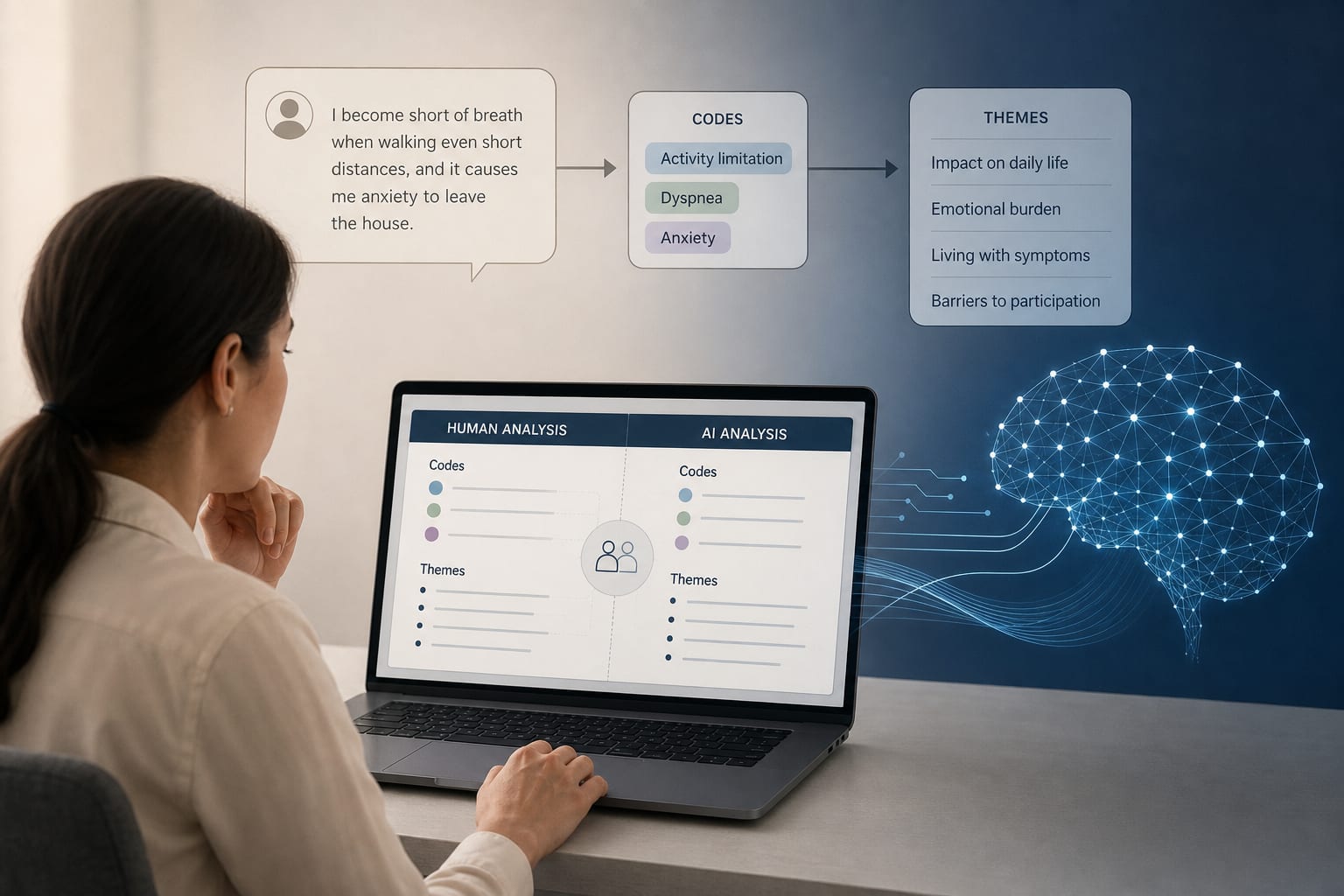
Multimodule Human–Artificial Intelligence Collaboration Pipeline for Large Language Model–Assisted Thematic Analysis Across Digital Health Interview Studies: Comparative Evaluation Study - Summary - MDSpire
Advertisement
Multimodule Human–Artificial Intelligence Collaboration Pipeline for Large Language Model–Assisted Thematic Analysis Across Digital Health Interview Studies: Comparative Evaluation Study
To evaluate a modular human-AI collaboration framework for thematic analysis across qualitative health studies.
Approach:
Framework Development: The study decomposes thematic analysis into three discrete subtasks to facilitate collaboration between human researchers and AI.
Comparative Assessment: The framework is assessed across three qualitative health studies involving patients with interstitial lung disease, postural orthostatic tachycardia syndrome, and chronic obstructive pulmonary disease.
Key Findings:
LLMs can support coding, theme generation, and synthesis in qualitative analysis when prompts are structured and outputs are reviewed by human researchers.
Human oversight is crucial for interpreting AI-generated themes, especially for deeper cultural and emotional interpretations.
There are significant limitations in LLM performance for context-dependent interpretation, with lower agreement rates for nuanced themes.
Interpretation:
The findings suggest that while LLMs can enhance qualitative workflows, their effectiveness is contingent on the dataset, task, and workflow structure.
Limitations:
Many studies focus on a single model or dataset, complicating the understanding of model-specific versus workflow-specific effects.
Heterogeneous evaluation practices make it difficult to draw consistent conclusions across studies.
Critical concerns remain regarding the potential loss of clinically meaningful insights due to overcompression of data by models.
Conclusion:
The study highlights the potential of a human-AI collaborative framework in thematic analysis while emphasizing the need for careful oversight and methodological rigor.