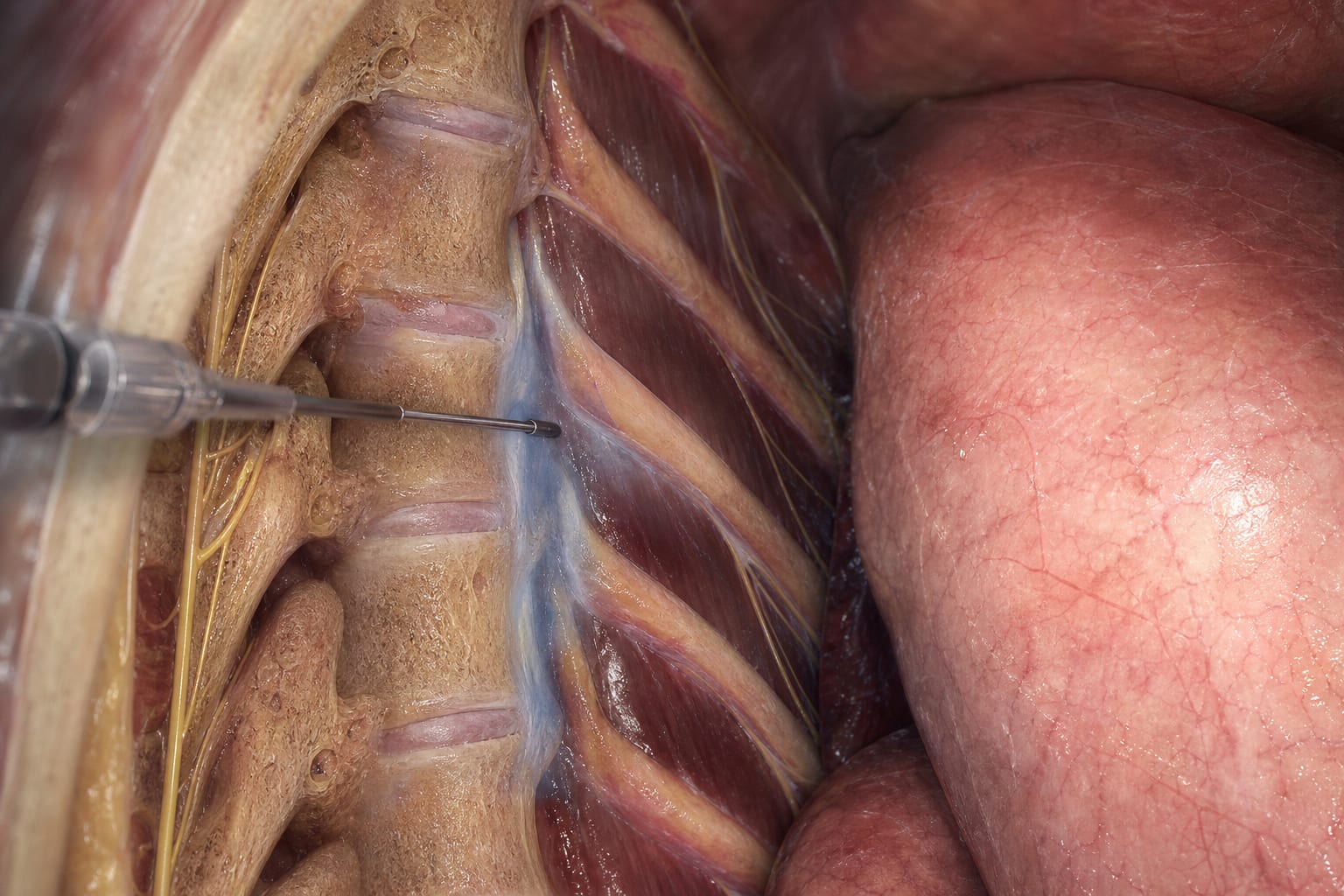
To evaluate the feasibility and advantages of thoracoscopic paravertebral block in patients undergoing uniportal VATS.
Approach:
Study Design: Single-center prospective randomized comparative study involving 228 patients undergoing uniportal VATS.
Groups: Patients were randomly assigned to Group A (intraoperative thoracoscopic direct-vision transthoracic paravertebral block) or Group B (preoperative ultrasound-guided thoracic paravertebral block).
Data Analysis: Perioperative data, postoperative pain scores, opioid rescue analgesic use, and complications were analyzed using repeated-measures ANOVA.
Key Findings:
No significant differences in demographic and clinical characteristics between the two groups (P > 0.05).
Postoperative complications were less frequent in Group A than in Group B (P < 0.05).
Significant differences in VAS scores were observed between groups over time (F = 774.002, P < 0.001), indicating better pain control in Group A.
Interpretation:
Thoracoscopic paravertebral block is associated with lower postoperative pain scores and reduced tramadol requirements compared to ultrasound-guided approaches.
Limitations:
Study conducted at a single center, which may limit generalizability.
Further validation through prospective randomized controlled trials is required.
Conclusion:
The study indicates that thoracoscopic paravertebral block may improve pain management for patients undergoing uniportal VATS.
A large audit of biomedical publications suggests fabricated references are increasingly appearing in peer-reviewed papers — often in ways that are difficult for reviewers and readers to detect.