Systemic immune-inflammation Index is an independent risk factor for Major adverse cardiovascular events in patients with coronary artery ectasia - Summary - MDSpire
To evaluate whether SII independently predicts major adverse cardiovascular events (MACE) in patients with angiographically confirmed coronary artery ectasia (CAE).
Approach:
Study Design: Retrospective cohort study at Cangzhou Central Hospital involving 200 consecutive patients with CAE followed for a median of 30 months.
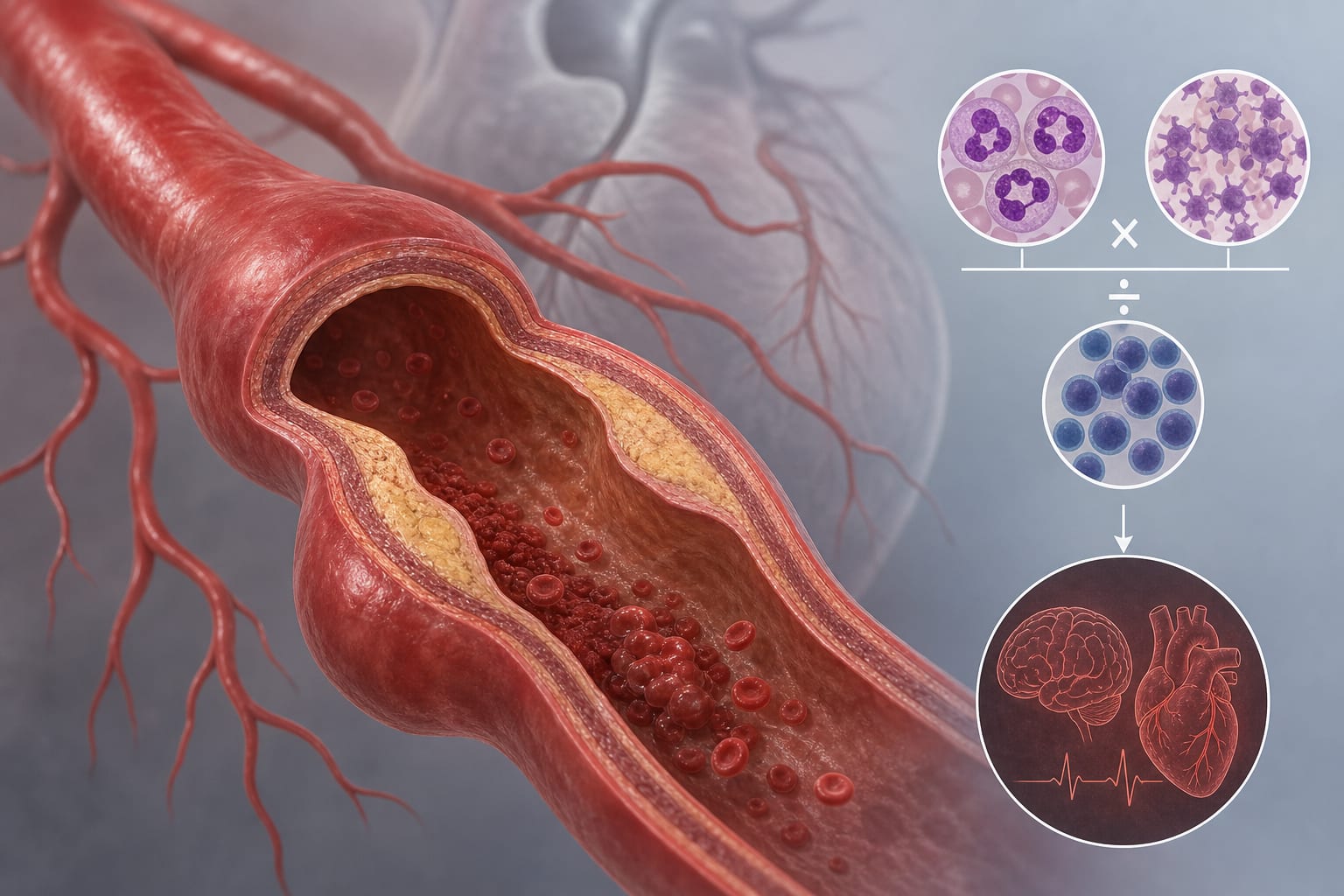
SII Calculation: SII was calculated as platelet count × neutrophil count / lymphocyte count.
Endpoints: Primary endpoint was MACE, defined as cardiovascular death, nonfatal myocardial infarction, ischemic stroke, and target vessel revascularization.
Statistical Analysis: ROC curve analysis for optimal SII cut-off value; Kaplan–Meier survival analysis and Cox proportional hazards regression for outcome association.
Key Findings:
During follow-up, 18% of patients experienced MACE.
Baseline SII levels were significantly higher in patients who developed MACE.
ROC analysis demonstrated good discriminatory ability of SII for predicting MACE (AUC 0.81), with an optimal cut-off value of 645.
Kaplan–Meier analysis showed significantly lower event-free survival in patients with high SII levels.
In multivariate Cox regression analysis, SII remained independently associated with MACE.
Interpretation:
Elevated SII is an independent predictor of MACE in CAE patients, enhancing prognostic accuracy when incorporated into clinical risk assessment models.
Limitations:
Retrospective design may introduce selection bias.
Single-center study limits generalizability.
Conclusion:
SII may serve as a valuable tool for risk stratification in patients with coronary artery ectasia.