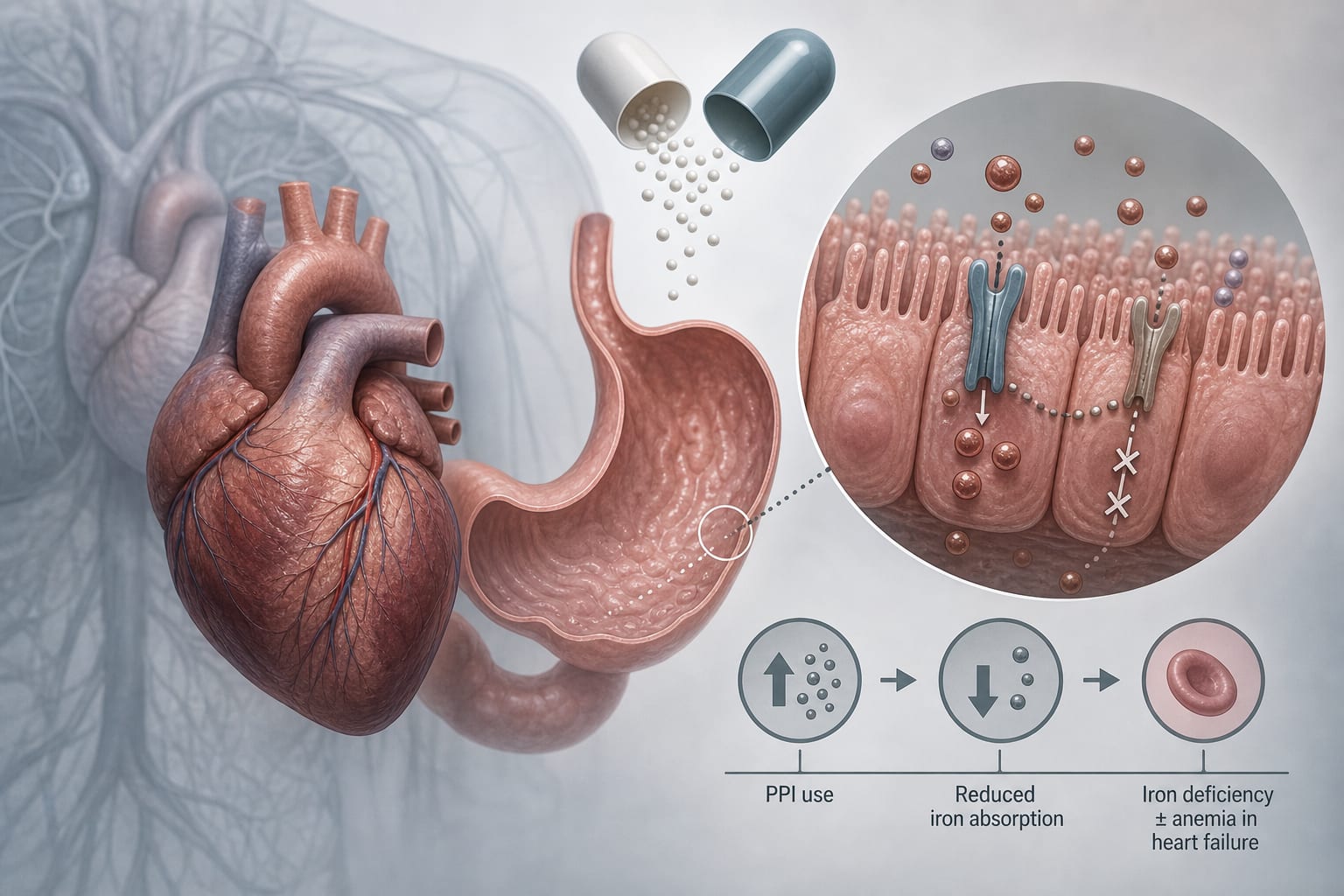
To investigate associations between proton-pump inhibitor (PPI) use and iron deficiency (ID) in patients with heart failure (HF), including potential differences by PPI subtype and acid-suppressive dose.
Approach:
Study Design: Post hoc analysis of the BIOSTAT-CHF index and validation cohorts, including 4056 adults with new-onset or worsening HF and complete iron-parameter and medication data.
PPI Use Assessment: Daily PPI doses were converted to omeprazole equivalents using relative potency factors to account for differences in acid suppression.
Iron Deficiency Definition: ID was defined as transferrin saturation below 20%.
Statistical Analysis: Multivariable logistic regression assessed associations of PPI use and omeprazole-equivalent dose with ID after adjustment for demographic, treatment, clinical, and laboratory factors.
Key Findings:
PPI use was reported by 1534 patients (38%); users were older and had more comorbidities than nonusers.
PPI users had lower transferrin saturation, serum iron, hemoglobin, and albumin levels.
ID was more prevalent among PPI users than nonusers (64% vs 56%; P < .001).
PPI use remained independently associated with ID in the fully adjusted model (OR, 1.29; 95% CI, 1.08–1.54; P = .006).
Each 10-mg increase in omeprazole-equivalent dose was associated with greater odds of ID (OR, 1.09; 95% CI, 1.03–1.16; P = .005).
Individual PPI subtypes were not independently associated with ID after adjustment for acid-suppressive potency.
Interpretation:
The dose-response relationship and absence of consistent subtype differences suggest that the association may be driven primarily by the potency of acid inhibition. Reduced gastric acidity may impair nonheme iron absorption, while in vitro and mouse-model findings suggest that increased hepcidin provides another potential mechanism.
Limitations:
The observational design precludes causal inference and does not exclude residual confounding.
Data on gastrointestinal disease and duration of PPI use were unavailable, limiting mechanistic and time-response analyses.
C-reactive protein was unavailable in the validation cohort and could not be included in adjusted models.
Conclusion:
In patients with HF, PPI use was independently associated with ID in a dose-dependent manner. The authors recommend considering more frequent iron-status monitoring in patients receiving PPIs and critically evaluating the indication for continued PPI therapy.