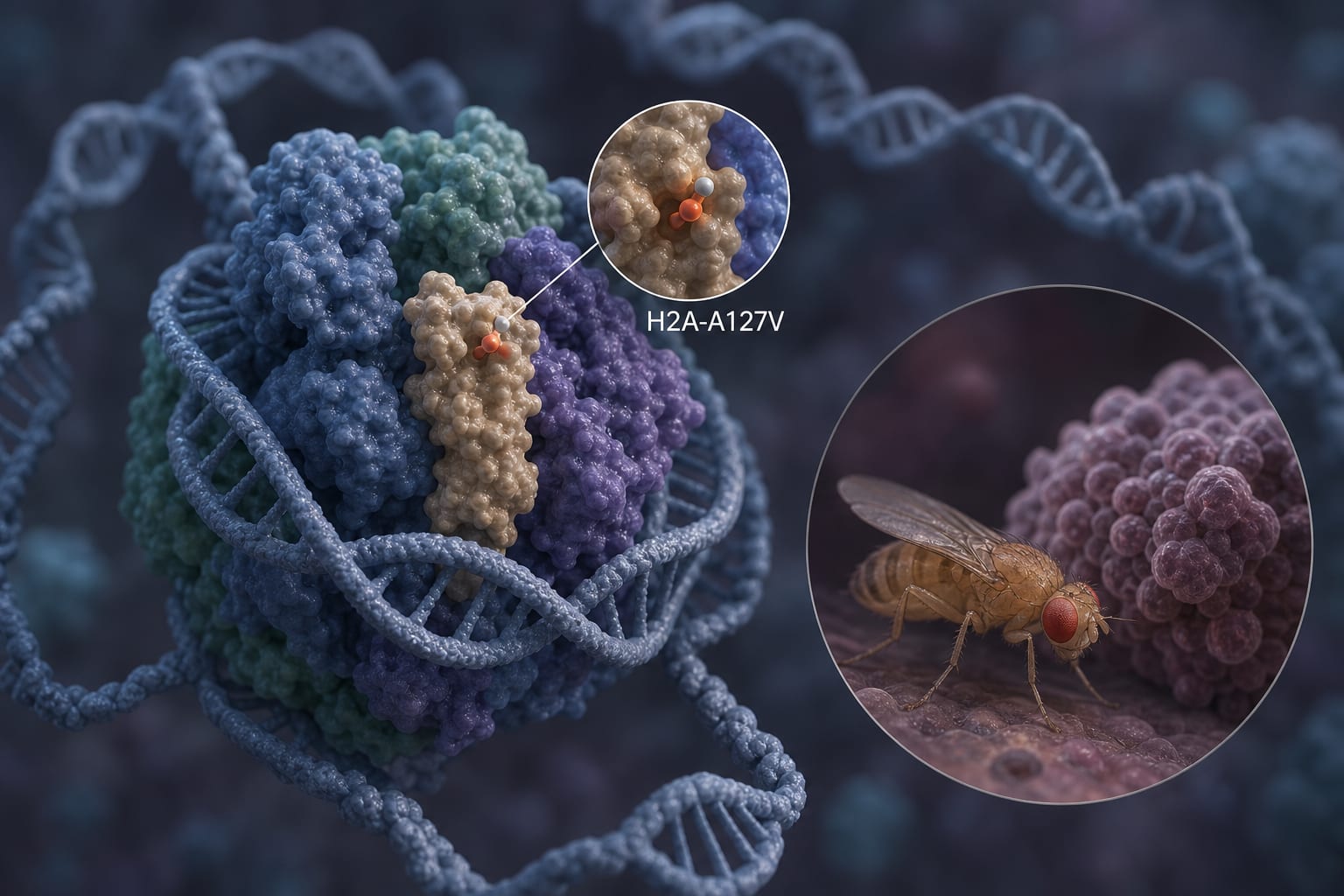
A novel H2A-A127 variant is associated with human cancer and enhances tumor-related phenotypes in Drosophila melanogaster models
-
By
-
Zeinab AlHajj Hassan
-
Hassan Dakik
-
Patricia Arreba-Tutusaus
-
Felice Frey
-
Sarah Mantash
-
Amanda Mitchell
-
Meaghan Boileau
-
Sagi Abelson
-
Malak Kleit
-
Zahraa Hayek
-
Jana Awada
-
Roy El Darzi
-
Kolja Eppert
-
Margret Shirinian
-
July 13, 2026
Objective:
To identify novel variants in histone genes associated with human cancers, particularly focusing on the H2A-A127 variant.
Approach:
- Cancer genomic analysis: Interrogated cancer genomic datasets to identify novel variants.
- In vivo functional assays: Conducted assays using Drosophila melanogaster tumor models to assess the impact of identified variants.
Key Findings:
- Identified a recurrent Alanine to Valine substitution at position 127 (H2A-A127V) in AML and solid tumors.
- H2A-A127V promotes eye tumor phenotypes and tissue overgrowth in Drosophila models.
- The variant interacts with the Enhancer of zeste (E(z)), suggesting a role in disease progression.
- H2A-A127V is an uncommon polymorphism (1.44%) that may predispose carriers to cancer.
Interpretation:
The findings highlight the significance of considering duplicated histone genes in mutation analyses for a better understanding of cancer development.
Limitations:
- The study primarily focuses on a specific variant and may not encompass the full spectrum of histone mutations in cancer.
- Potential biases in genomic datasets and the limitations of Drosophila models in fully replicating human cancer biology.
Conclusion:
The study uncovers a novel cancer-associated histone variant.