An exploratory multimodal imaging and clinicopathological strategy for suspected Kümmell’s disease in the absence of MRI - Summary - MDSpire

An exploratory multimodal imaging and clinicopathological strategy for suspected Kümmell’s disease in the absence of MRI

  • By

  • Buqing Ma

  • Guanxiong Wang

  • Baokun Lin

  • Dongxu Yang

  • Yijing Fang

  • Yihao Zhu

  • Zibin Li

  • Chang Liu

  • Jie Ding

  • Jiayang Li

  • Haoyang Rao

  • Bin Mai

  • Zhen Zhang

  • Guoye Mo

  • Huizhi Guo

  • Danqing Guo

  • Yanhuai Ma

  • Yuewei Lin

  • Yongchao Tang

  • Kai Yuan

  • Shuncong Zhang

  • Haishan Li

  • Yongxian Li

  • July 9, 2026

  • 0 min

Share

Objective:

To propose and preliminarily evaluate a multimodal diagnostic strategy for diagnosing Kümmell’s disease (KD) in patients who cannot undergo MRI.

Approach:
  • Initial Screening: Patients underwent clinical symptom screening followed by plain radiography and high-resolution CT to detect morphological signs.
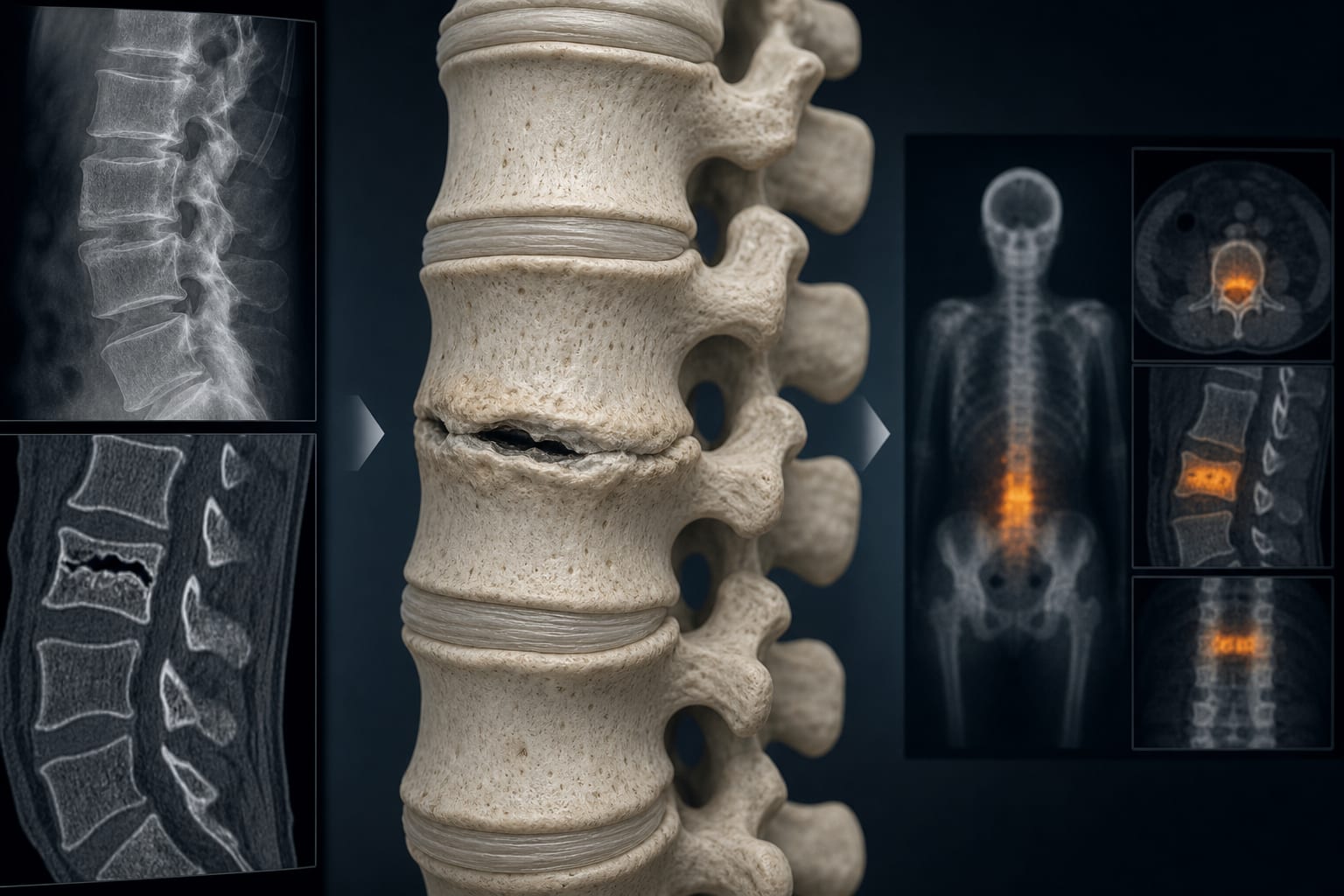
  • Imaging Techniques: CT scans provided anatomical evidence of vertebral injury, while 99ᵐTc-MDP bone scintigraphy assessed metabolic status through emission computed tomography (ECT).
Key Findings:
  • CT scans provided conclusive anatomical evidence of vertebral injury and instability, including intervertebral vacuum clefts and fracture-end sclerosis.
  • ECT scans revealed metabolic activity, identifying lesions with high metabolic activity (hot areas) or decreased radiotracer uptake intensity (cold areas), corresponding to repair processes and avascular necrosis.
  • The combination of CT and ECT provided convergent imaging evidence supportive of the diagnosis of KD.
Interpretation:

The multimodal approach may enhance diagnostic accuracy for KD in patients with MRI contraindications by integrating anatomical and metabolic data.

Limitations:
  • The study was a single-center, retrospective exploratory study with a limited sample size.
  • The method's efficacy has not been validated against a standardized diagnostic pathway.
Conclusion:

Combining CT and ECT bone imaging may serve as a feasible exploratory diagnostic approach for KD in patients unsuitable for MRI.

Original Source(s)

Related Content