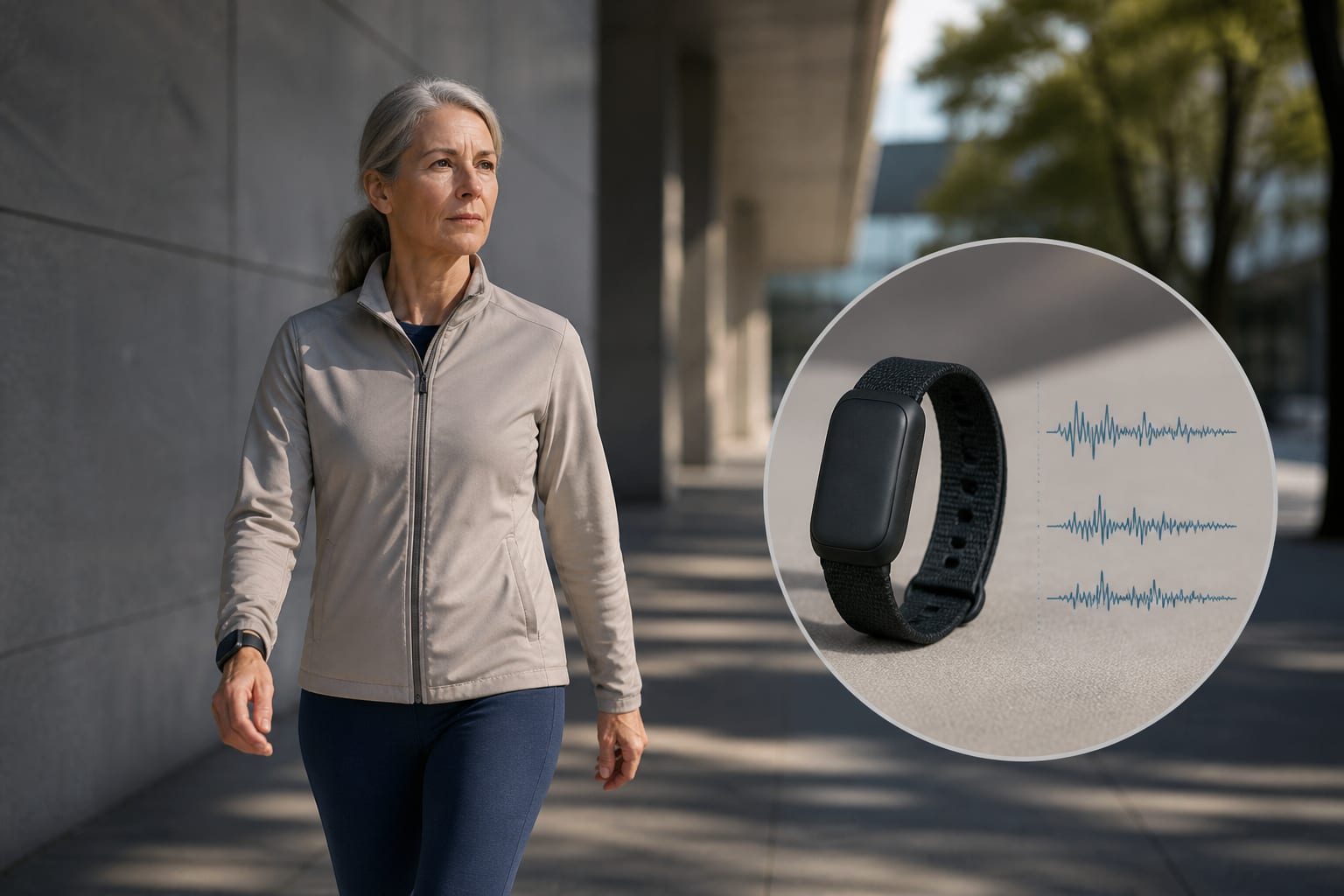
Assessing Real-World Mobility Function Beyond Timed Walking Tests
-
By
-
Davide Liborio Vetrano
-
October 23, 2026
Objective:
To summarize evidence comparing clinical walking speed and free-living walking cadence as measures associated with mortality risk.
Approach:
- Study: Haddadj and colleagues compared usual speed on a brief clinical walking test with median and 95th-percentile cadence from 9 days of wrist-worn accelerometry in 4,067 Whitehall II participants.
- Follow-up: Participants were followed for a median of 11.8 years; mortality associations and discrimination were assessed after adjustment for sociodemographic, behavioral, and health-related factors.
Key Findings:
- All three measures were associated with lower all-cause mortality, and their overall discriminative abilities were broadly similar.
- Only clinical walking speed significantly improved discrimination beyond the fully adjusted risk model.
- The adjusted model’s C index was 0.742; it was 0.747 with clinical walking speed, 0.744 with median cadence, and 0.745 with 95th-percentile cadence.
- Clinical walking speed and free-living cadence were only modestly correlated.
- The cohort was relatively high functioning and active: mean clinical walking speed was 1.2 m/s and average activity was approximately 9,500 steps per day. Participants providing accelerometer data were healthier than the overall cohort.
Interpretation:
Clinical walking tests measure performance under standardized conditions, whereas free-living cadence reflects mobility as expressed in daily life. The limited incremental discrimination does not establish that the measures are equivalent; their prognostic information may partly converge on health and physiologic reserve. The article notes that free-living monitoring may be more informative in people with lower function, a group comparatively underrepresented in this cohort.
Limitations:
- The cohort was relatively high functioning and physically active, with limited functional variability that may have constrained risk discrimination.
- Accelerometer-data contributors were healthier than the overall Whitehall II population.
- The reported gains in discrimination were modest.
Conclusion:
Both clinical walking speed and free-living cadence were associated with mortality, but clinical walking speed alone significantly improved discrimination beyond the adjusted model. The article emphasizes that the measures capture related but potentially distinct aspects of mobility.
Sources:
Based on findings from:
Measuring Mobility Function in Everyday Life—Beyond the Stopwatch
Davide Liborio Vetrano. Jama Network Open, 2026.
https://jamanetwork.com/journals/jamanetworkopen/fullarticle/2855786
This content is an AI-generated, fully rewritten summary based on a published scholarly article. It does not reproduce the original text and is not a substitute for the original publication. Readers are encouraged to consult the source for full context, data, and methodology.