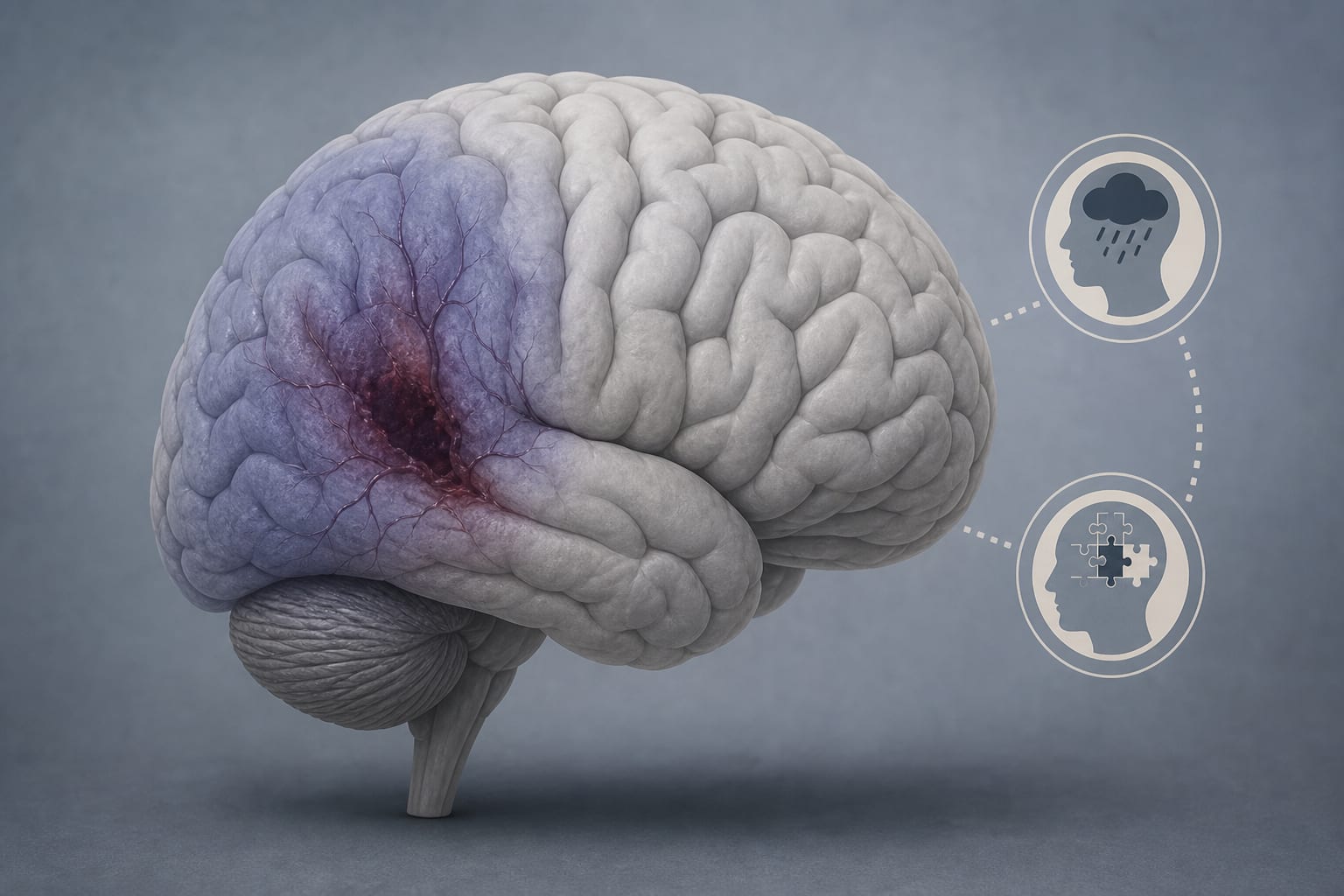
To examine predictors of post-stroke depression (PSD) and cognitive impairment (PSCI) among acute stroke survivors.
Approach:
Method: T
Method: h
Method: e
Method: c
Method: o
Method: m
Method: n
Method: a
Method: r
Method: y
Method: d
Method: i
Method: s
Method: u
Method: p
Method: v
Method: b
Method: l
Method: .
Method: f
Method: w
Method: 7
Method: 8
Method: k
Method: 6
Method: g
Key Findings:
Right-hemisphere lesions, higher baseline PHQ-9 scores, and lower baseline MMSE scores independently predicted composite outcomes of PSD and PSCI.
The combined endpoint of PSD and PSCI encompasses different trajectories that may require distinct treatment approaches.
The use of PHQ-9 and MMSE as screening tools can identify individuals at risk for PSD and PSCI.
Interpretation:
The overlap between PSD and PSCI may indicate shared neurobiological mechanisms, but their determinants and treatment may differ.
Limitations:
The operationalization of PSD and PSCI through brief screening scales may affect risk stratification and clinical interpretation.
MMSE has limitations in detecting specific cognitive deficits in post-stroke populations.
Conclusion:
Future research should refine definitions of PSD and PSCI, explore domain-specific cognitive assessments, and model depressive and cognitive trajectories separately.
Baptist Health will bring together leading physicians, researchers and healthcare professionals from South Florida and across the country for the 14th Annual Baptist Health Miami Neuroscience Symposium, taking place Nov. 4-6, 2026, at Hilton Miami Dadeland and virtually via Zoom.
New findings from CREST-2 are providing important evidence on the role of carotid artery stenting (CAS) in patients with severe asymptomatic carotid stenosis — while underscoring the importance of operator experience, patient selection and procedural technique in achieving favorable outcomes.