Malignant transformation of lower-grade glioma: contrast enhancement, extent of resection, and the natural history under interval-censored analysis - Summary - MDSpire
Conexiant’s news site is now MDSpire News. Learn more
Advertisement
Transformation of Lower-Grade Gliomas to Malignancy: The Role of Contrast Enhancement, Surgical Resection Extent, and Interval-Censored Analysis of Natural History
To model malignant transformation (MT) of lower-grade gliomas (LGGs) as an interval-censored event and assess the impact of preoperative imaging phenotype and extent of surgical resection on the timing and likelihood of transformation.
Approach:
Cohort and endpoint: The study included a cohort of 155 patients with histologically confirmed adult-type diffuse gliomas classified as WHO grade 2 or 3. All patients underwent preoperative multiparametric MRI and had follow-up imaging to monitor disease progression.
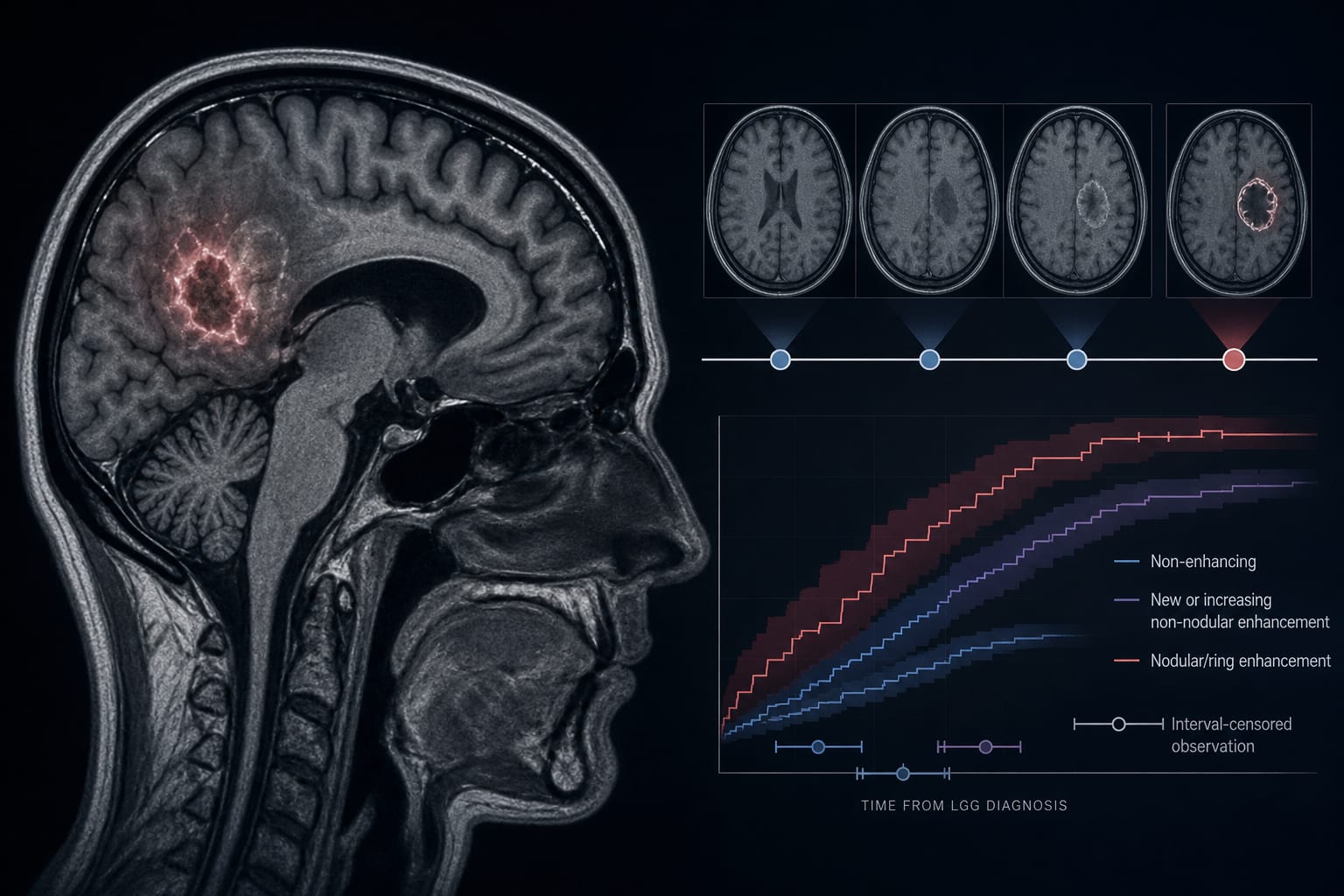
Imaging analysis: Tumours were segmented using a sophisticated deep-learning pipeline, allowing for the extraction of 428 distinct features from the MRI scans. Contrast enhancement (CE) was assessed visually based on established criteria to determine the degree of tumor vascularity and permeability.
Statistical analysis: A Bayesian interval-censored Weibull model was employed to analyze the timing of malignant transformation, incorporating various clinical and imaging predictors to enhance the understanding of the transformation process.
Key Findings:
The modeling of malignant transformation as an interval-censored event significantly improved the accuracy of timing estimates for when LGGs may progress to a higher grade.
A detailed reassessment of preoperative imaging features, including the presence and extent of contrast enhancement, along with the degree of surgical resection, revealed their predictive value regarding the likelihood of malignant transformation.
Interpretation:
The findings suggest that the timing of malignant transformation in lower-grade gliomas can be more accurately predicted by considering both imaging characteristics and surgical intervention. The use of interval-censored analysis allows for a more nuanced understanding of the progression from lower to higher-grade gliomas. Specifically, the presence and extent of contrast enhancement on preoperative imaging serve as critical indicators of tumor behavior, potentially guiding clinical decision-making regarding the timing of surgical resection. Furthermore, the extent of surgical resection appears to play a significant role in influencing transformation outcomes, emphasizing the need for tailored surgical strategies based on individual tumor characteristics.
Limitations:
The findings of this study may not be generalizable to all populations, as the results are specific to the cohort studied and the imaging techniques employed.
There are potential biases inherent in imaging assessments, and the retrospective nature of the analysis could introduce confounding factors that may affect the results.
Conclusion:
This research provides a refined approach to understanding the dynamics of malignant transformation in lower-grade gliomas through the application of interval-censored analysis and comprehensive imaging assessment, highlighting the importance of preoperative characteristics in predicting transformation outcomes.
by Baran Atli, Maximilian Wartha, Matthias Gmeiner, Martin Aichholzer, Serge Weis, Dominik Vorhauer, Helga Wagner, Tanja Hauer, Carlo Serra, Petra Böhm, Michael Sonnberger, Nico Stroh-Holly, Stefan Aspalter, Kathrin Aufschnaiter, Tobias Rossmann, Maria Gollwitzer, Jawed Ziai, Annette Leibetseder, Josef Pichler, Wolfgang Thomae, Christian Dorfer, Andreas Gruber, Harald Stefanits, Philip Rauch