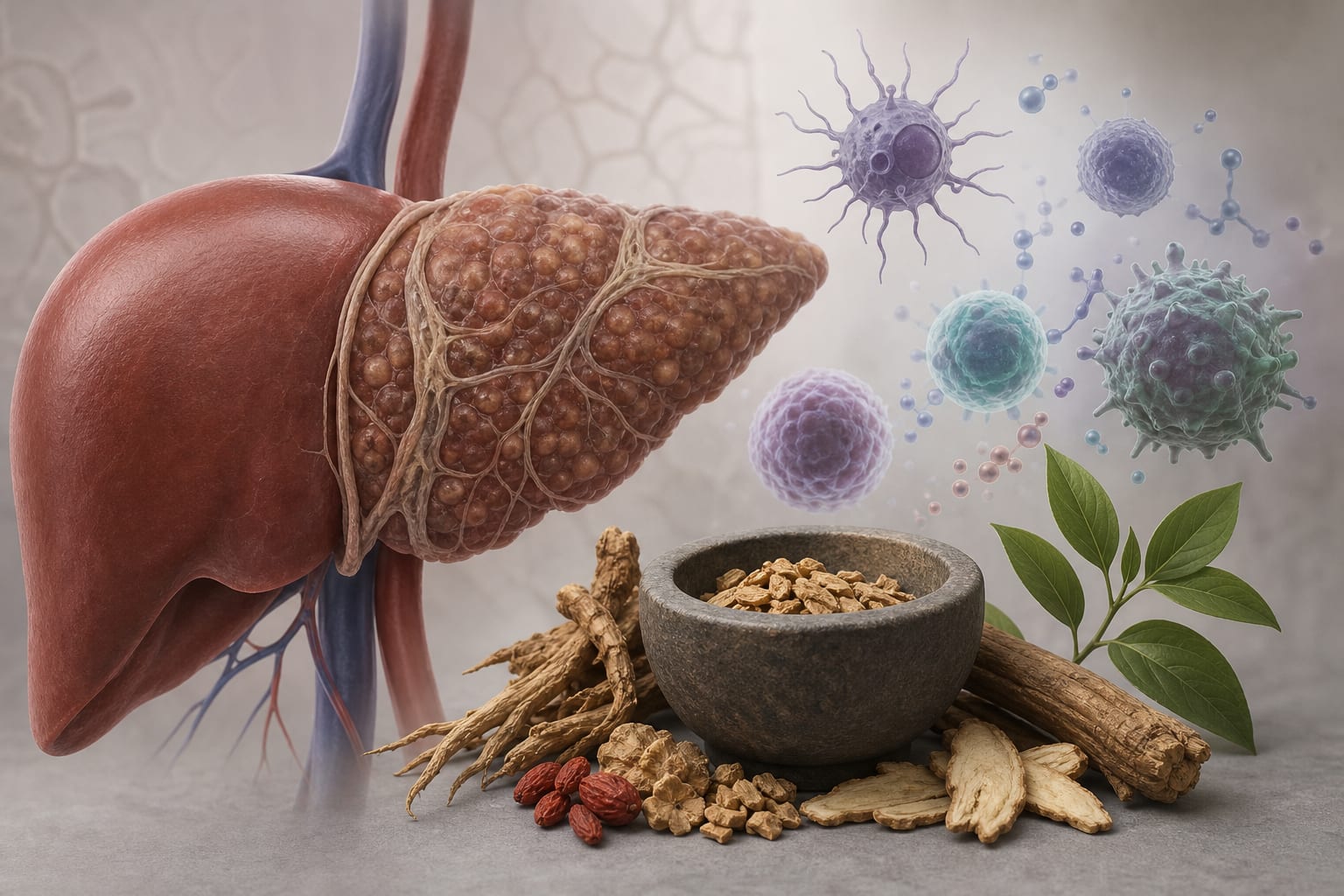
The efficacy of traditional Chinese medicine on immune function in patients with hepatitis B-related liver fibrosis or cirrhosis: a systematic review and meta-analysis - Summary - MDSpire
Advertisement
Assessing the Impact of Traditional Chinese Medicine on Immune Function in Patients with Hepatitis B-Induced Liver Fibrosis or Cirrhosis: A Systematic Review and Meta-Analysis
To explore the efficacy of Traditional Chinese Medicine (TCM) combined with nucleos(t)ide analogs (NAs) compared to NAs alone in patients with hepatitis B-related liver fibrosis or cirrhosis.
Approach:
Data Sources: Electronic databases including Chinese National Knowledge Infrastructure, Wanfang, SinoMed, Weipu, PubMed, Web of Science, EMBASE, and Cochrane were searched for randomized controlled trials (RCTs).
Quality Assessment: Methodologic quality of included RCTs was assessed using the Cochrane RoB 2 tool.
Meta-Analysis: Data were analyzed using Review Manager 5.4.1, and evidence quality was assessed with the GRADE method.
Key Findings:
25 RCTs involving 2,585 patients were included.
TCM combined with NAs improved CD3+ [MD = 5.83, 95%CI (3.93, 7.73), p < 0.00001], CD4+ [MD = 4.32, 95%CI (3.56, 5.08), p < 0.00001], CD4+/CD8+ [MD = 0.24, 95%CI (0.18, 0.29), p < 0.00001], and NK cells.
TCM decreased CD8+ cells [MD = -2.67, 95%CI (-3.46, -1.89), p < 0.00001], IL-6, TGF-β, TNF-α, and liver function markers compared to NAs alone.
The certainty of evidence was low for immune function, liver function, and liver fibrosis indexes.
Interpretation:
A combination of NAs and TCM may improve immune cell metrics and liver function in patients with hepatitis B-related liver fibrosis or cirrhosis.
Limitations:
Risk of bias concerns were noted in the majority of RCTs.
The quality of the included studies was low.
Conclusion:
More high-quality RCTs are needed to strengthen the evidence regarding the efficacy of TCM in treating hepatitis B-related liver fibrosis or cirrhosis.