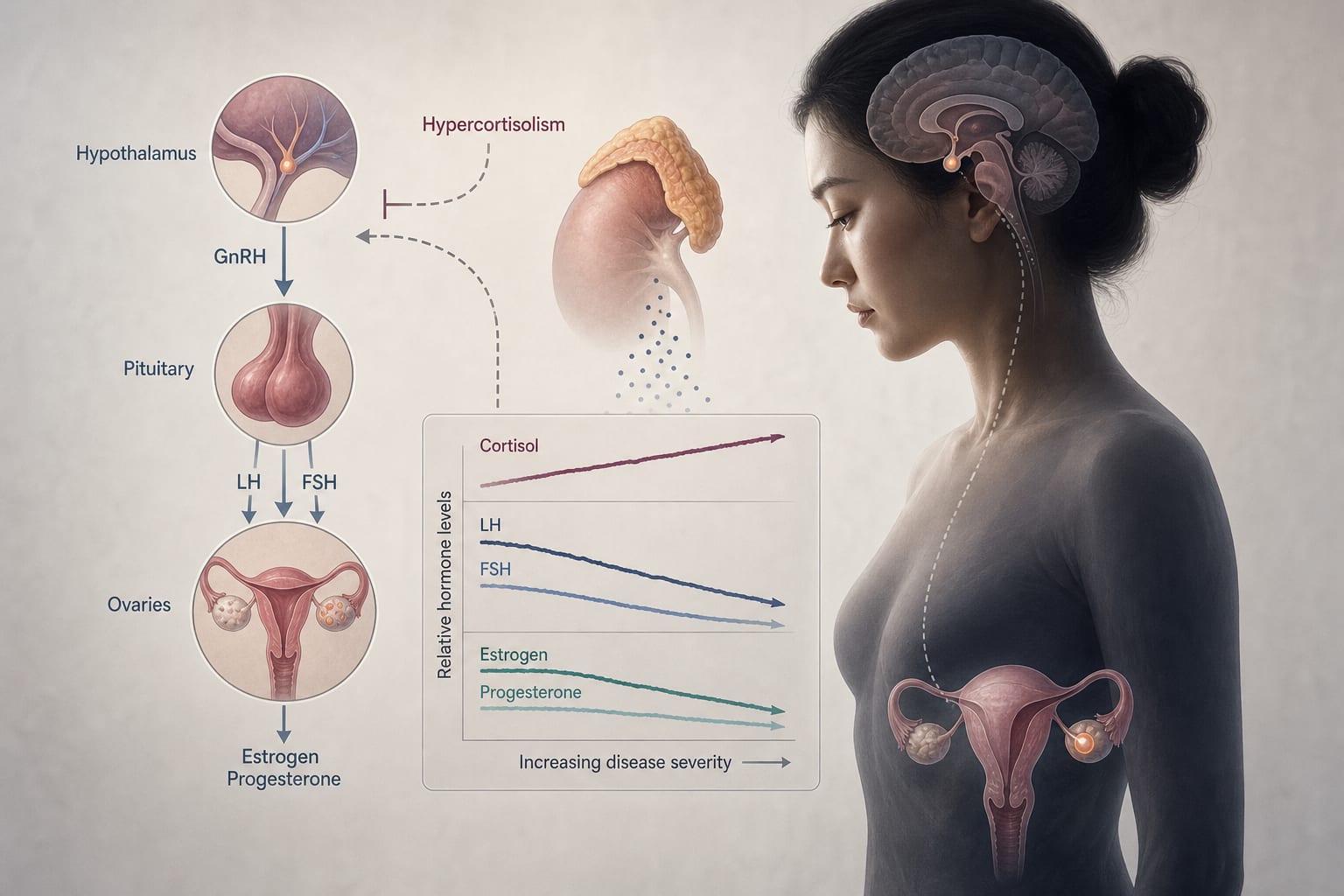
To evaluate the clinical status of the HPG axis in women with Cushing syndrome (CS), focusing on the influence of different subtypes and varying intensity of hypercortisolism in both pre- and postmenopausal women.
Approach:
Study Design: Retrospective cross-sectional study evaluating 137 women diagnosed with adrenal CS, Cushing’s disease, and ectopic ACTH syndrome from 2007 to May 2024.
Data Analysis: Linear regression analysis was used to assess associations between reproductive hormone levels and severity of hypercortisolism.
Subgroup Analysis: In a subgroup of 45 women, plasma androgens were evaluated using liquid chromatography-tandem mass spectrometry (LC-MS/MS) and analyzed through ROC curve analysis.
Comparative Analysis: Examined the relative susceptibility of the gonadal axis and thyroid axis to hypercortisolism.
Key Findings:
Women with ectopic ACTH syndrome (EAS) showed significantly elevated ACTH and cortisol levels.
EAS patients had higher testosterone and lower LH and FSH levels.
Positive correlation between serum cortisol and testosterone; inverse correlation with LH and FSH, particularly in postmenopausal women.
Plasma androgens demonstrated superior diagnostic power in distinguishing Cushing's disease from adrenal Cushing syndrome.
The gonadal axis exhibited greater susceptibility to hypercortisolism compared to the thyroid axis.
Interpretation:
The study indicates a severity-dependent glucocorticoid suppression of HPG axis function across CS subtypes, with the most pronounced effects observed in EAS.
Limitations:
Retrospective design may introduce bias.
Limited sample size for subgroup analysis.
Lack of longitudinal data to assess changes over time.
Conclusion:
The findings facilitate identification of HPG axis dysfunction in women with Cushing syndrome.
A matched electronic health record study of more than 876,000 patients with type 2 diabetes found a low absolute incidence but higher relative hazard of documented smell and taste disturbances among patients prescribed glucagon-like peptide-1 receptor agonists.
Published evidence linked liraglutide and semaglutide to improvements in psoriasis severity, inflammatory markers, and metabolic outcomes, while evidence in psoriatic arthritis remained sparse.