Depressive symptoms in chronic kidney disease: the hidden role of uremic toxins - Summary - MDSpire

Depressive symptoms in chronic kidney disease: the hidden role of uremic toxins

  • By

  • Hélène Levassort

  • Sophie Liabeuf

  • Julie Boucquemont

  • Gaye Hafez

  • Solene M Laville

  • Celine Lange

  • Luc Frimat

  • Christian Combe

  • Denis Fouque

  • Maurice Laville

  • Christian Jacquelinet

  • Yves-Edouard Herpe

  • Lucile Montalescot

  • Islam Amine Larabi

  • Natalia Alencar de Pinho

  • Ziad A Massy

  • Jean-Claude Alvarez

  • Marion Pépin

  • on behalf of CKD-REIN

  • June 24, 2026

  • 0 min

Share

Objective:

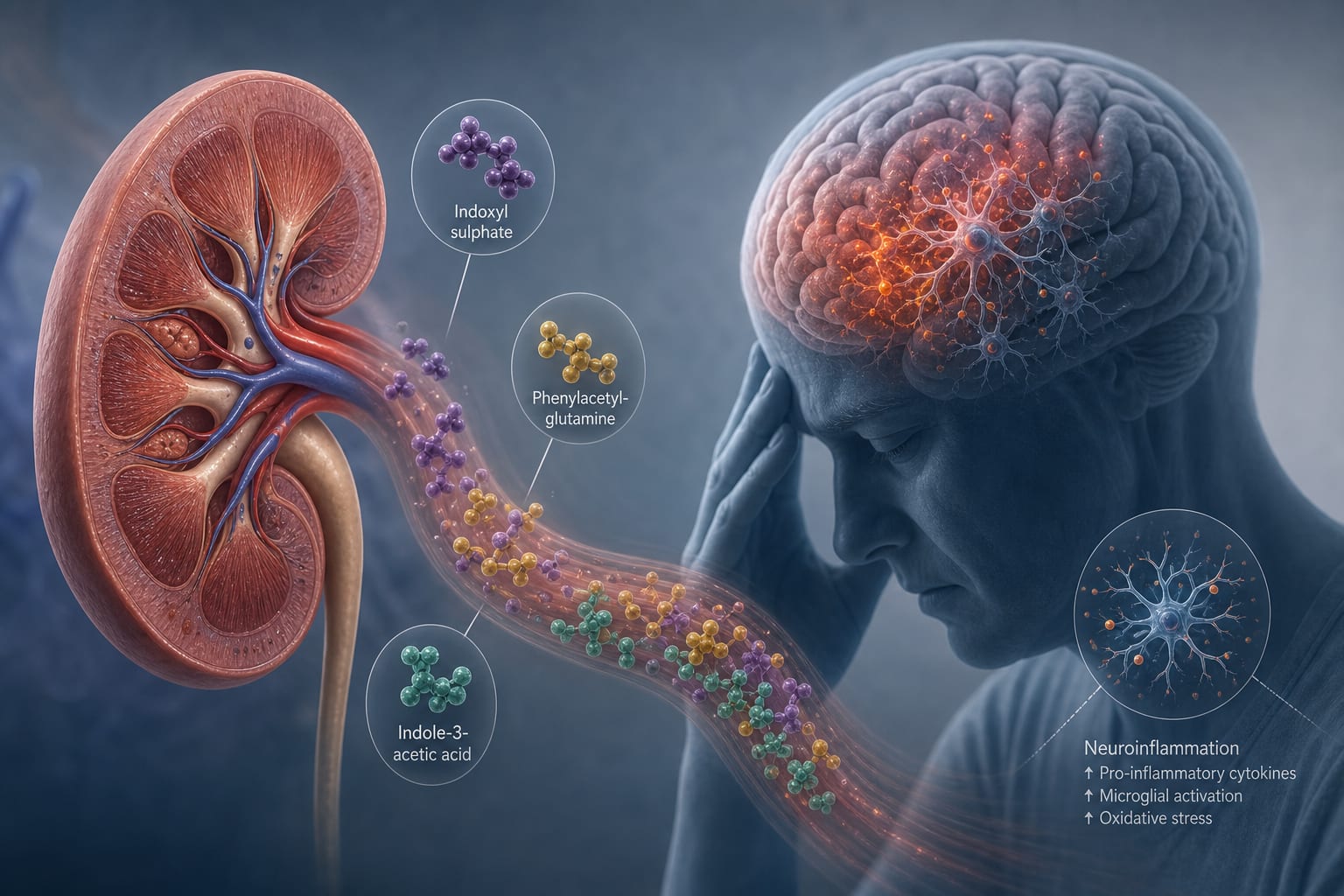
To evaluate the association between uremic toxins (UTs) and depressive symptoms in a cohort of non-dialysed adults with chronic kidney disease (CKD).

Approach:
  • Cohort Study: The study utilized the CKD-REIN cohort comprising 3033 CKD stage 2–5 patients with 5 years of follow-up, assessing changes in depressive symptoms using the CESD scale.
  • Statistical Analysis: Mixed models were employed to examine associations between changes in CESD scores and baseline levels of various UTs.
Key Findings:
  • 2165 patients were included with a median age of 68 years and mean eGFR of 35 mL/min/1.73 m²; median baseline CESD score was 7 and mean follow-up time was 4.0 years.
  • The CESD score increased by 0.11 points per year after adjusting for confounders.
  • Doubling PAG levels was associated with an additional increase of 0.06 points per year in CESD.
  • Doubling IS and IAA levels was linked to higher mean CESD scores but not to score changes over time.
Interpretation:

PAG was significantly associated with changes in CESD score over time, while higher IS and IAA levels correlated with higher mean scores.

Limitations:
  • The study did not include patients on kidney replacement therapy.
  • Further studies are needed to confirm the findings and explore the potential for therapeutic strategies targeting UTs.
Conclusion:

Further studies are needed to confirm the findings and explore the potential for therapeutic strategies targeting UTs.

Original Source(s)

Related Content