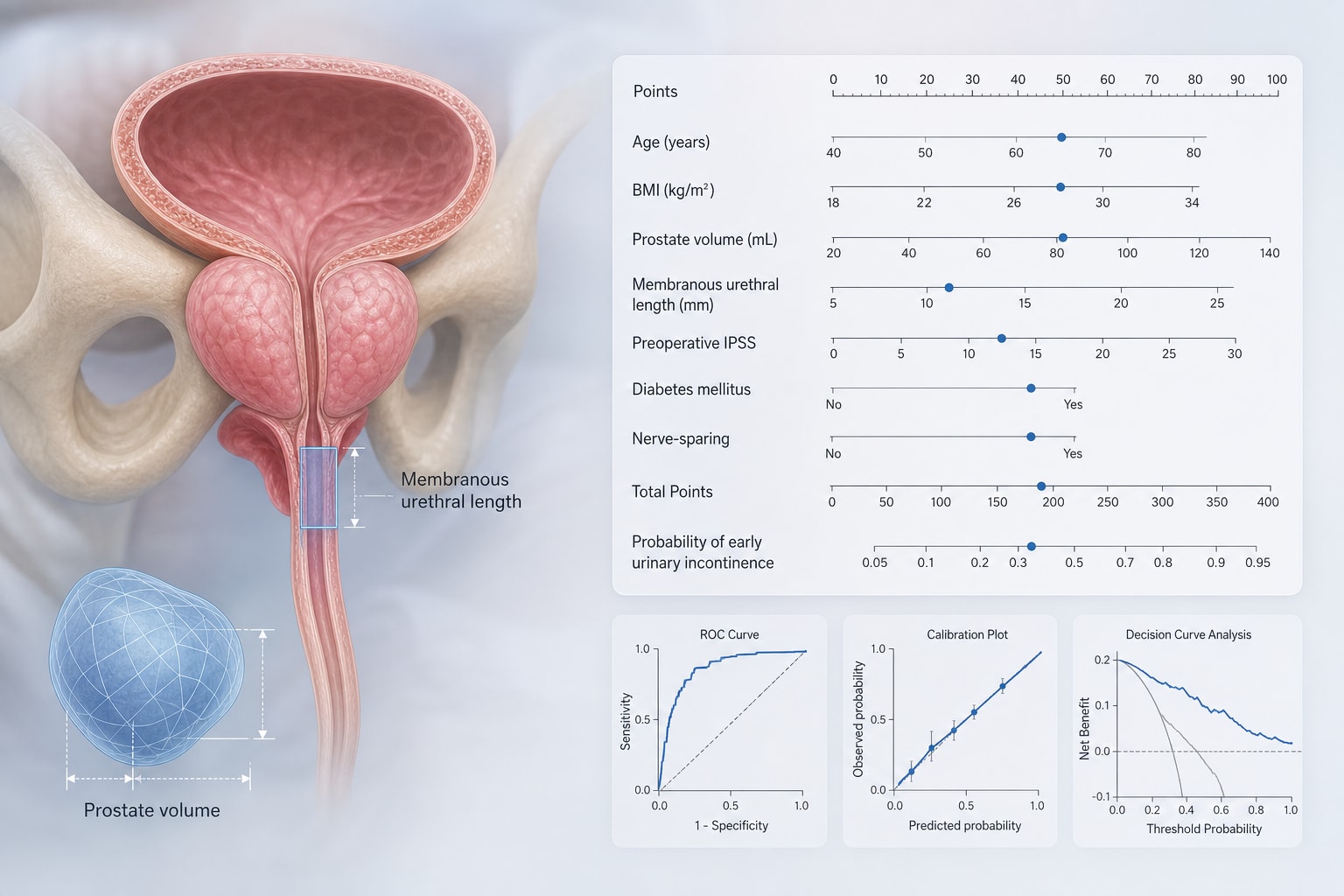
Developing a predictive model for early urinary incontinence after laparoscopic radical prostatectomy: a retrospective cohort study - Summary - MDSpire
Advertisement
Developing a predictive model for early urinary incontinence after laparoscopic radical prostatectomy: a retrospective cohort study
To create a predictive model for early urinary incontinence following laparoscopic radical prostatectomy (LRP).
Approach:
Study Design: Retrospective analysis of clinical data from 408 patients who underwent LRP at Xiangyang Central Hospital from December 2020 to December 2025. Exclusion criteria included patients with a history of prostate surgery or urinary incontinence, lack of a preoperative MRI, need for preoperative catheterization due to urinary retention, receipt of neoadjuvant endocrine therapy or radiotherapy, or incomplete clinical data.
Key Findings:
41.2% of patients experienced urinary incontinence post-surgery.
58.8% of patients did not experience urinary incontinence post-surgery.
Independent predictors identified include prostate volume, membranous urethral length (MUL), intravesical prostatic protrusion length (IPPL), and neurovascular bundle (NVB) preservation.
The nomogram developed showed good predictive performance with an AUC of 0.910.
Interpretation:
The identified predictors have significant value in forecasting early urinary incontinence after LRP, and the nomogram demonstrates strong predictive capabilities.
Limitations:
The study is retrospective and may be subject to selection bias.
Exclusion criteria may limit the generalizability of the findings.
Conclusion:
The nomogram based on prostate volume, MUL, IPPL, and NVB preservation effectively predicts early urinary incontinence after LRP.