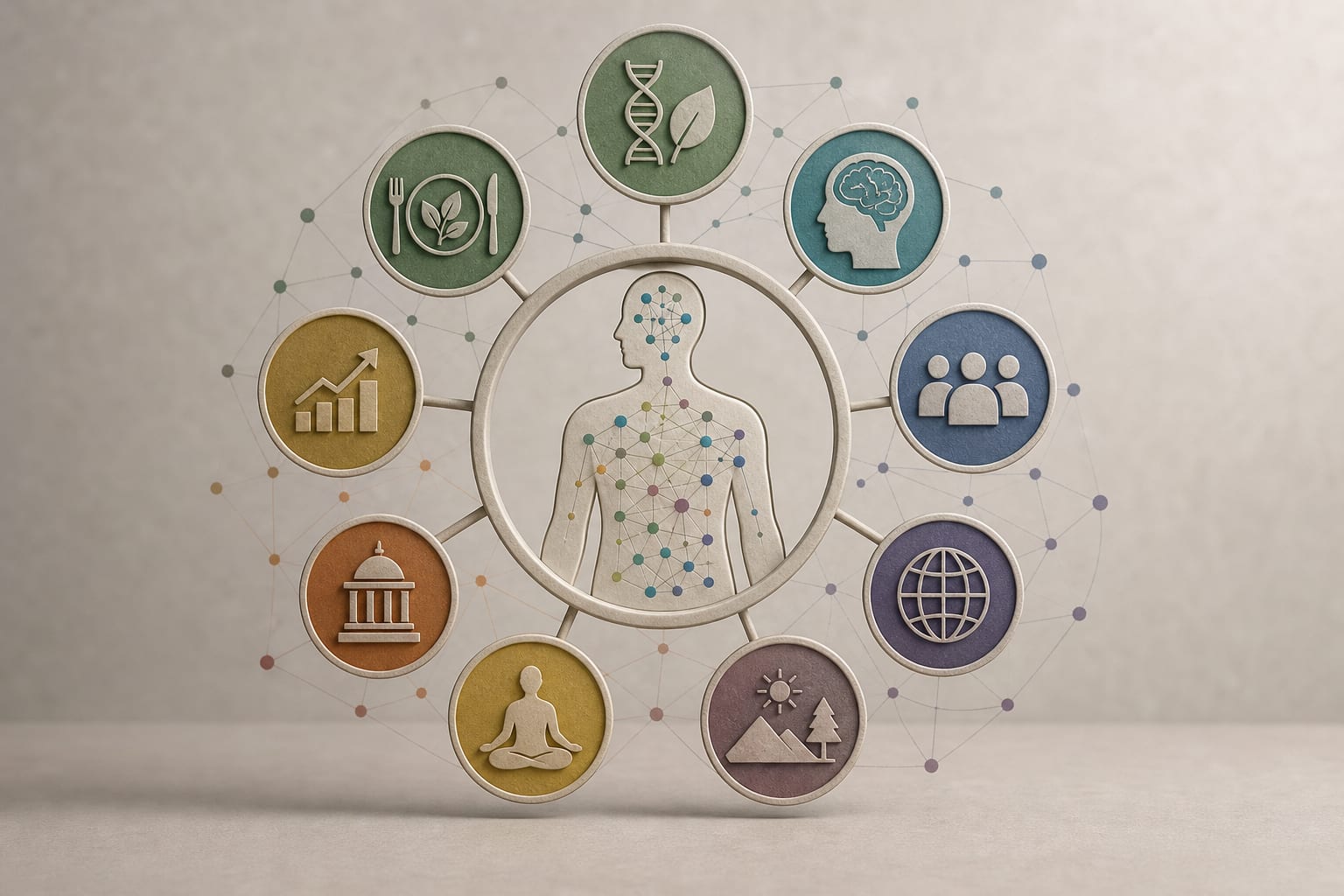
From Engel's Bio-Psycho-Social model to the personalized health determinants model: a comprehensive framework and illustrative operationalization for precision health - Summary - MDSpire
Advertisement
From Engel's Bio-Psycho-Social model to the personalized health determinants model: a comprehensive framework and illustrative operationalization for precision health
To propose the Personalized Health Determinants Model (PHDm) as an expansion of Engel's Bio-Psycho-Social model, addressing its limitations in specificity for precision health, particularly in nutrition, lifestyle, and socioeconomic factors.
Approach:
Key Findings:
The PHDm expands Engel's BPS model by providing a comprehensive framework for health determinants.
Preliminary evaluation on NHANES data showed −85% predictive accuracy for the Bayesian Network and −80% concordance for the rule-based system, based on initial findings.
The current model is a proof-of-concept and not yet a clinically validated decision-support tool.
Interpretation:
Limitations:
The model is based on four simplified factors and binary thresholds.
Further validation across diverse populations and clinical settings is necessary.
Resource constraints and complexity of holistic frameworks complicate implementation.
Conclusion:
The PHDm serves as a conceptual framework, inviting further validation and development before clinical application.
A long-term cohort study found that obesity was not associated with worse patient-reported outcomes or higher reoperation rates following total ankle replacement in optimized surgical candidates.
Turns out biology tracks more than we thought — from a spit test that reads your all-nighter to a surgical outcome that still shows up in household chores two decades later. Plus: habits aren't built gradually. They snap.