Quantitative multi-slice spiral CT perfusion parameters as predictors of collateral status and 90-day functional outcome in acute ischemic stroke - Summary - MDSpire
Conexiant’s news site is now MDSpire News. Learn more
Advertisement
Assessment of Quantitative Multi-Slice Spiral CT Perfusion Metrics as Indicators of Collateral Circulation and 90-Day Functional Outcomes in Acute Ischemic Stroke
To evaluate the utility of quantitative computed tomography perfusion parameters for assessing collateral circulation and predicting 90-day functional outcomes in acute ischemic stroke.
Approach:
Study Design: Retrospective study including 82 patients who underwent perfusion imaging within 24 hours of symptom onset.
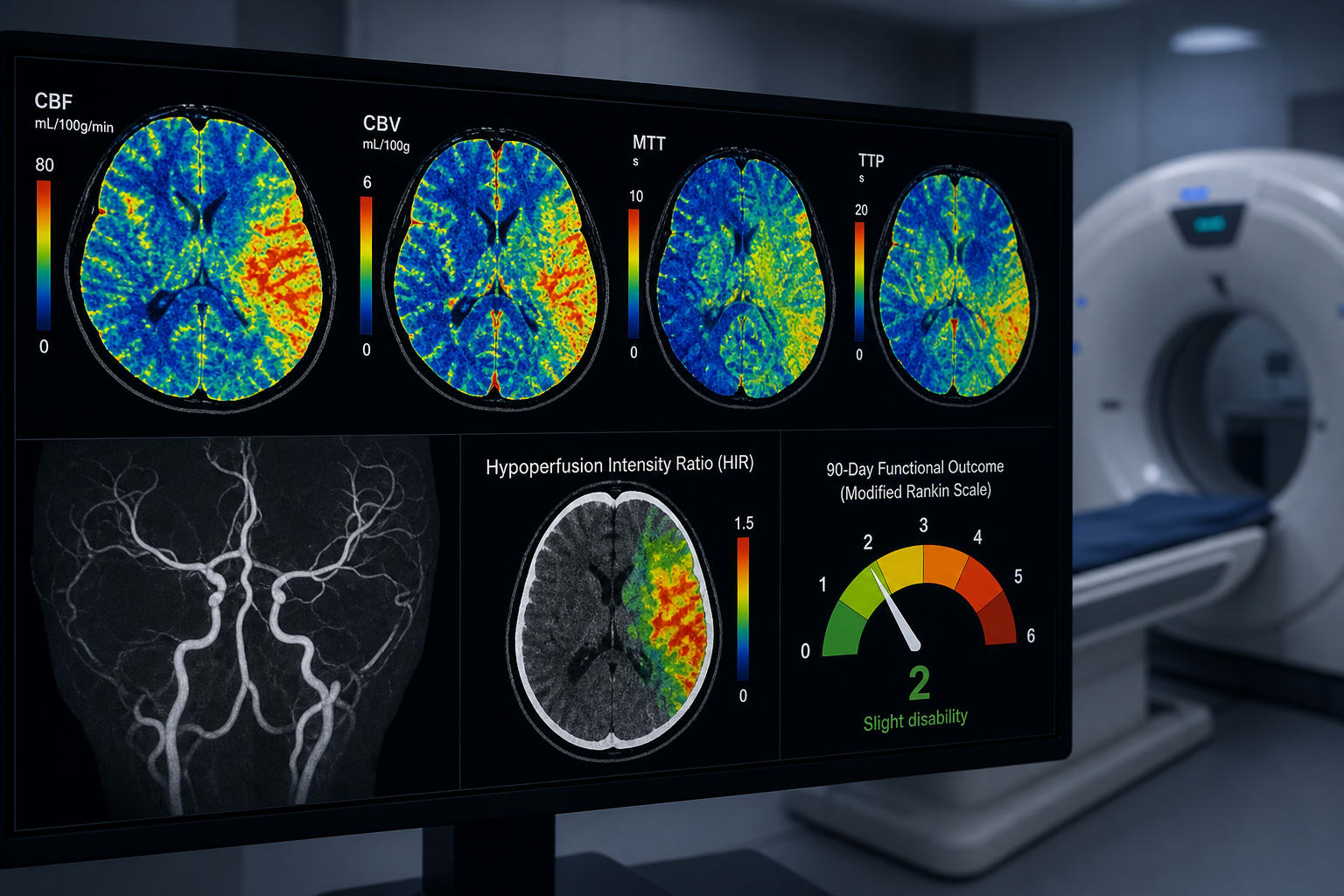
Parameters Analyzed: Included relative cerebral blood flow, relative cerebral blood volume, mean transit time, time to maximum, and hypoperfusion intensity ratio.
Collateral Status Classification: Classified using multiphase angiography.
Outcome Assessment: 90-day outcomes assessed using the modified Rankin Scale.
Key Findings:
Patients with robust collateral circulation showed higher relative cerebral blood flow and volume and shorter perfusion times.
Hypoperfusion intensity ratio demonstrated strong diagnostic performance (AUC 0.925).
For predicting unfavorable 90-day outcomes, HIR achieved an AUC of 0.912, outperforming mismatch ratio.
Combined HIR–rCBF–Tmax model achieved an AUC of 0.938.
Hypoperfusion intensity ratio correlated positively with functional disability, while relative cerebral blood flow correlated negatively with infarct volume.
Favorable outcomes were more frequent in patients with robust collaterals.
Interpretation:
Quantitative CTP parameters bridge anatomical collateral assessment and downstream tissue-level perfusion. HIR may provide a particularly informative functional marker of collateral efficiency and 90-day prognosis beyond conventional mismatch assessment.
Limitations:
Retrospective design may introduce selection bias.
Study conducted at a single institution, limiting generalizability.
Conclusion:
Quantitative CTP parameters can effectively assess collateral circulation and predict functional outcomes in acute ischemic stroke.