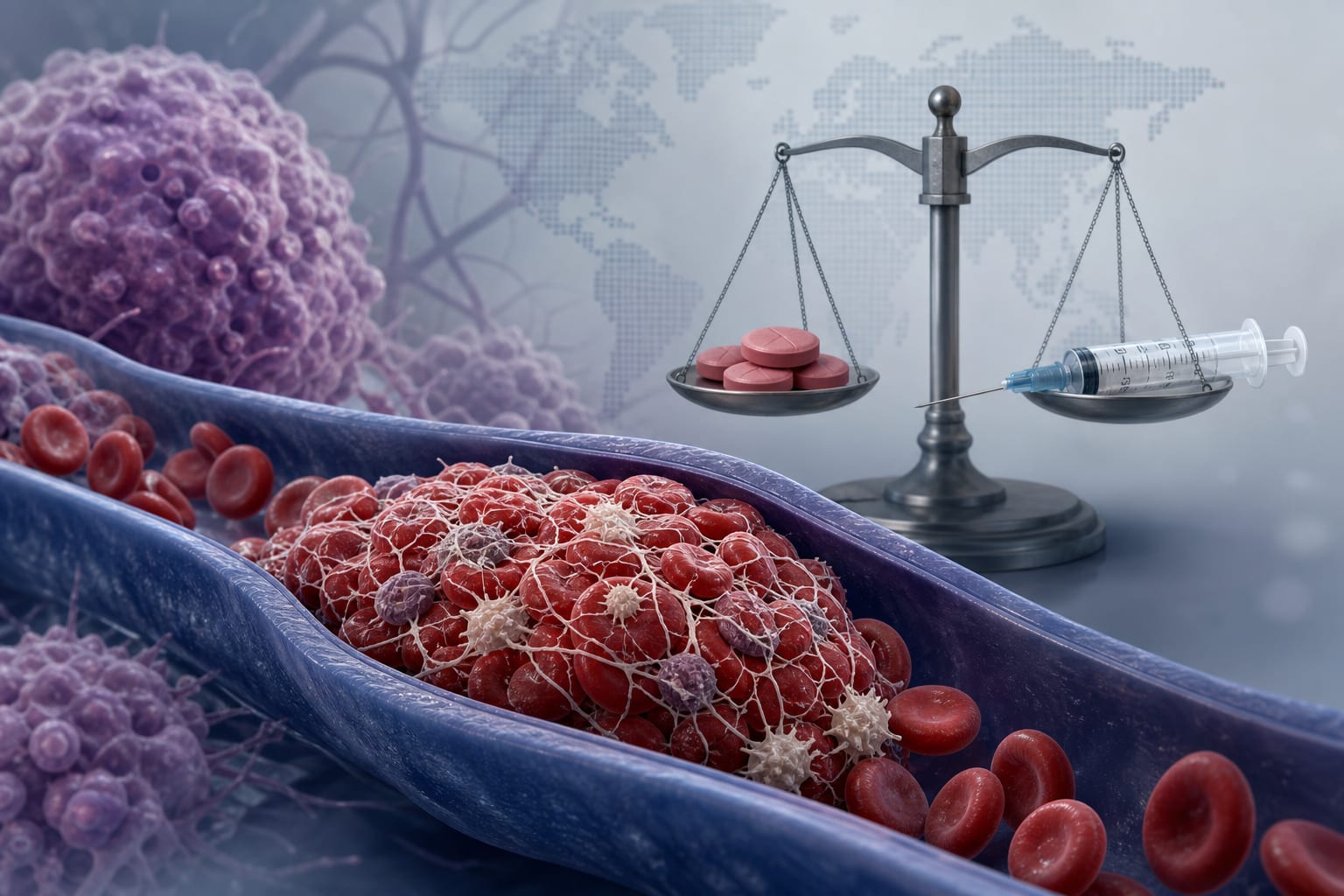
Safety and Effectiveness of Direct Oral Anticoagulants Versus Low-Molecular-Weight Heparin for Cancer-Associated Thrombosis: A Systematic Review and Meta-analysis - Summary - MDSpire

Safety and Effectiveness of Direct Oral Anticoagulants Versus Low-Molecular-Weight Heparin for Cancer-Associated Thrombosis: A Systematic Review and Meta-analysis

  • By

  • Wei Kang

  • Bowie P. Y. Lam

  • Rinko Tsz Lam Lau

  • Silvia T. H. Li

  • Kangrui Wu

  • Yue Wei

  • Yu Yang

  • Kyung Jin Lee

  • Caige Huang

  • Vincent K. C. Yan

  • Hei Hang Edmund Yiu

  • Shing Fung Lee

  • Aya El Helali

  • Victor H. F. Lee

  • Stephen L. Chan

  • Rina Y. M. Hui

  • Ka On Lam

  • Esther W. Chan

  • June 15, 2026

  • 0 min

Share

Objective:

To quantitatively analyze the overall safety and effectiveness of direct oral anticoagulants (DOACs) compared to low-molecular-weight heparin (LMWH) among patients with cancer-associated thrombosis (CAT).

Approach:
    Key Findings:
    • DOACs were associated with a significantly lower risk of recurrent venous thromboembolism compared to LMWH.
    • DOACs showed a significantly lower risk of all-cause mortality in cohort studies, but not in randomized controlled trials.
    • Safety profiles of DOACs and LMWH were comparable, with no significant increase in major bleeding risk for DOACs.
    Interpretation:

    Limitations:
    • Variability in study design, follow-up periods, and outcome measurements contributed to heterogeneity.
    • RCTs referenced in guidelines may have been underpowered to detect certain clinical outcomes.
    Conclusion:

Original Source(s)

Related Content