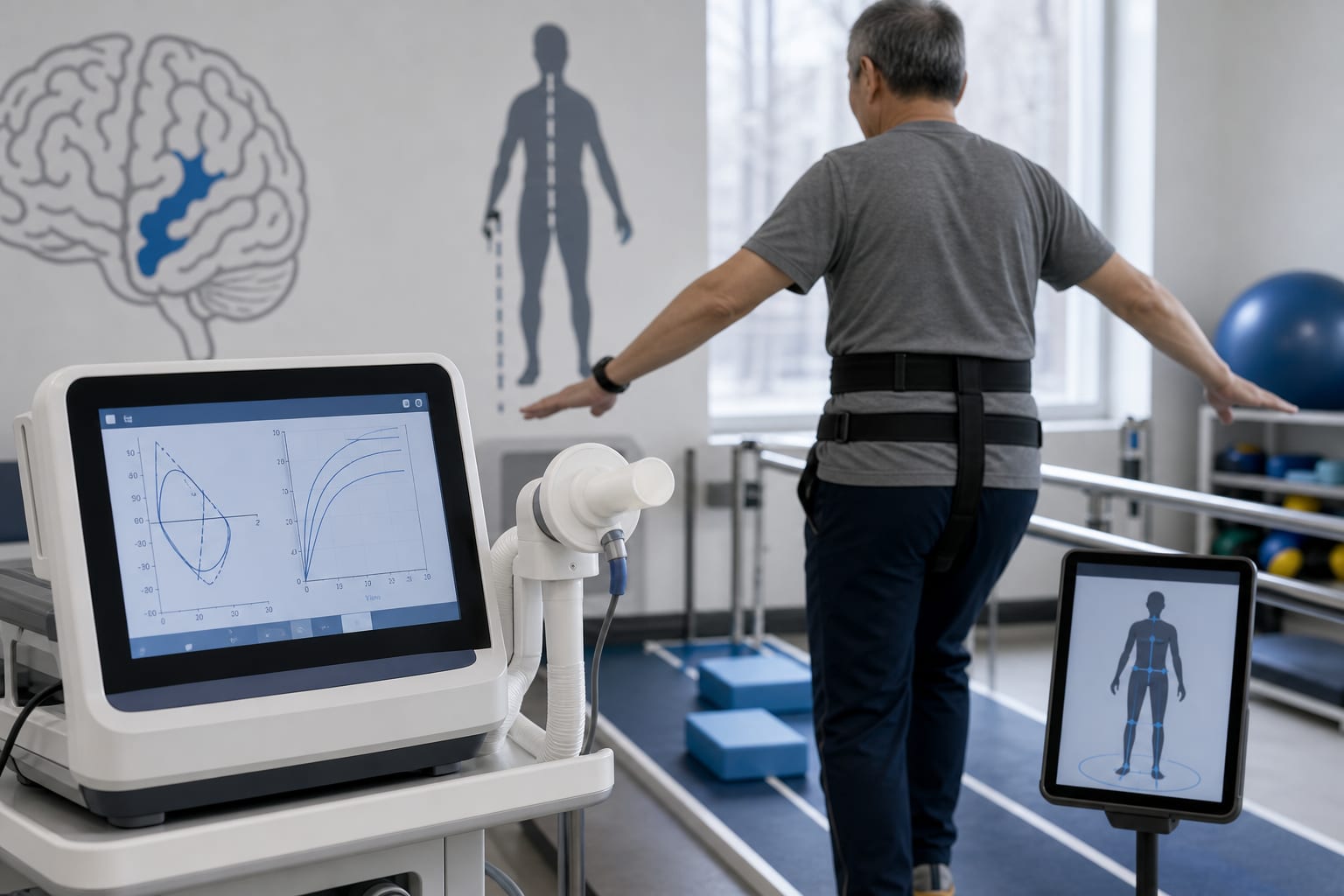
To provide empirical evidence supporting the integration of pulmonary assessment into multidisciplinary stroke rehabilitation by examining associations between pulmonary function parameters and functional domains in stroke survivors.
Approach:
Key Findings:
BBS and FMA-LE scores positively correlated with VC%, FEV1%, and PEF% (r = 0.30–0.48, p < 0.05).
TIS scores positively associated with multiple pulmonary parameters (VC%, IC%, FVC%, FEV1%, FEV1/FVC, PEF%, MVV%; r = 0.31–0.54, p < 0.05).
Strongest correlation observed between TIS and PEF% (r = 0.54, p < 0.001).
PEF% negatively correlated with COP path length and velocity (rs = −0.30 to −0.33, p < 0.05).
95% confidence ellipse area negatively correlated with IC% (rs = −0.40, p < 0.01) and PEF% (rs = −0.34, p < 0.05).
Interpretation:
The results support the integration of simple pulmonary screening, particularly PEF measurement, into stroke rehabilitation workflows to enhance multidisciplinary collaboration.
Limitations:
The study is observational and cross-sectional, limiting causal inferences.
Sample size may restrict generalizability of findings.
Conclusion:
Integrating pulmonary assessment into stroke rehabilitation may improve long-term functional outcomes for stroke survivors.