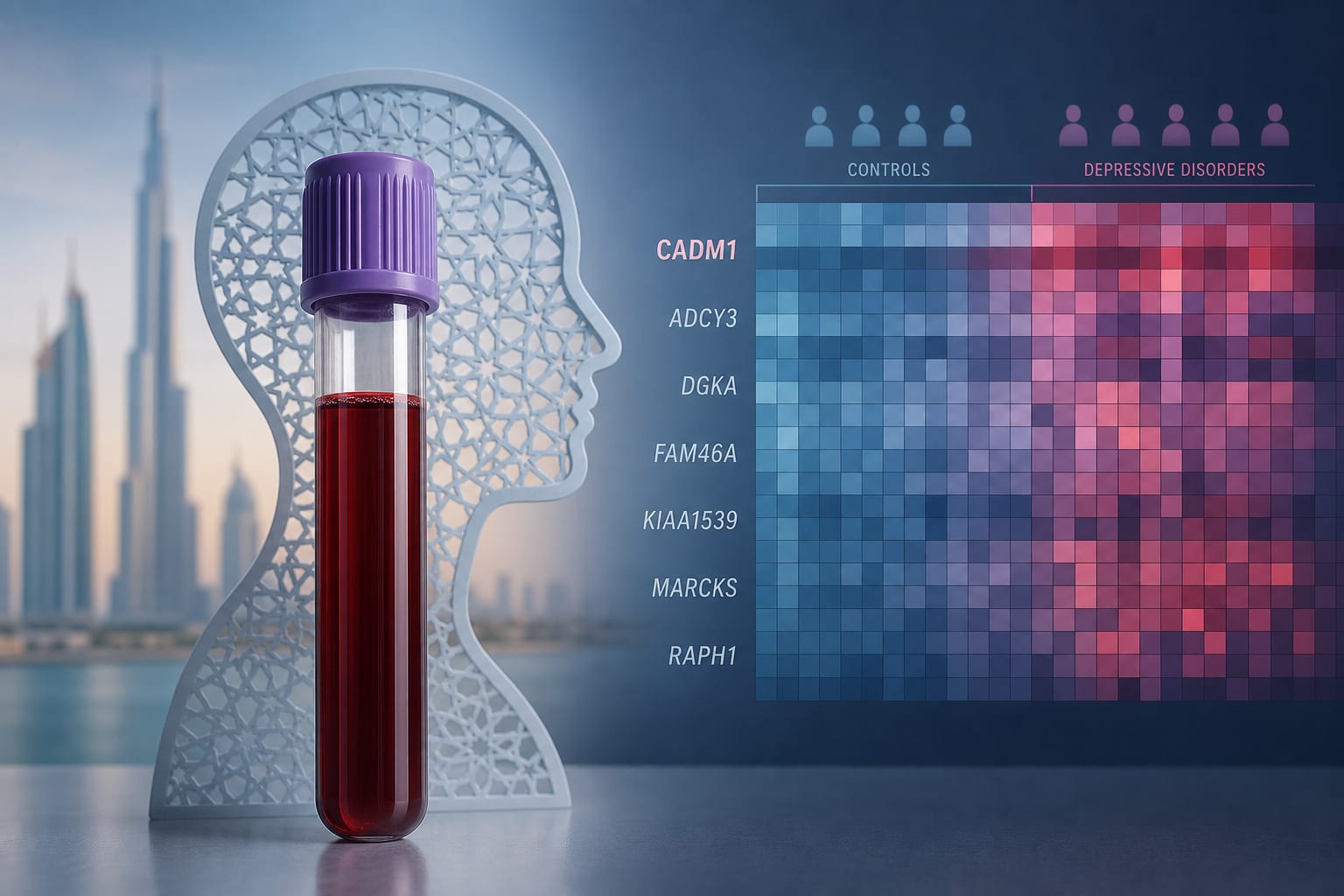
Peripheral blood CADM1 expression and multi-gene signatures in depressive disorders: a pilot case-control study from the United Arab Emirates - Summary - MDSpire
Advertisement
Peripheral blood CADM1 expression and multi-gene signatures in depressive disorders: a pilot case-control study from the United Arab Emirates
To investigate peripheral blood expression of seven candidate genes in adults with and without depressive disorders in the UAE.
Approach:
Study Design: A case-control study involving 49 adults with depressive disorders and 49 non-depressed controls.
Assessment Tools: Participants were assessed using the Beck Depression Inventory-II and Patient Health Questionnaire-9.
Gene Expression Measurement: Peripheral blood expression of seven genes was measured by quantitative real-time PCR, normalized to GAPDH.
Statistical Analysis: Analyses included Mann-Whitney U tests, principal component analysis, fold-change estimation, and receiver operating characteristic analysis.
Key Findings:
CADM1 showed modest upregulation in the depressive disorder group (1.30-fold; Mann-Whitney p = 0.049, uncorrected).
Principal component analysis revealed an unadjusted PC2 difference (p = 0.006), driven by CADM1 and RAPH1, that did not survive age adjustment (MANCOVA p = 0.156).
CADM1 correlated negatively with depression severity (BDI-II ρ = −0.280, p = 0.005), with the signal strengthening across severity strata.
The CADM1 area under the receiver operating characteristic curve was 0.616, indicating no diagnostic utility.
Interpretation:
The findings indicate that CADM1 may warrant further investigation in depressive disorders, but the results are not robust enough for clinical application.
Limitations:
Small sample size.
Mean age difference of 13 years between groups.
Unmeasured confounders may affect results.
Conclusion:
The study provides preliminary data on gene expression related to depression in a UAE population, highlighting the need for validation in larger, age-matched studies.