Integrative single-cell transcriptomics and mendelian randomization identifies BTN3A2 as a shared protective factor in Behçet’s disease and inflammatory bowel disease - Summary - MDSpire
Conexiant’s news site is now MDSpire News. Learn more
Advertisement
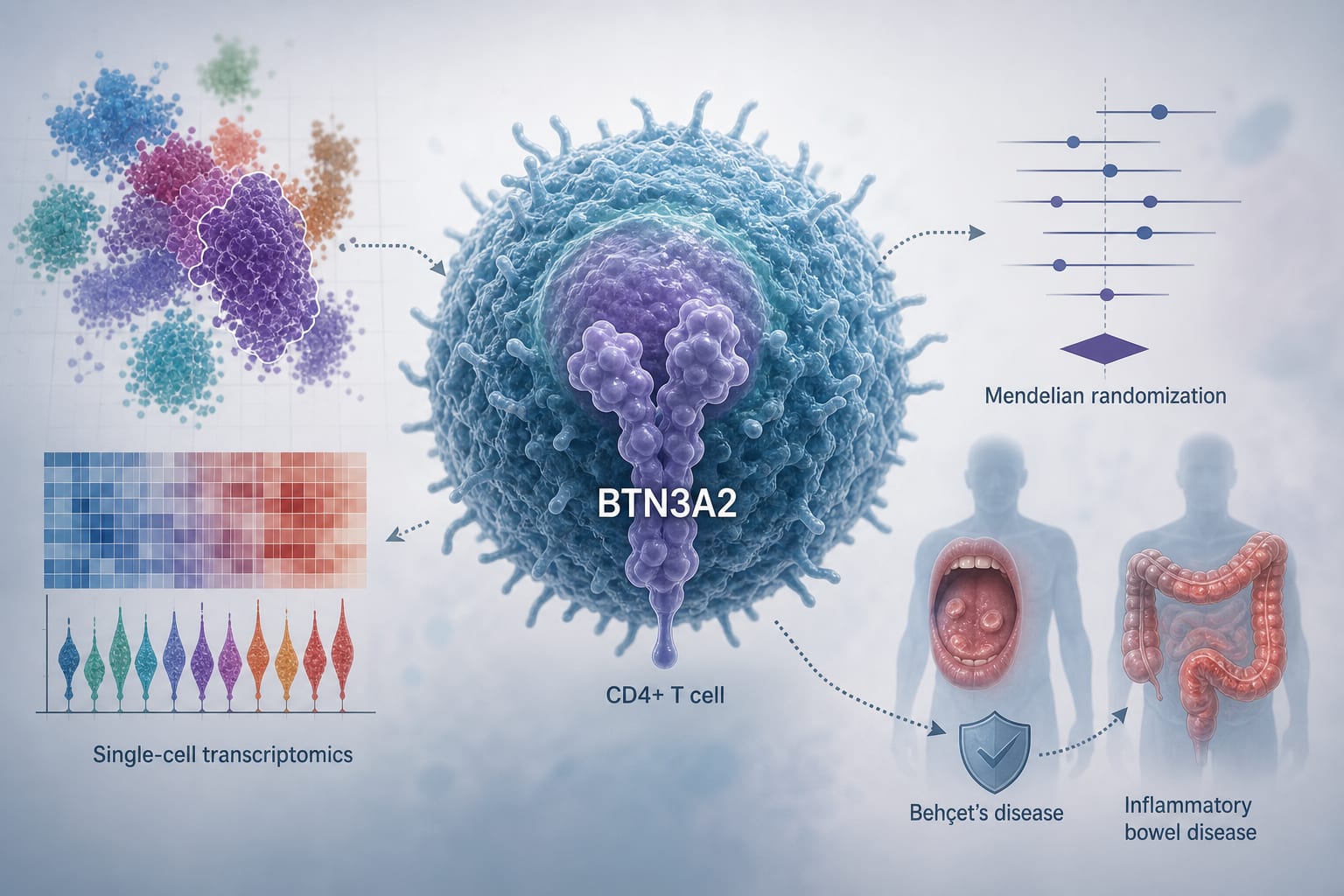
Integrative Analysis of Single-Cell Transcriptomics and Mendelian Randomization Reveals BTN3A2 as a Common Protective Factor in Behçet’s Disease and Inflammatory Bowel Disease
To explore potential links and shared treatment targets between Behçet’s disease (BD) and inflammatory bowel disease (IBD).
Approach:
scRNA-seq Analysis: Analyzed single-cell RNA sequencing data from peripheral blood of BD and IBD patients to identify key immune cell subsets.
Mendelian Randomization: Combined expression quantitative trait loci (eQTL) and genome-wide association study (GWAS) data to infer causal relationships between key gene expressions in BD and IBD.
Validation: Used experimental autoimmune uveitis (EAU) mouse model, external datasets, and blood samples from BD uveitis patients for validation.
Key Findings:
Significant decrease in CD4+ TEM_TH1-like cells in both BD and IBD.
BTN3A2 identified as a protective gene in both BD and IBD.
Co-localization of BTN3A2 eQTL and BD GWAS signals.
Distinct cell-cell communication networks and pathway enrichment characteristics between BTN3A2+ and BTN3A2- CD4+ TEM_TH1-like cells.
EAU mouse model displayed IBD-like colonic pathology and elevated IL-1β expression.
Downregulation of BTN3A2 at mRNA and protein levels in BD patients with uveitis.
Interpretation:
BTN3A2 is identified as a protective factor in BD and IBD.
Conclusion:
The study identifies BTN3A2 as a common protective factor in BD and IBD.