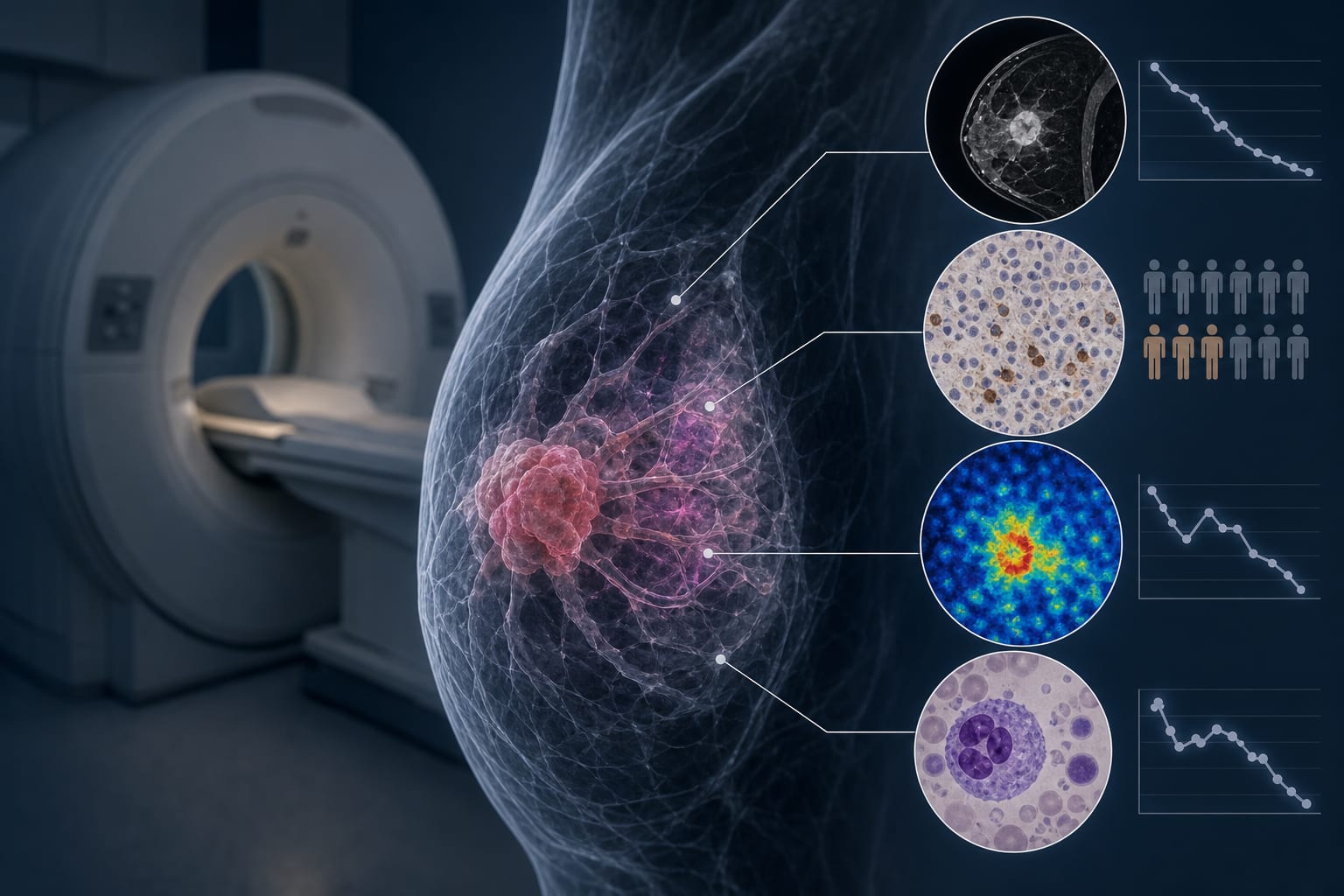
To develop and internally validate a multimodal prediction model for neoadjuvant therapy (NAT) non-response in breast cancer patients by integrating various data types.
Key Findings:
33.9% of patients were identified as non-responders to NAT, indicating a significant portion of the cohort.
Individual domain models achieved AUCs of 0.844 (clinical), 0.786 (imaging), 0.828 (TME), and 0.706 (inflammatory), demonstrating varying predictive capabilities.
The multimodal model yielded an AUC of 0.933, with bootstrap-corrected AUC of 0.855 and mean five-fold cross-validation AUC of 0.908 ± 0.038, indicating strong predictive performance.
Independent predictors included TILs, TSR, PIV2, and Ki-67, which are critical for understanding treatment response.
Interpretation:
The multimodal prediction model shows potential for early identification of breast cancer patients unlikely to benefit from NAT, which could guide treatment decisions.
Limitations:
Limited sample size may affect the generalizability of the findings.
Performance estimates require cautious interpretation and external validation is essential.
Conclusion:
The study presents a promising multimodal model for predicting NAT non-response, but further validation is necessary to confirm its applicability in broader clinical settings.