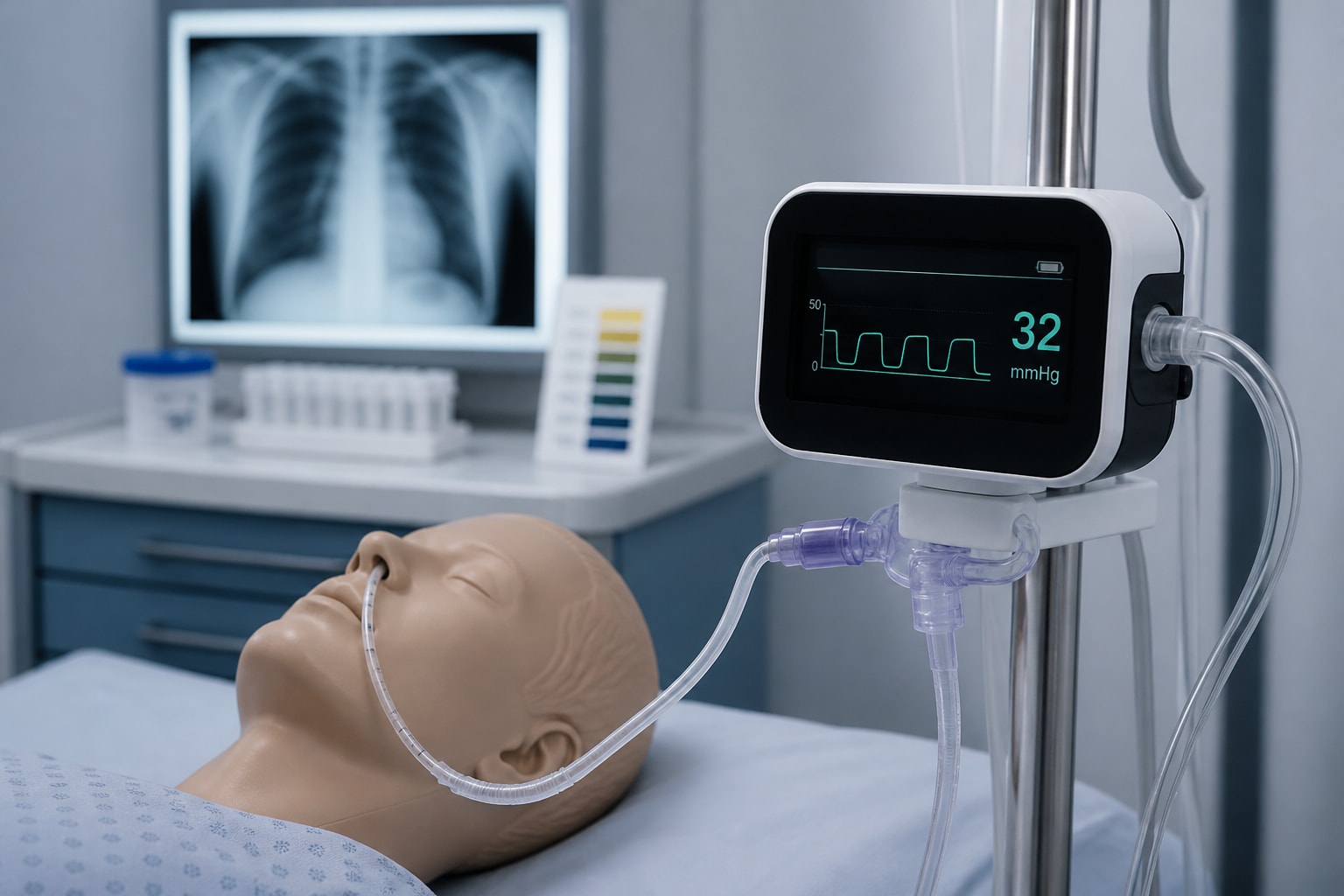
To question whether the reported cost savings for capnography account for the additional verification required when aspirate pH is unavailable or inconclusive.
Approach:
Study and cost estimate: The letter reviews a 21-hospital study of 508 patients and its hypothetical comparison of capnography with radiography for all patients.
Pathway analysis: It uses reported marginal counts to estimate how many patients with negative capnography results also lacked aspirate or had pH > 5.5, while noting that their exact overlap is unknown.
Key Findings:
At an ETCO₂ threshold of >5 mmHg, 23 patients tested positive and 485 negative; the reported hypothetical saving was HK$210.3 per patient versus radiography for all patients.
Aspirate was unavailable in 241 patients and pH was >5.5 in 61, totaling 302 patients with these findings.
Given the reported counts, at least 279 of the 485 capnography-negative patients had unavailable aspirate or pH >5.5; the precise overlap requires joint-result data.
Interpretation:
The letter argues that the cost estimate does not establish the costs of a combined capnography-and-pH pathway, because the subsequent confirmation steps for patients without a usable pH result are unspecified.
Limitations:
The exact overlap between capnography results, aspirate availability, pH category, and radiographic position is not reported in the cited table.
The cost comparison is described as hypothetical and separate from a cost-effectiveness analysis.
The cohort included indications beyond nutritional support, and the appropriate pathway may depend on local practice and intended tube use.
Conclusion:
The letter asks the authors to provide joint-result data and recalculate costs for a clearly specified verification pathway, including any repeat bedside checks, imaging, repositioning, or alternative confirmation methods.