VANGL1 links angiogenesis–stemness programs and tumor microenvironment remodeling: a pan-cancer, multi-omics study with translational validation - Summary - MDSpire

VANGL1 links angiogenesis–stemness programs and tumor microenvironment remodeling: a pan-cancer, multi-omics study with translational validation

  • By

  • Wei Zhou

  • Lizhen Wang

  • Mengxing Li

  • Xuan Liu

  • Qing Fang

  • Yang Yu

  • Songjie Zhang

  • Jing Guo

  • Rui Chang

  • Cheng Zhang

  • Tongliang Zhou

  • Yang Liu

  • Xiaoxia Ren

  • Honglin Liu

  • Lihong Liu

  • May 29, 2026

  • 0 min

Share

Objective:

To investigate the expression landscape, clinical relevance, and mechanistic role of VANGL1 in tumor progression across various cancer types.

Key Findings:
  • VANGL1 was significantly upregulated in solid tumors and associated with poor prognosis.
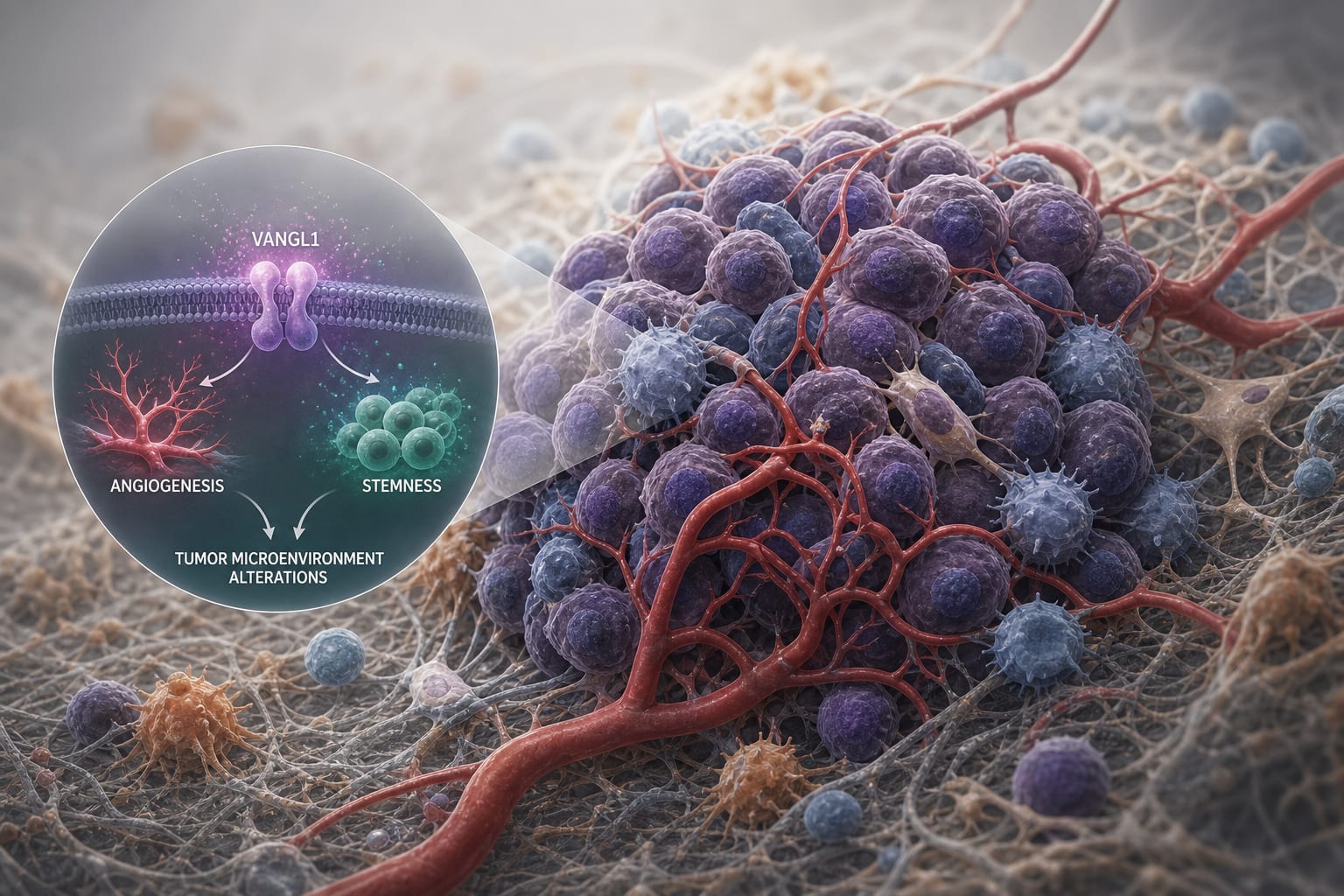
  • Single-cell analysis indicated enhanced communication between VANGL1+ malignant cells and stromal components.
  • VANGL1 integrated Wnt/Notch/mTOR signaling with cancer stemness and angiogenesis.
  • Knock-down of VANGL1 suppressed tumor cell proliferation, migration, and invasion in vitro, and reduced tumor growth and angiogenesis in vivo.
Interpretation:

VANGL1 serves as a master regulator linking cancer stemness, angiogenesis, and tumor microenvironment remodeling across multiple cancer types.

Limitations:
  • The study's exploratory nature limits the generalizability of findings without cross-cancer false discovery rate correction.
  • Potential biases in data acquisition and analysis methods may affect results.
Conclusion:

VANGL1 is identified as a pan-cancer therapeutic target, highlighting its role in the tumor microenvironment.

Original Source(s)

Related Content