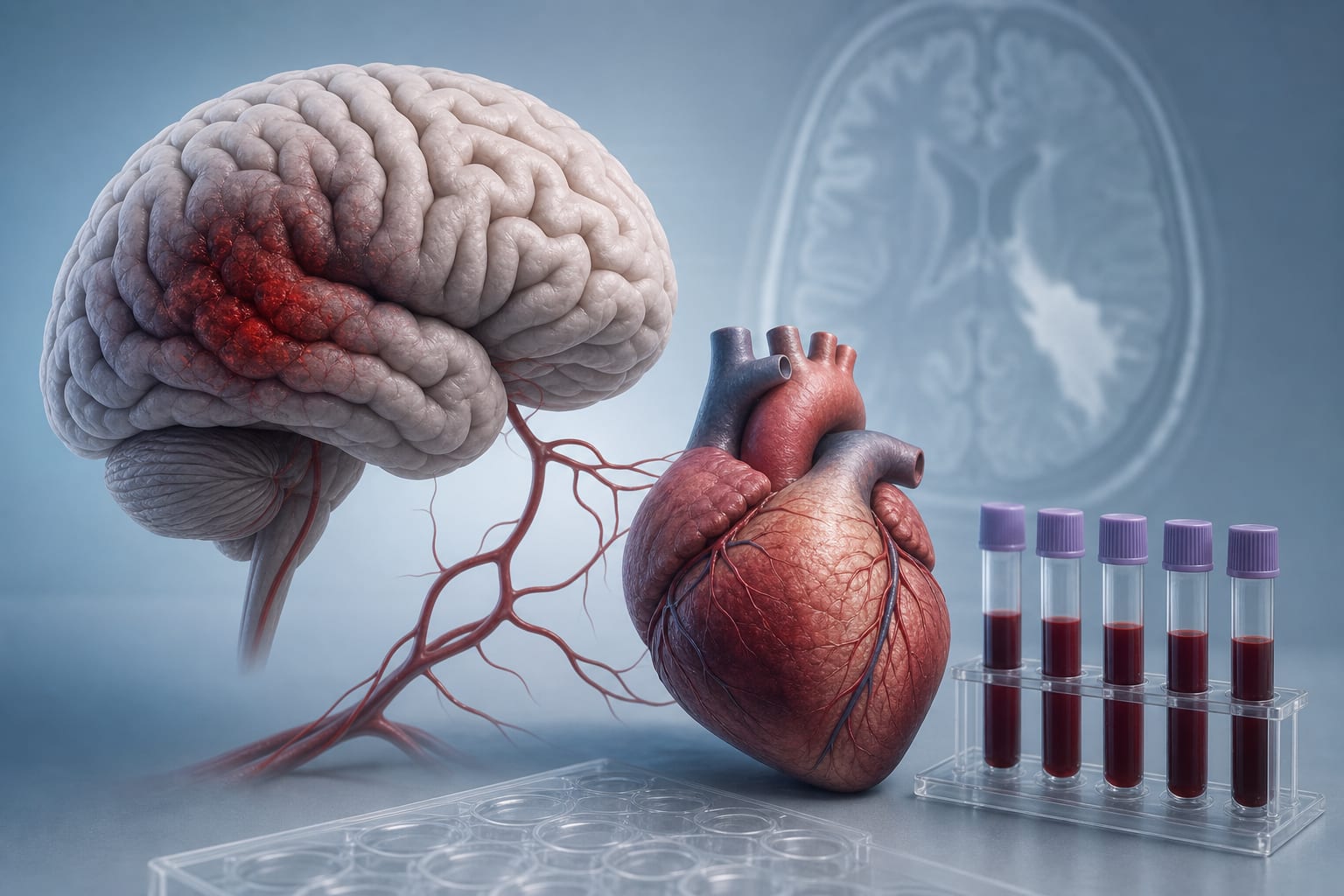
To investigate the significance of multiple cardiovascular biomarkers for cerebral–cardiac syndrome (CCS) in patients with acute ischemic stroke (AIS).
Approach:
Study Design: Retrospective analysis of 177 AIS patients admitted to Yongchuan People’s Hospital of Chongqing from March 2022 to March 2023.
Biomarker Measurement: Plasma levels of BNP, cTnI, Myo, CK-MB, D-Dimer, FDP, and CRP were measured.
Statistical Analysis: Multivariable Firth’s penalized logistic regression was used to identify independent risk factors for CCS, with receiver operating characteristic analysis and bootstrap validation for diagnostic performance.
Key Findings:
CCS occurred in 97 patients (54.8%).
BNP, DD, cTnI, Myo, and CK-MB were significantly elevated in the CCS group (p < 0.001).
Age, BNP, and Myo were identified as independent risk factors for CCS.
The combined model of age, BNP, and Myo had an AUC of 0.945, indicating excellent discriminatory ability.
Interpretation:
Age, BNP, and Myo constitute a robust diagnostic model for early identification of CCS in AIS patients.
Limitations:
Retrospective design may introduce bias.
Single-center study limits generalizability.
Conclusion:
The study investigates the potential of using age, BNP, and Myo for risk stratification in CCS management.