Atypical Presentation of Persistent Sore Throat in an Older Adult
-
November 17, 2026
Objective:
To describe disseminated blastomycosis presenting as persistent unilateral sore throat and an oropharyngeal lesion suspicious for malignancy.
Approach:
- Clinical evaluation: A 78-year-old man with 4 months of left-sided sore throat and odynophagia underwent otorhinolaryngologic assessment and direct laryngoscopy with biopsy.
- Diagnostic testing: Biopsy histology and GMS/PAS staining, fungal PCR, serology, urine antigen testing, and chest imaging were used to evaluate the lesion and suspected dissemination.
- Treatment: Itraconazole was started, then stopped after suspected cardiotoxicity; liposomal amphotericin B was given for 1 week with posaconazole, which was continued as maintenance therapy.
Key Findings:
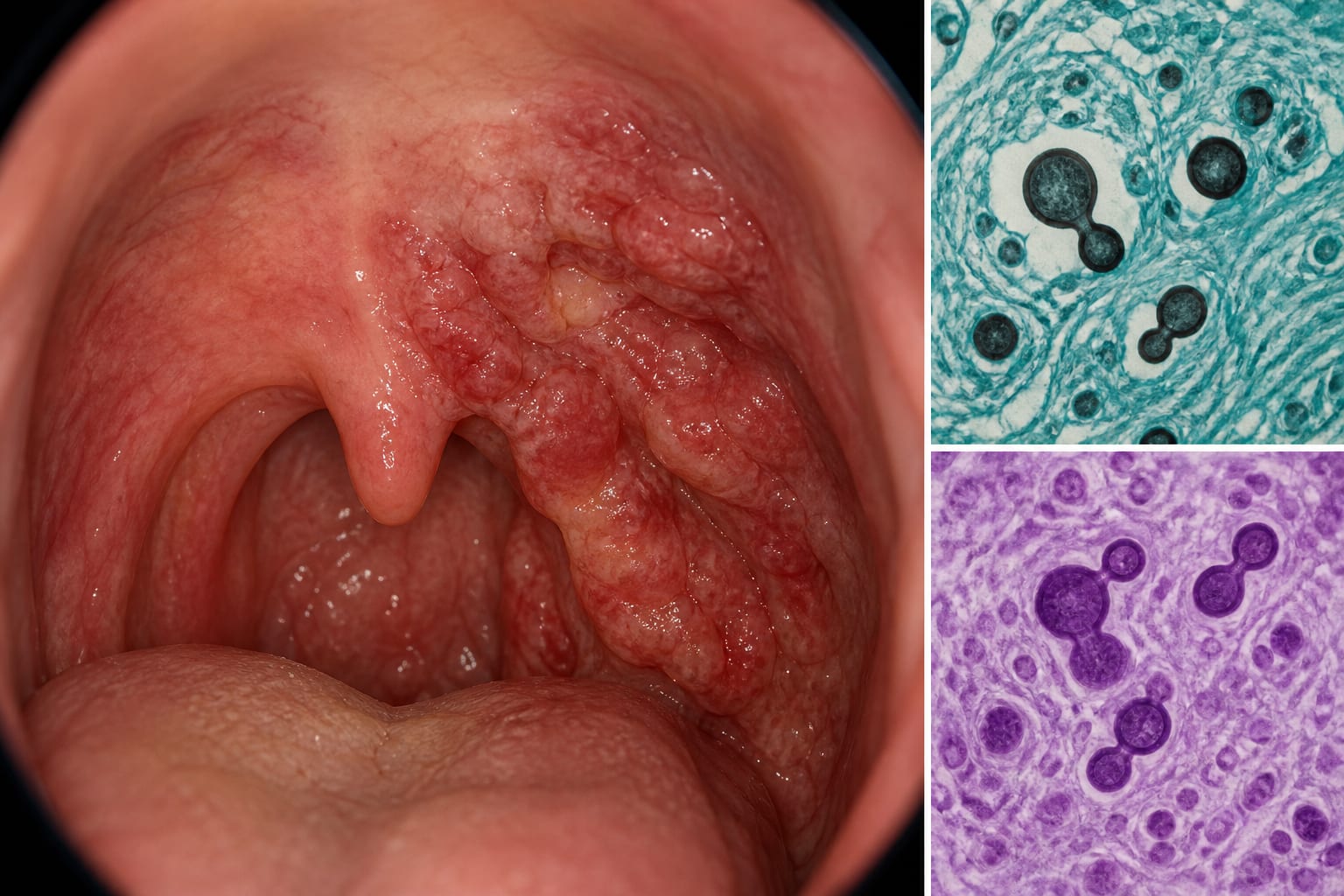
- Laryngoscopy showed irregular erythematous mucosa involving the left soft palate and tonsillar fossa; biopsy showed ulceration, acute inflammation, and nonnecrotizing granulomas without malignancy.
- GMS and PAS staining showed broad-based budding yeasts, and tissue PCR detected Blastomyces dermatitidis/Blastomyces gilchristii.
- Chest imaging showed bilateral pulmonary opacities; the initial Blastomyces urine antigen concentration exceeded 20 ng/mL, and serum antibody tests were positive.
- After 4 weeks of itraconazole, the patient developed worsening exertional dyspnea, reduced left ventricular ejection fraction, pleural effusions, and elevated NT-proBNP; itraconazole-induced heart failure was suspected.
- Symptoms resolved after antifungal treatment. At 12 months, chest CT showed resolved mediastinal lymphadenopathy and pulmonary opacities that were stable to mildly improved; urine antigen remained detectable below quantification, and therapy continued to 15 months.
Interpretation:
The authors interpreted the findings as disseminated blastomycosis with oropharyngeal involvement, an uncommon presentation that can mimic malignancy. They emphasized that biopsy with fungal stains and molecular testing can establish the diagnosis when clinical appearance is concerning for cancer. The pulmonary findings and positive antigen and antibody tests supported dissemination. They also noted the suspected itraconazole-associated heart failure and the need to monitor for cardiac adverse effects and adapt antifungal treatment when toxicity occurs. The case illustrates that clinical and radiographic improvement may occur while urine antigen remains detectable, so treatment decisions should consider the overall clinical course.
Limitations:
- Fungal cultures were not obtained from the biopsy, and fungal blood cultures were negative.
- No follow-up imaging or laryngoscopic examination of the oropharyngeal lesion was performed because symptoms resolved.
- The provided article text ends during the month-15 urine antigen result.
Conclusion:
Blastomycosis should be considered in the differential diagnosis of persistent oropharyngeal lesions, including those that resemble malignancy. Tissue examination and molecular testing can help establish the diagnosis. Treatment requires attention to potential itraconazole-associated cardiac toxicity and may need to be adjusted based on clinical response and adverse effects.
Sources:
Based on findings from:
An Atypical Case of Prolonged Sore Throat
Annals Of Internal Medicine: Clinical Cases, 2026.
https://www.acpjournals.org/doi/10.7326/aimcc.2026.0382
This content is an AI-generated, fully rewritten summary based on a published scholarly article. It does not reproduce the original text and is not a substitute for the original publication. Readers are encouraged to consult the source for full context, data, and methodology.