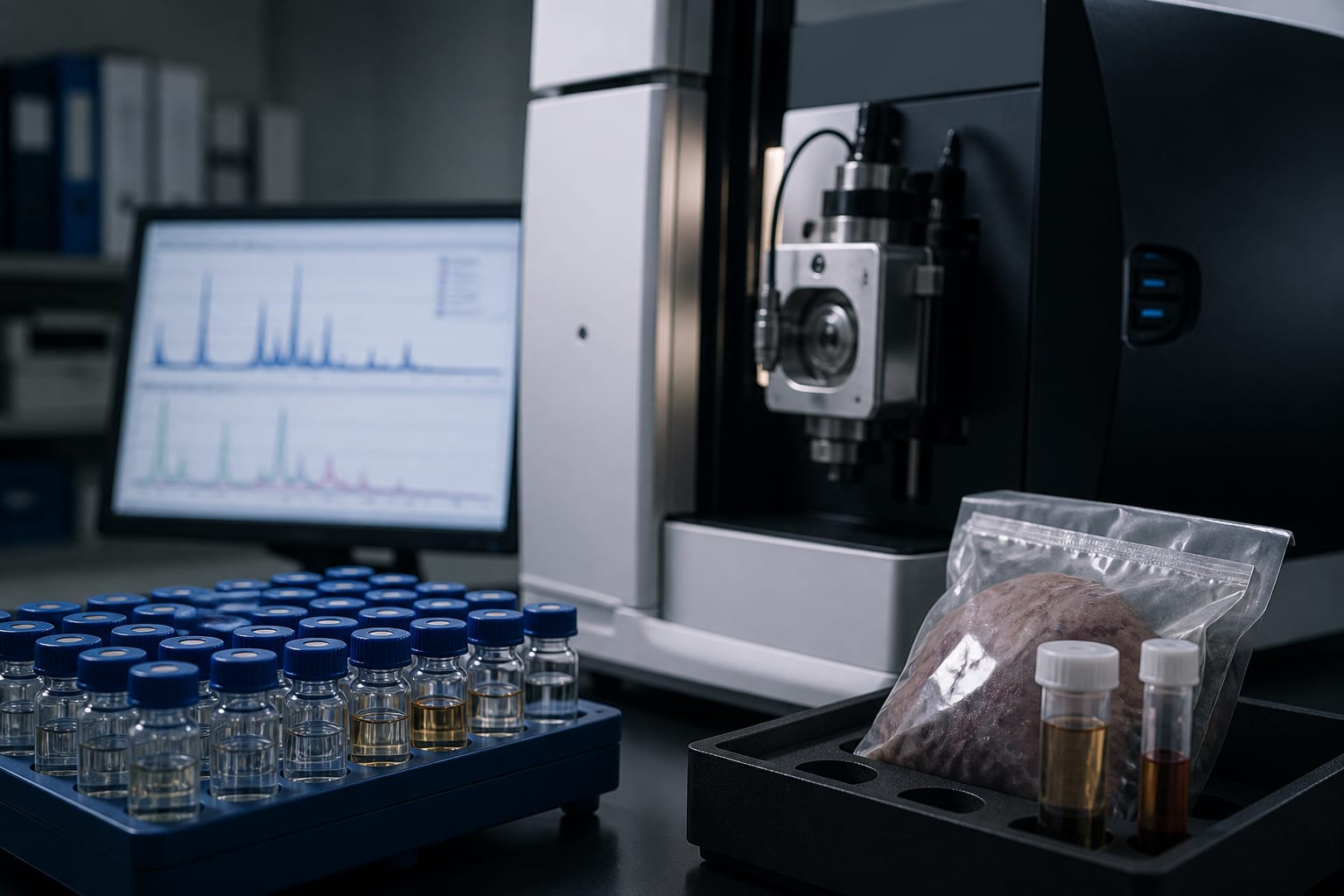
The article examines the objective, findings, and clinical context described in A Glimpse into the Future of Analytical Instrument Design?.
Approach:
Development: The system evolved from academic projects in computational imaging and machine learning, including BlurryScope, into a scanner intended for routine pathology use.
Image acquisition and reconstruction: Unlike conventional stop-and-stare scanners, SCANIMUS records video during continuous stage movement at about 10–20 mm/s. An image-to-image AI model is trained using paired fast, blurred scans and much slower, high-quality reference scans to reconstruct sharp …
Alternative mode and robotics: A slower stop-and-stare mode is also available, though the interviewee says it does not match high-end commercial scanners’ throughput. Robotic features can record user interactions and may support personalized workflows and automation.
Key Findings:
The interviewee reports that computational reconstruction can reliably recover sharp images from fast, motion-blurred scans.
The system is designed to be compact and straightforward to integrate into pathology workspaces.
The interviewee notes that more than 90% of routine biopsies are not digitized, including in well-resourced healthcare systems.
The proposed design principle is to co-design acquisition and reconstruction, accepting controlled, characterized imperfections rather than optimizing optics, mechanics, and computation independently.
Interpretation:
The interviewee argues that computation can be incorporated into the measurement process itself, provided the acquisition imperfections are controlled and characterized. Reconstructed images should be treated as derived measurements, with raw data retained and validation including reference comparisons, testing beyond training conditions, failure-mode stress tests, application-level metrics, uncertainty assessment, and data provenance.
Limitations:
The context is an interview and does not provide quantitative performance results or independent validation data.
The slower stop-and-stare mode uses more modest hardware and a smaller camera and is described as having lower throughput than high-end commercial scanners.
The source text ends mid-sentence after “In our BlurryScope,” so further details on validation are unavailable.
Conclusion:
SCANIMUS illustrates a scanner architecture that pairs continuous acquisition with AI-based reconstruction. The interviewee emphasizes that this approach is not a claim that software can repair arbitrarily poor measurements.