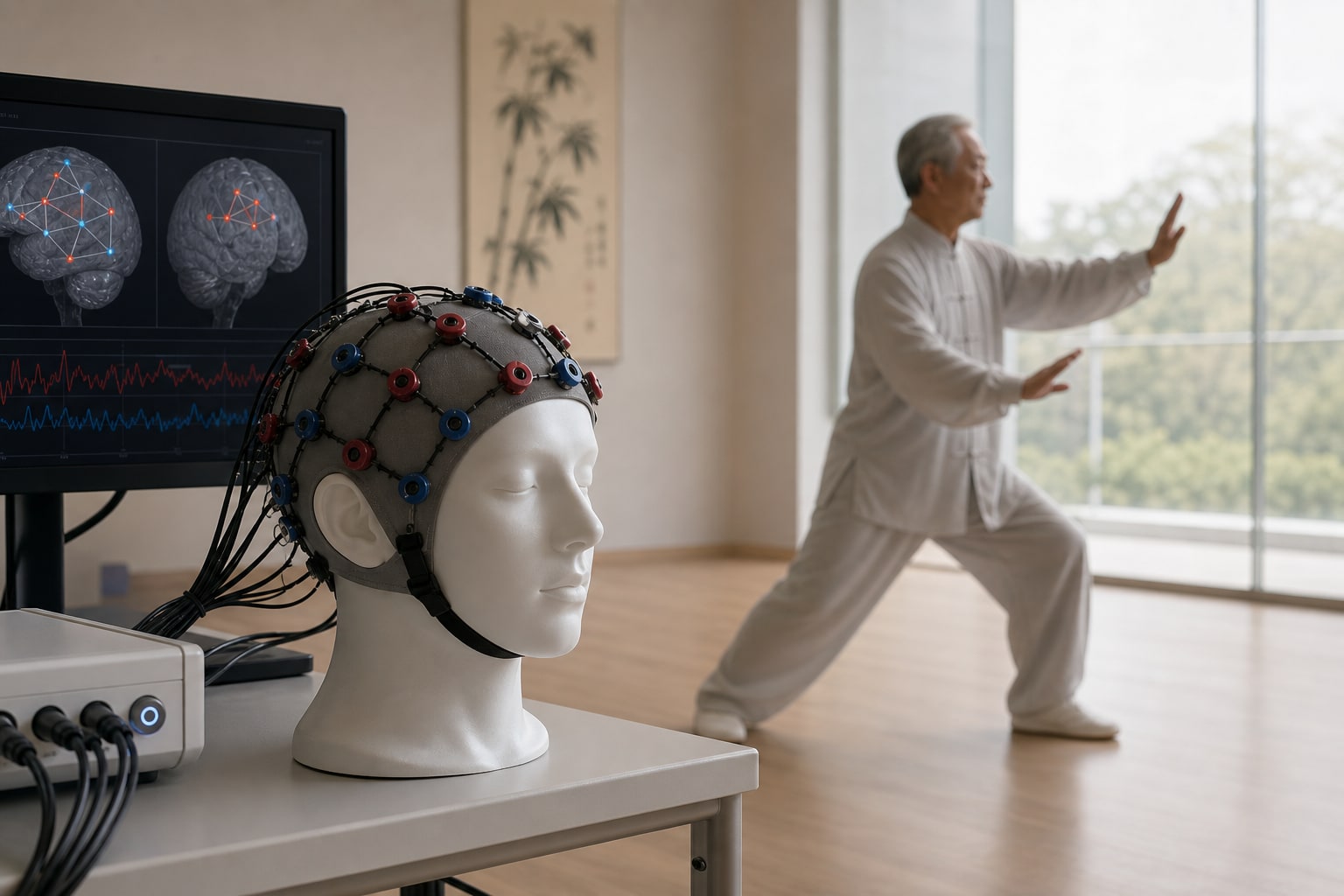
To evaluate the effects of a 2-week Tai Chi Cloud Hands regimen on balance and resting-state functional connectivity in post-stroke patients, specifically focusing on improvements in balance metrics and brain connectivity patterns.
Key Findings:
The intervention group showed significant improvements in BBS (adjusted difference = 3.215 points, p < 0.05) and MBI (adjusted difference = 6.056 points, p < 0.05).
Notable reductions in COP path length (adjusted difference = -115.816 mm, p < 0.05) and sway area (adjusted difference = -79.480 mm2, p < 0.05) were observed.
Enhanced connectivity was found in DLPFC–PreM and PreM–M1 interactions, with decreased SMA–SMA connectivity, indicating potential neural mechanisms underlying balance improvements.
Interpretation:
The Tai Chi Cloud Hands regimen significantly improved balance and functional outcomes in post-stroke patients, alongside specific changes in prefrontal-motor connectivity.
Limitations:
The study was limited to a short intervention period of 2 weeks, which may restrict the generalizability of the findings.
Findings regarding connectivity should be interpreted as associative rather than mechanistic, highlighting the need for further research.
Conclusion:
Integrating Tai Chi Cloud Hands into conventional rehabilitation enhances balance and daily functioning in post-stroke patients, with associated changes in brain connectivity.