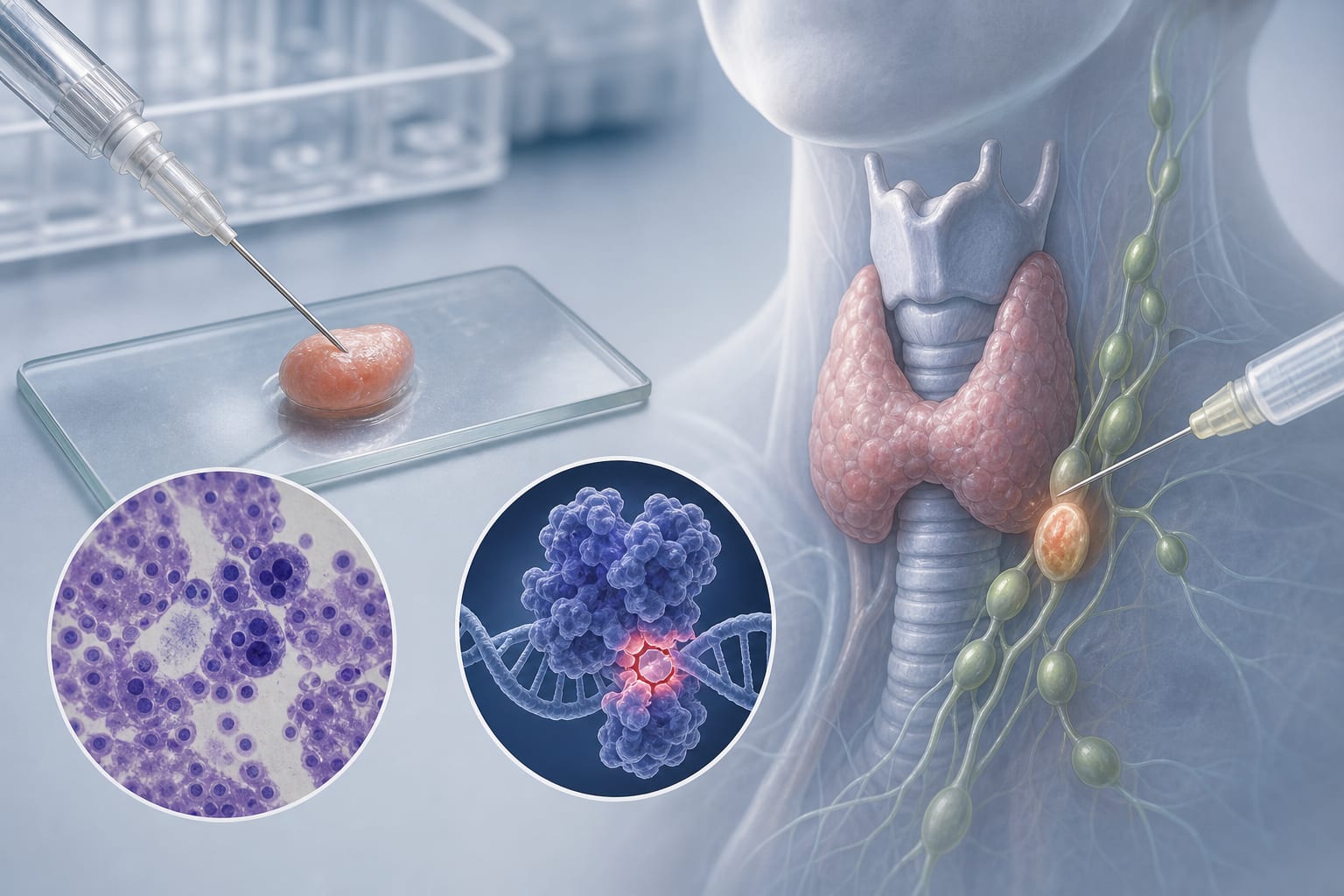
Risk-adapted trajectory selection for ultrasound-guided thyroid fine-needle aspiration biopsy: a multicenter study of in-plane and out-of-plane approaches - Summary - MDSpire
Advertisement
Risk-adapted trajectory selection for ultrasound-guided thyroid fine-needle aspiration biopsy: a multicenter study of in-plane and out-of-plane approaches
To evaluate the association between needle approach (in-plane vs. out-of-plane) and diagnostic adequacy in ultrasound-guided thyroid fine-needle aspiration biopsy (FNAB) and to explore a risk-adapted trajectory-selection concept.
Approach:
Study Design: Multicenter retrospective cohort study including 506 thyroid nodules undergoing ultrasound-guided FNAB across three tertiary hospitals.
Data Analysis: Multivariable logistic regression was used to assess the association between needle approach and diagnostic adequacy, adjusting for various factors.
Key Findings:
Diagnostic adequacy was higher with the in-plane approach (98.3%) compared to the out-of-plane approach (85.7%; P < 0.001).
The in-plane approach showed a significant adjusted odds ratio for diagnostic adequacy in both the primary cohort (adjusted OR, 9.39; 95% CI, 2.37–37.18) and external validation cohort (adjusted OR, 14.51; 95% CI, 2.82–74.74).
Satisfactory needle-tip visualization was more frequent with the in-plane approach (97.2% vs. 63.6%; P < 0.001).
No significant difference in immediate hematoma occurrence between the two approaches (6.2% vs. 9.2%; P = 0.234).
Interpretation:
The study found that the in-plane approach is associated with higher diagnostic adequacy without a significant increase in immediate hematoma.
Limitations:
The study is retrospective and may be subject to selection bias.
Findings are based on a specific cohort and may not be generalizable to all clinical settings.
Conclusion:
The in-plane approach demonstrates higher diagnostic adequacy in ultrasound-guided thyroid FNAB.