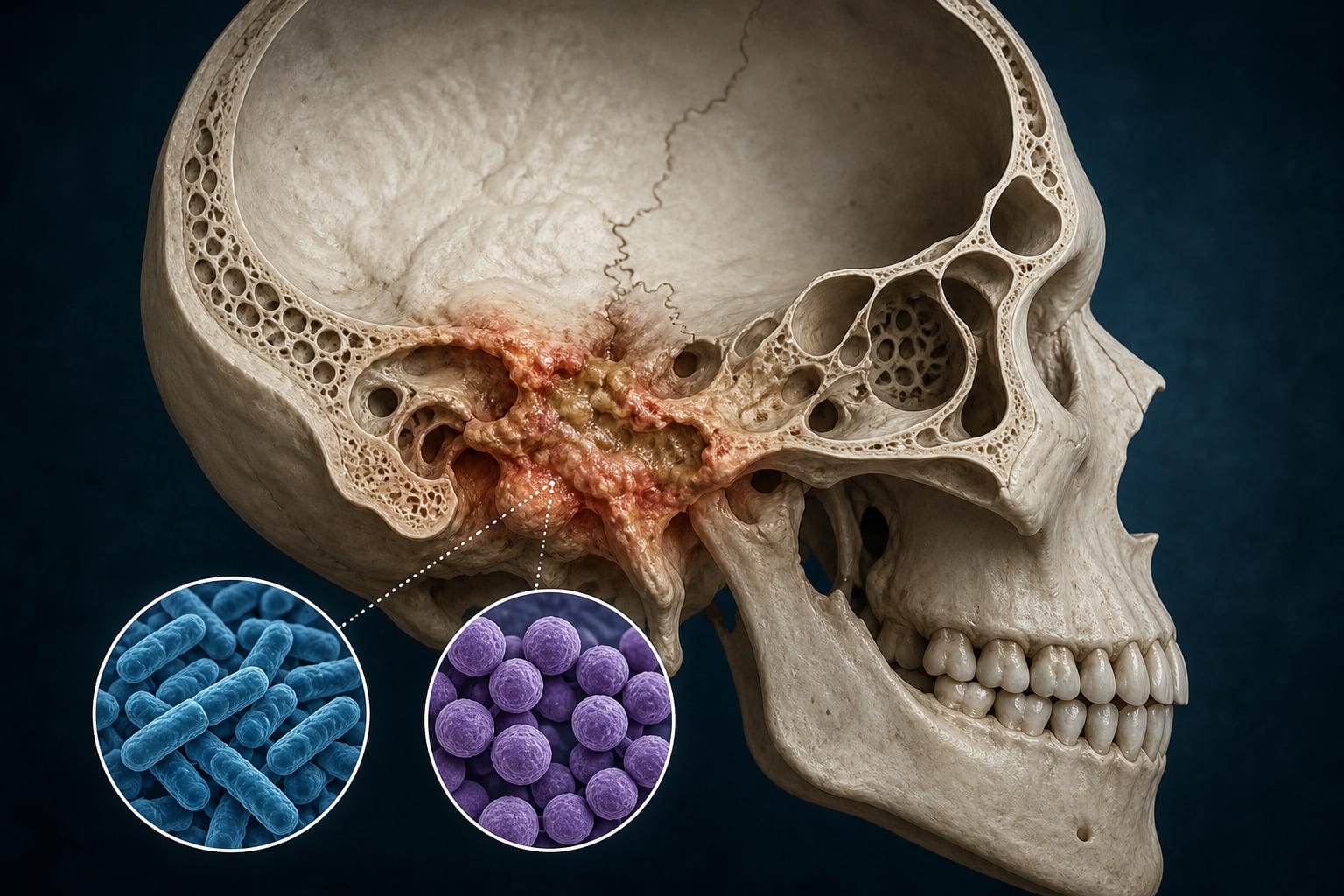
To compare the clinical features, microbiological diagnosis, management, and outcomes of bacterial and fungal skull base osteomyelitis (SBO).
Approach:
Study Design: This single-center retrospective study was conducted at Lariboisière Hospital, a tertiary care hospital in Paris, from January 1, 2012, through August 31, 2022.
Eligibility Criteria: Adults with clinical manifestations of otogenic or non-otogenic SBO and radiologic evidence of bone involvement on CT or MRI were included. Patients without CT- or MRI-confirmed bone involvement, those with chronic sinusitis–related bone changes, and those with osteoradionecrosis were excluded.
Data Collection: Demographic, clinical, laboratory, radiologic, microbiological, histologic, treatment, and follow-up data were collected in a standardized anonymized database.
Classification: Cases were categorized as bacterial or fungal according to microbiological and histologic findings. Polymicrobial infections involving both fungi and bacteria were classified as fungal SBO.
Outcome Assessment: Investigators evaluated treatment delay, hospital stay, first-line treatment failure, intensive care unit admission, sequelae, disease-specific mortality, and all-cause 1-year mortality.
Key Findings:
The analysis included 127 patients: 97 with bacterial SBO, 27 with fungal SBO, and 3 without final microbiological identification. Median age was 72.3 years, and 83% had diabetes.
Pseudomonas aeruginosa was the most frequently identified pathogen, occurring in 89 of 124 microbiologically documented cases (71%). Aspergillus flavus was the most common fungus, identified in 18 cases.
Compared with bacterial SBO, fungal SBO was associated with more headache (44% vs 8%), facial paralysis (48% vs 24%), and other cranial nerve palsies (30% vs 9%).
Imaging showed more thrombosis, vascular and nerve infiltration, collections, muscle infiltration, and C1-C2 arthritis in fungal cases.
Fungal infections were more frequently polymicrobial than bacterial infections (78% vs 33%); 21 of 27 fungal cases included at least 1 associated bacterium.
Deep surgical samples were required for diagnosis in 78% of fungal cases and 29% of bacterial cases. Among patients with superficial followed by deep sampling before treatment, deep samples changed the microbiological diagnosis and treatment in 34 of 50 cases (68%).
Median time from first consultation to effective treatment was longer for fungal than bacterial SBO (25.5 vs 11.0 days), and median hospital stay was also longer (38 vs 10 days).
First-line treatment failure was more frequent with fungal SBO (33% vs 8%), as were intensive care admission (30% vs 4%) and sequelae among patients with adequate follow-up (63% vs 25%).
Fungal SBO was independently associated with intensive care admission or disease-specific mortality (OR, 3.56; 95% CI, 1.04–12.60), but overall 1-year mortality did not differ significantly between fungal and bacterial cases (15% vs 10%).
Interpretation:
Fungal SBO presented with greater neurologic involvement, more extensive imaging abnormalities, a longer interval from first consultation to effective treatment, and worse morbidity than bacterial SBO. Microbiological diagnosis frequently required deep surgical sampling, particularly when fungal infection was suspected or superficial samples were unrevealing. Although fungal SBO was associated with the combined outcome of intensive care admission or disease-specific mortality, the study did not demonstrate a statistically significant difference in disease-specific or all-cause 1-year mortality alone.
Limitations:
The retrospective design created potential bias from missing data, particularly for follow-up, and sampling and treatment practices were not standardized.
Delays in microbiological sampling and prior antibiotic exposure may have influenced pathogen recovery and comparisons between sample types.
Management at an expert tertiary center with ready access to surgical biopsy and advanced microbiological techniques may limit generalizability.
Inclusion of non-otogenic disease and extensive use of deep sampling may have contributed to the comparatively high proportion of fungal cases.
Antifungal susceptibility testing was not systematically available, limiting conclusions about antifungal treatment selection.
Classification of some microorganisms as pathogenic or contaminating depended on physician judgment because standardized diagnostic and clinical-cure criteria were unavailable.
The observational design did not permit comparative conclusions about the effectiveness of specific antimicrobial regimens.
Conclusion:
Fungal SBO was associated with more severe clinical and radiologic involvement, greater diagnostic difficulty, higher first-line treatment failure, and greater morbidity than bacterial SBO. When fungal involvement is suspected, deep surgical sampling should be performed rapidly to confirm the diagnosis and investigate possible coinfection. Further studies are needed to standardize diagnostic criteria, clarify when surgical sampling is most beneficial, and inform treatment guidance.