The prognostic significance of immunohistochemical expressions of proliferating cell nuclear antigen, P16 and Ki-67 in breast cancer - Summary - MDSpire
Advertisement
The prognostic significance of immunohistochemical expressions of proliferating cell nuclear antigen, P16 and Ki-67 in breast cancer
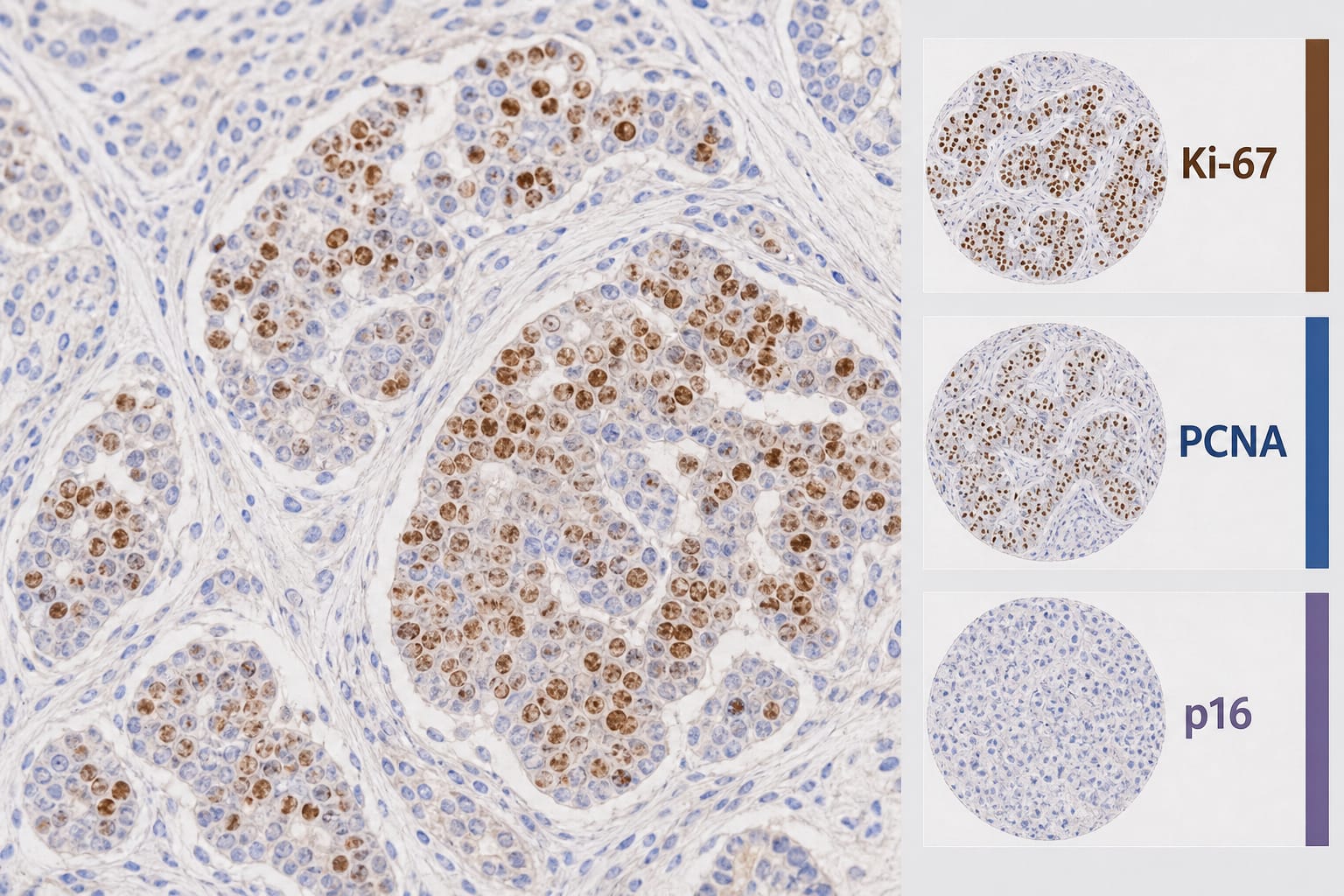
To investigate the link between proliferation markers (PCNA, p16, Ki-67) and histopathological factors, exploring their prognostic value in breast cancer patients.
Approach:
Study Design: Retrospective analysis of female breast cancer patients who underwent surgery, collecting data on demographics, clinical parameters, pathology, treatments, tumor staging, lymph node status, receptor status, and survival.
Marker Analysis: Immunohistochemical staining was used to analyze PCNA, p16, and Ki-67 expression in paraffin blocks.
Key Findings:
PCNA scores showed no association with demographic or clinical features.
A significant inter-marker correlation was found between PCNA and p16.
Higher Ki-67 index was associated with decreased ER and PR expression and decreased survival.
Ki-67 remains the most informative proliferation marker for prognostic stratification in breast cancer.
Interpretation:
The study indicates that while PCNA and p16 are inter-correlated, they lack independent prognostic value, whereas Ki-67 is significantly associated with hormone receptor status and overall survival.
Limitations:
The study is retrospective and may have biases related to data collection.
The sample size and diversity of the cohort may limit the generalizability of the findings.
Further prospective studies with standardized scoring are needed to clarify the prognostic value of PCNA and p16.
Conclusion:
Ki-67 is the most informative marker for prognostic stratification in breast cancer.