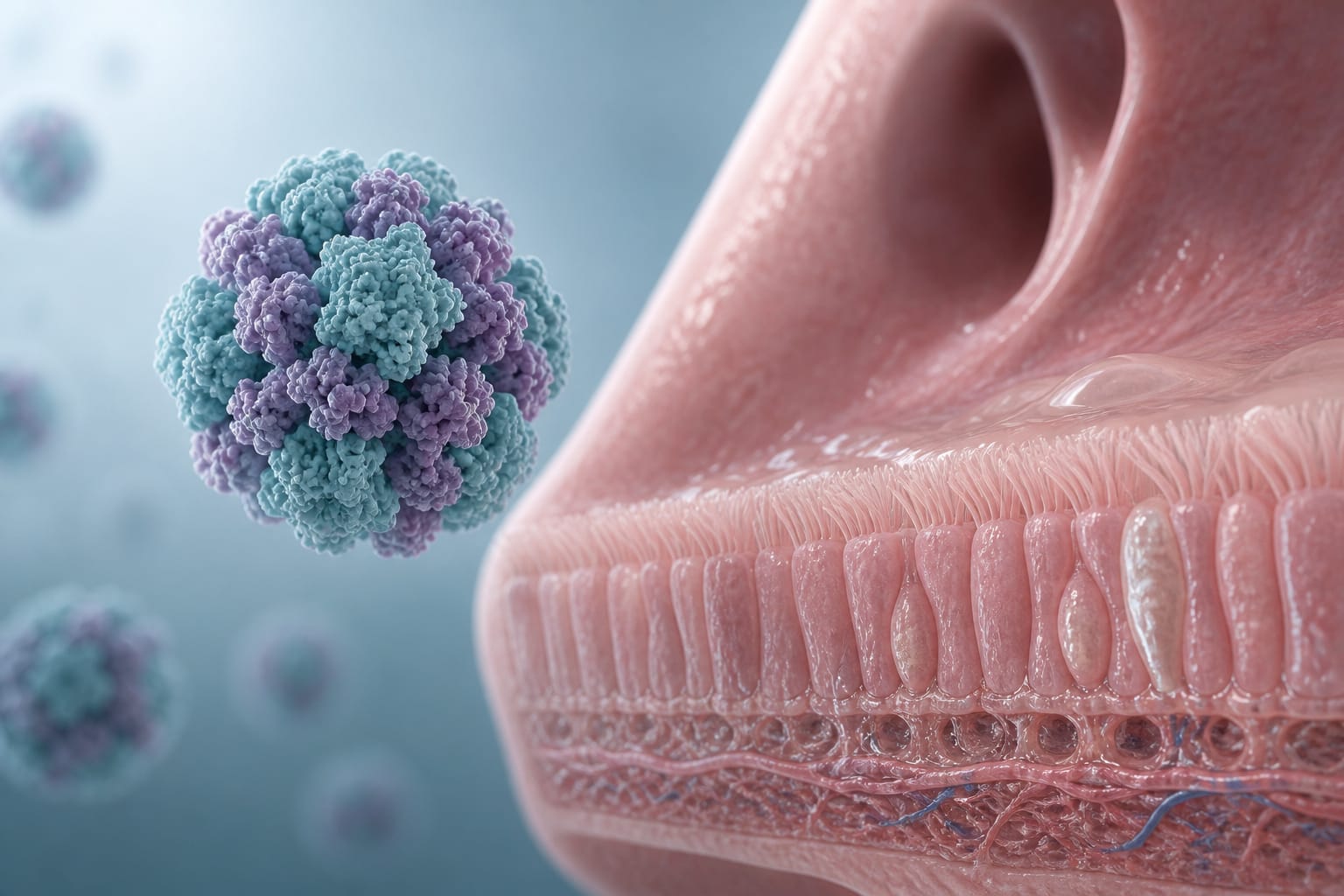
Assess the safety and efficacy of intranasal 2-deoxy-D-glucose (2-DG) versus placebo for preventing rhinovirus-associated illness (RAI) after rhinovirus 39 (RV39) challenge in healthy adults, and establish the challenge model at the study center.
Approach:
Design and participants: Randomized, double-blind, placebo-controlled phase 2a trial at the Centre for Human Drug Research in Leiden, the Netherlands. Sixty-four healthy adults aged 18–64 years with RV39-specific serum neutralizing antibody titers ≤1:4 were randomized 1:1.
Intervention and challenge: Intranasal 2-DG, 14 mg per dose, or placebo was administered four times daily, beginning the day before inoculation and continuing through 5 days afterward. Two doses were given on the first and final administration days. Participants received 100 TCID50 of RV39 intranasally.
Assessments: RAI required symptomatic illness and laboratory-confirmed infection. Assessments included viral testing, antibody responses, Modified Jackson Scores, Wisconsin Upper Respiratory Symptom Survey-21 scores, and safety monitoring.
Key Findings:
In the primary per-protocol analysis, RAI occurred in 16/27 participants (59.3%) receiving 2-DG and 17/29 (58.6%) receiving placebo.
Laboratory-confirmed infection occurred in 23/27 participants (85.2%) receiving 2-DG versus 27/29 (93.1%) receiving placebo. Infection rates, viral loads, and symptom scores did not differ significantly.
The trial stopped after the planned interim analysis of 64 participants because the recalculated sample size needed to detect a difference was considered infeasible.
Treatment-emergent adverse events affected 13/32 participants (40.6%) receiving 2-DG and 16/32 (50.0%) receiving placebo. No severe or serious adverse events occurred, and none prompted treatment discontinuation or modification.
Interpretation:
The tested regimen showed no measurable preventive benefit against RAI. Safety findings were comparable between groups, and the outpatient RV39 challenge model was successfully implemented.
Limitations:
Self-administration introduced possible dosing errors or nonadherence.
Pharmacokinetic data were unavailable to confirm adequate exposure.
A single rhinovirus type and a challenge dose exceeding natural exposure limit translation to naturally acquired infection.
Conclusion:
Intranasal 2-DG did not prevent RAI under the tested conditions. The RV39 challenge model enabled early assessment of the regimen’s lack of efficacy.
by Victor M. Cnossen, Salma Assil, Marieke L. de Kam, Meta Roestenberg, Anna-Dorothea Gorki, Ronald B. Turner, Guido A. Gualdoni, Ingrid M.C. Kamerling