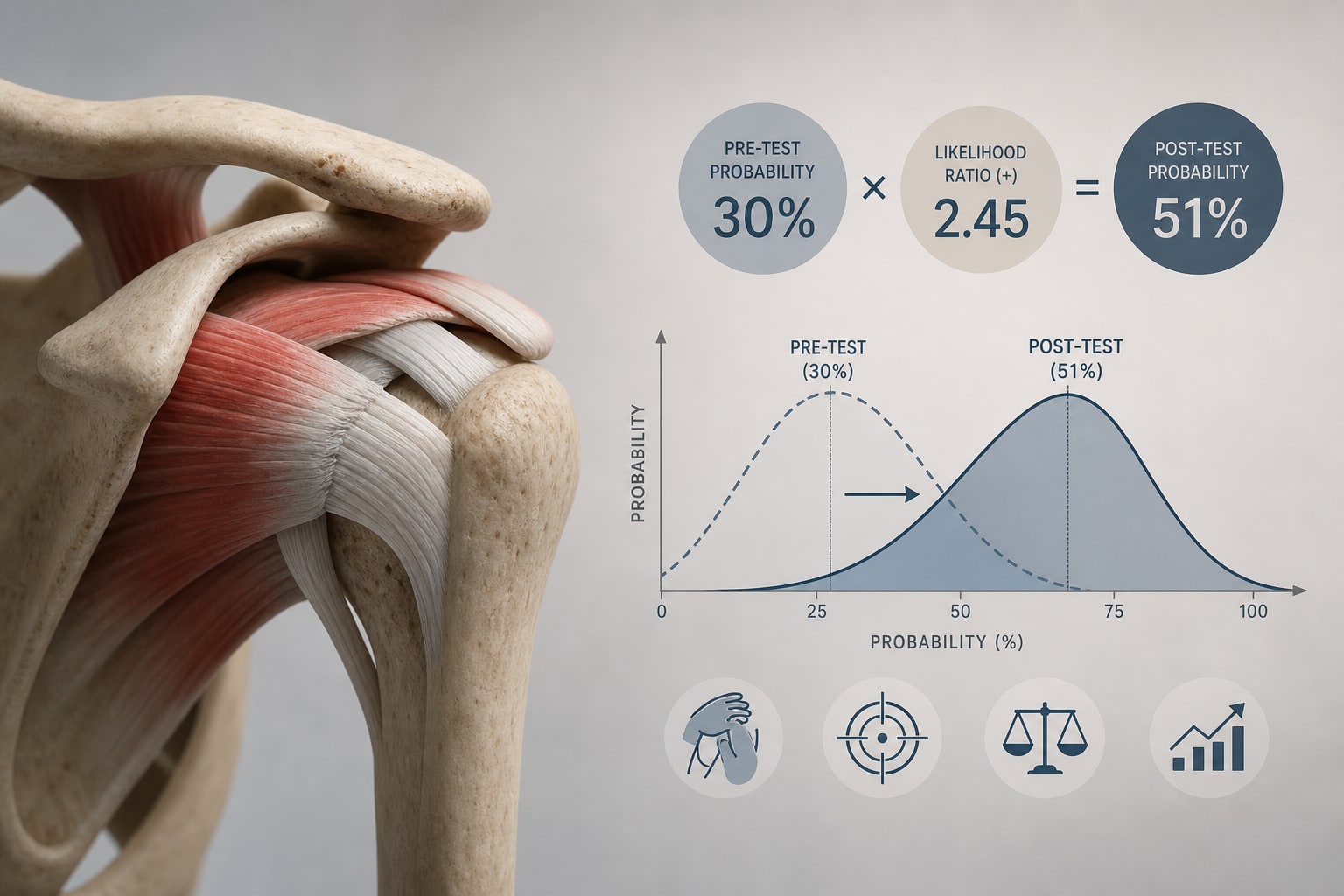
To apply a Bayesian framework to improve diagnostic reasoning in shoulder assessments by integrating pre-test probability with pooled likelihood ratios from published data.
Approach:
Bayesian Framework Application: The study integrates pre-test probability with pooled likelihood ratios using published data to calculate post-test probability.
Clinical Example: A pre-test probability of 30% increased to approximately 51% after a positive Drop Arm Test.
Sequential Test Application: Applying multiple tests sequentially can significantly increase post-test probability.
Key Findings:
Individual clinical tests have limited standalone diagnostic value.
Sequential application of tests leads to substantial increases in post-test probability.
Bayesian modeling provides a coherent framework for interpreting clinical test results.
Interpretation:
The findings emphasize the need for a structured, evidence-based approach to shoulder diagnostics that accounts for diagnostic uncertainty.
Limitations:
Heterogeneity across studies limits the ability to perform simple arithmetic pooling of sensitivity and specificity.
Likelihood ratios derived from individual studies should be interpreted as ranges rather than precise estimates.
Conclusion:
A Bayesian approach offers a more robust method for interpreting clinical test results in musculoskeletal care.