To examine the relationship between oxidative stress markers, metacognition, and clinical symptoms in patients with schizophrenia.
Approach:
Participants: 89 patients with schizophrenia and 90 healthy controls were included in the study.
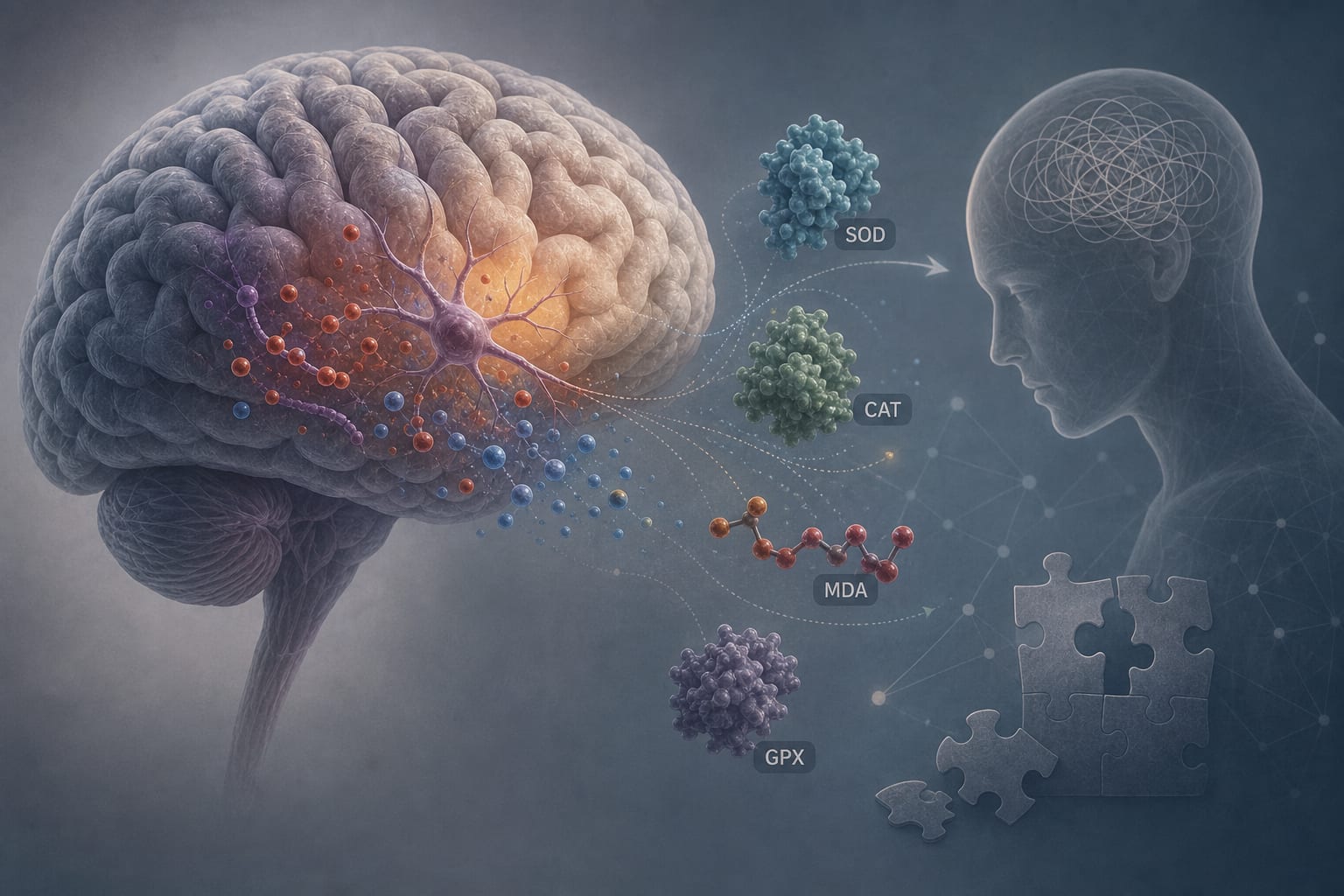
Measurements: Oxidative stress markers (SOD, CAT, MDA, GPX) were measured, and metacognition was assessed using the Metacognitive Assessment Scale (MAS-A). Symptoms were evaluated with the Positive and Negative Syndrome Scale (PANSS).
Statistical Analysis: Partial correlation and linear regression analyses were conducted to explore associations between oxidative stress markers, metacognition, and psychopathology.
Key Findings:
Patients with schizophrenia had significantly lower MAS-A scores compared to healthy controls (all p < 0.01).
Patients exhibited lower levels of SOD (130.69 vs 152.12 ng/L), CAT (2.46 vs 6.62 ng/L), and GPX (158.09 vs 197.75 μmol/L), and higher levels of MDA (9.22 vs 7.34 μmol/L) compared to controls (all p < 0.05).
Significant correlations were found between oxidative stress markers and both metacognitive (MAS-A) and psychopathological (PANSS) scores.
Interpretation:
The study found correlations between oxidative stress severity, metacognition, and psychopathological symptoms in schizophrenia patients.
Limitations:
The study's cross-sectional design limits causal inferences.
Potential confounding factors such as medication effects were not fully controlled.
Conclusion:
Oxidative stress abnormalities are associated with metacognitive impairments and psychopathological symptoms in schizophrenia.