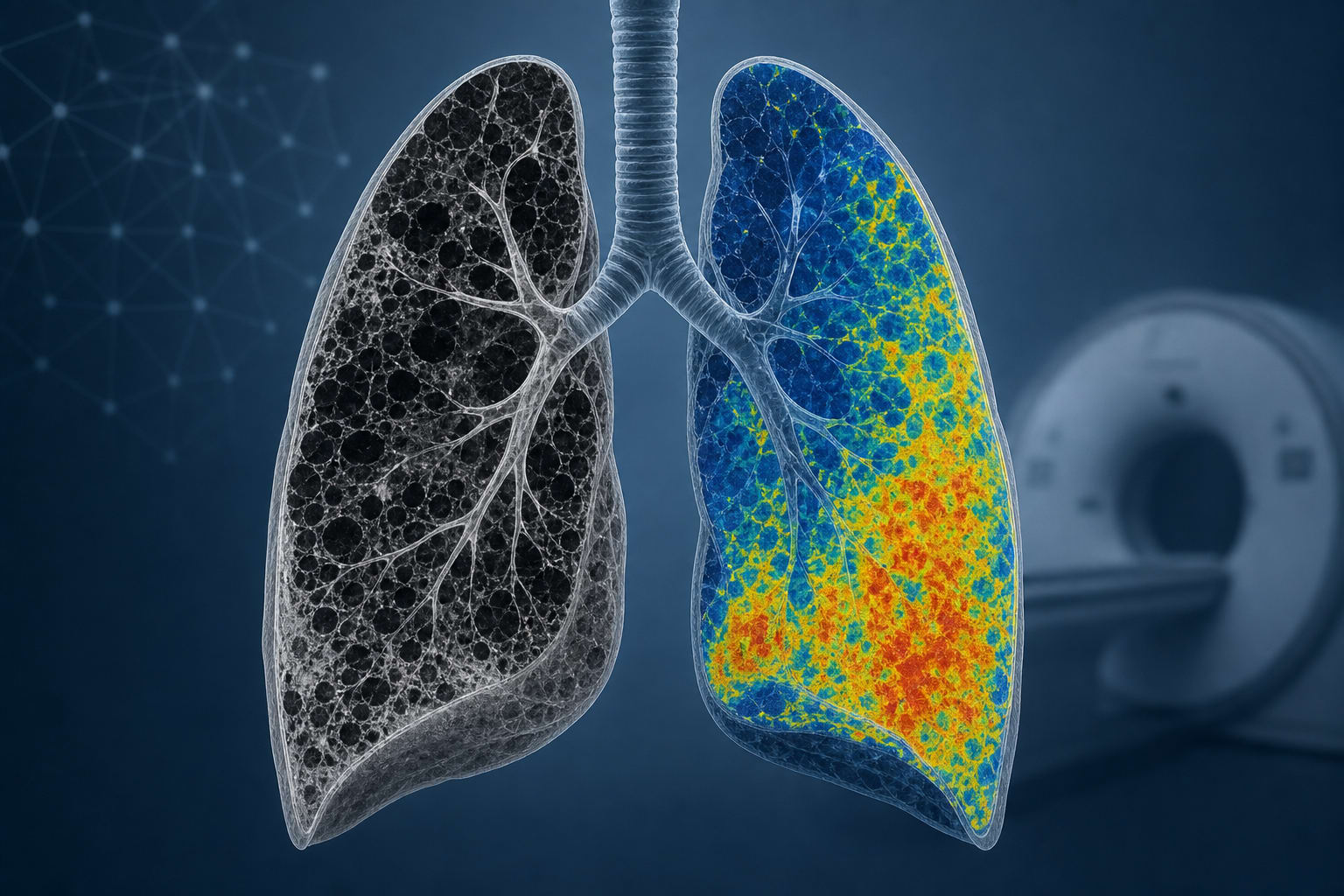
To address the limitations of current emphysema measurement techniques and explore advanced methods for quantifying emphysema using deep learning.
Approach:
Current Measurement Limitations: Spirometry cannot delineate emphysema; CT is the only practical method for quantifying lung parenchyma. The LAA-950 threshold has limitations due to measurement error and variability across different imaging parameters.
Deep Learning Segmentation: Sotoudeh-Paima et al. introduced a deep-learning-based segmentation model trained on synthetic data to improve emphysema measurement accuracy.
Virtual Imaging Trial: A virtual imaging trial with anthropomorphic patients was conducted to establish a reference standard, producing 540 CT volumes with known emphysema characteristics.
Performance Evaluation: The deep learning model showed improved reproducibility and clinical concordance compared to traditional LAA-950 measurements.
Key Findings:
The reproducibility coefficient for the deep learning model improved to 3.8% ± 0.2 from 11.1% ± 0.2 for LAA-950.
Clinical concordance with visual emphysema scores increased from 0.47 to 0.77.
The model demonstrated robustness across different scanner models and imaging conditions.
Interpretation:
The segmentation-based deep learning model is less sensitive to acquisition parameters than traditional density thresholding, potentially improving emphysema quantification.
Limitations:
The process lacks true boundaries, making spatial overlap metrics potentially unsuitable for assessment.
Independent testing included only 23 patients, which may limit generalizability.
Longitudinal validation is necessary to assess the model's performance over time.
Conclusion:
The study suggests that deep learning models may advance emphysema measurement techniques, but further longitudinal evaluation is needed to confirm their efficacy in clinical settings.