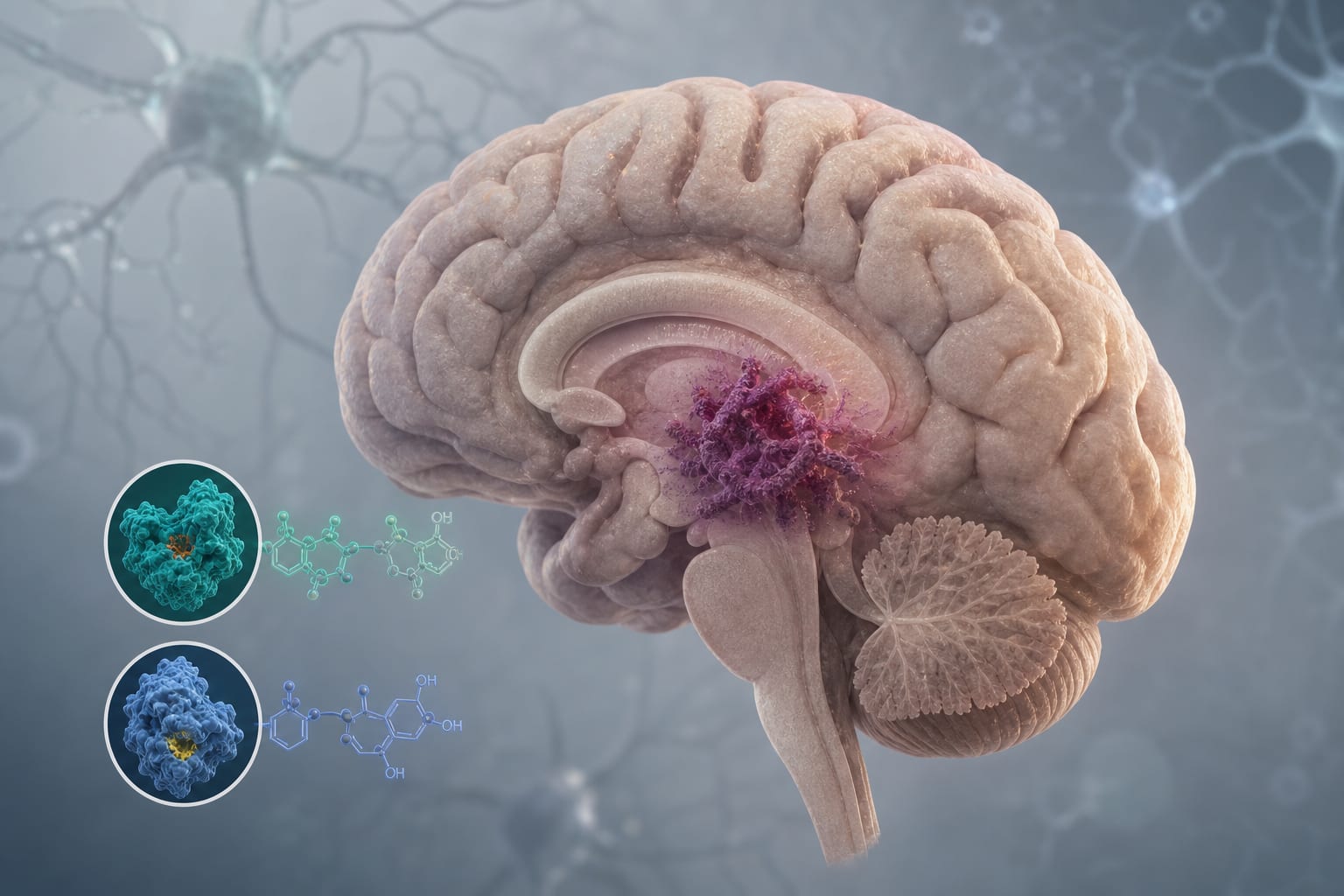
To explore the hypothesis that reduced striatal dopaminergic transmission is a common mechanism underlying psychomotor retardation across various neurological and psychiatric disorders, emphasizing its transdiagnostic nature.
Key Findings:
Psychomotor retardation is associated with reduced striatal dopaminergic transmission.
Conditions such as Parkinson's disease, catatonia, and depression share features of slowed movement and verbal output.
Neuroimaging studies support the link between psychomotor retardation and decreased dopamine activity, particularly in the dorsal striatum, with specific study references.
Dopaminergic medications are effective in treating Parkinson's disease and catatonia, while dopamine antagonists can induce parkinsonism and catatonia.
Interpretation:
The findings suggest that dopaminergic deficits may represent functional disruptions in psychiatric disorders, contrasting with structural damage seen in Parkinson's disease, while acknowledging the potential role of other neurotransmitters.
Limitations:
Variability in measuring psychomotor retardation.
Challenges in distinguishing between cognitive and motor slowing.
Inconsistent results from CSF measurements of dopamine catabolites, and the potential impact of other neurotransmitters.
Conclusion:
Further research is needed to investigate the effects of dopaminergic treatments in depression with psychomotor retardation and to explore alternative neuroimaging methods, while also considering the roles of other neurotransmitters.
by Ian Lam Leong, Tsz Huen Ng, Kunal Sen, Ella Burchill, Harry Costello, James B Badenoch, Jan Coebergh, Robert A McCutcheon, Akshay Nair, Michael Browning, Quentin J M Huys, Glyn Lewis, Andrew Lees, Anthony S David, Jonathan P Rogers