To report a case of a 5-year-old girl with Carney complex presenting with Cushing's syndrome and subsequent growth hormone hypersecretion, highlighting the clinical features and diagnostic process.
Approach:
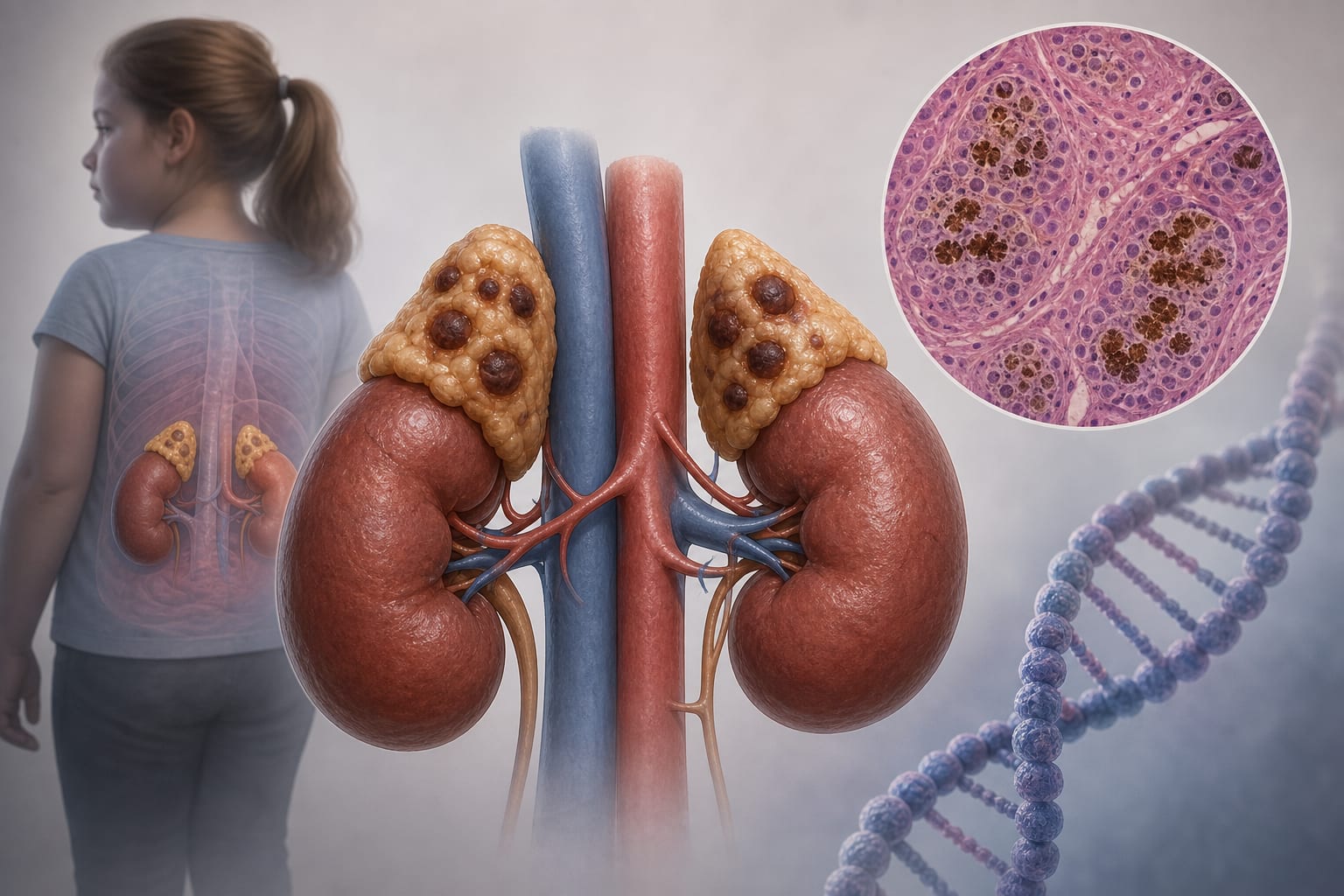
Case Presentation: A 5-year-old girl presented with rapid weight gain, facial changes, hypertension, hypokalemic alkalosis, and kidney stones. Biochemical evaluation confirmed ACTH-independent Cushing's syndrome, and abdominal MRI revealed bilateral adrenal nodules consistent with primary pigmented nodular adrenocortical disease. Genetic testing confirmed Carney complex.
Diagnosis: Diagnosis of Cushing's syndrome was confirmed through biochemical tests and MRI, revealing bilateral adrenal nodules consistent with primary pigmented nodular adrenocortical disease.
Follow-up: At 8.6 years, the patient exhibited accelerated growth and elevated IGF-1 levels, with no suppression of GH during glucose tolerance testing. Monitoring continued without immediate treatment for GH excess.
Key Findings:
The patient was diagnosed with ACTH-independent Cushing's syndrome due to PPNAD.
Genetic testing revealed a mutation in the PRKAR1A gene, confirming Carney complex.
Growth hormone hypersecretion was observed earlier than typical screening recommendations suggest.
Interpretation:
This case emphasizes the need for genetic testing in pediatric patients with Cushing's syndrome and highlights the potential for early growth hormone hypersecretion in Carney complex.
Limitations:
The case is based on a single patient, limiting generalizability.
Long-term outcomes and the need for treatment for GH excess were not established.
Conclusion:
The findings suggest the importance of surveillance for growth hormone hypersecretion in children with Cushing's syndrome and Carney complex.
by Gaia Pietropaolo, Adalgisa Festa, Giulio Rivetti, Federica Messa, Giovanni Di Iorio, Antonella Klain, Valeria Pellino, Daniela Cioffi, Rosario Ferrigno, Maria Cristina Savanelli, Emanuele Miraglia Del Giudice, Anna Grandone